I made this for my study group and also huge thanks to @lunaesteria I got a lot of the info from their post.
Graphic design wise I know this is messy as hell but I put glyphs and symbols everywhere to get some baby witches used to all of them since some might be unfamiliar with aspects and planetary symbols
Also over here the week starts with Monday so sorry if that comes off as confusing for some people lol.
A Guide to Different Planetary Geometric Arrangements
Pretty much everyone in magic is familiar with the Lesser Banishing Ritual of the Pentagram, the ritual used by the Golden Dawn as a standard banishing ritual, which involves drawing the pentagrams in the air on the four corners and so on. As each point of the pentagram is connected to an element, a different but similar ritual, the Greater Ritual of the Pentagram, may be used to tune your ritual space for elemental invocation. The same may be done for planetary forces, but in GD logic the pentagram is a sign of the microcosm (elements), while for macrocosmic forces (planets) the hexagram is used instead, which is the figure 1 in the image above.
In the Greater Invoking Ritual of the Hexagram, thus, you draw the hexagrams in the air according to the planet assigned to each corner, clockwise (anti-clockwise banishes). This neatly arranges them in a way that mimics the distribution of planetary correspondences in the Hermetic-Qabbalistic Tree of Life system used by the GD (in which Binah = Saturn, Chesed = Jupiter etc).
You’ll notice though that only the sun has no corner because it’s treated as the sum (no pun intended) of all planets, so a GIRH for the sun involves drawing ALL 6 other hexagrams. This literally hurts.
There are other systems, though, which, in a more practical fashion use a heptagram (7 corners, 7 planets). Figure number 2 is the one used in Sorita D’Este and David Rankine’s version of the planetary ritual explained in their book Practical Planetary Magick (Sorita also explains how it works on her blog). It features the chubbier variation of the heptagram (called a 7/2 heptagram) and the planets are arranged in a week-day cycle order. Number 3 is the skinnier heptagram (7/3) used by the Aurum Solis order (source: Melita Dennings and Philip Osbourne’s Planetary Magick: The Heart of Western Magick). Starting from Saturn at the top, as you follow the line you’ll get the same order as from the GD hexagram (Saturn-Jupiter-Mars-(Sun)-Venus-Mercury-Moon), also mimicking the descent from the 3rd sephirah, Binah, all the way down to Yesod.
The bottom three figures are purely theoretical and, as far as I know, are yet to be actually used in ritual, though they might be useful for me as I’m searching for a more Babylonian-centric system. Numbers 4 and 5 are derived from an academic paper by Peter James and Marinus Anthony van der Sluijs called “Ziggurats, Colors, and Planets: Rawlinson Revisited”, which aims at understanding what planetary order ancient Babylonians used, as well as their color correspondences, based on archeological evidence. Thrillingly for the occultist, they arrive at a pentagram and heptagram distribution: “As it happens, the Ecbatana ziggurat order can be correlated with the standard Neo-Babylonian sequence by means of a pentagram, by plotting either on the corners and reading along the diagonal lines. Such a result is not a mere curiosity. It is well known that, in imperial Roman times, the sequence of the weekdays (by their tutelary deities) was derived from the quasi-heliocentric (“Chaldaean”) planet order then in vogue (Cassius Dio 37.18–19; Boll 1911: 372–75; Neugebauer 1957: 169; 1975: 691) by taking leaps of two.” The pentagram layout excludes the two luminaries, however, though I suppose the Sun could be conflated with Saturn and the Moon with Jupiter due to some weird Babylonian logic that would take too long to explain here (see Ulla Koch-Westenholz’s Mesopotamian Astrology for more info). Their heptagram layout, though, is shockingly similar to Sorita and Rankine’s version, as it also follows the week-day order cycle, though with a different starting point (its top corner is the moon, for Monday, while Sorita and Rankine’s starts with Saturn).
The final figure, number 6, is another scholarly supposition, drawn by Sara de Rose in a paper called “Is CBS 1766 a Tone-Circle?” which attempts to interpret a 7/3 hexagram drawing on a clay tablet as a musical pattern. Its corner attribution also follows the week-day order cycle. I can’t comment on it further, however, due to my lack of musical knowledge.
I have decided to put all of these figures together for my own studies, but I share them here with whomever might be reading this because I think it might be interesting to other magicians who work with planetary magick.
“We all dream; it is a mystery in which all humankind participates. I realize this is an assumption, but it is one that I have no qualms in asserting as fact: the dream is an experiential universal for humanity.”
“A more or less superficial layer of the unconscious is undoubtedly personal. I call it the “personal unconscious”. But this personal layer rests upon a deeper layer, which does not derive from personal experience and is not a personal acquisition but is inborn. This deeper layer I call the “collective unconscious”. I have chosen the term “collective” because this part of the unconscious is not individual but universal; in contrast to the personal psyche, it has contents and modes of behaviour that are more or less the same everywhere and in all individuals.”
This is where I am at on the models of Magick. It is pretty much a meta model infused into each individual model. Hopefully from here on you will see each model as an aspect of what the whole is, like the blind men groping the different parts of an elephant and trying to guess what it is. Questions or thoughts are welcome.
Spirit Model:
The universe is populated with various types of spirits. You are a spirit. Even ideas and Ideals are types of spirits (a space of consciousness holding information and energy). Created spirits can over time or directed belief and magick build up enough to be effective in some way. When one calls a spirit they use tools and symbols that through the arts of magick have become effectively, spirits. Spirits cause change by manipulating the astral light/energy/chi/prana and elements to cause change. They do this by taking a quality (an idea, say Love) and building up the quantity (sensation and symbol) of that idea on the target. At a certain point this causes a manifestation to occur. Spirits can also influence and/or guide a person by influencing their thought stream in the same manner. Most people don’t realize that some of their thoughts are from such means. People don’t have ideas, Ideas have people. Over time and with skilled awareness one becomes aware that none of one’s thoughts are really one’s own much like clouds are not the sky.
Energy model:
All things that have an effect on something have some type of energy. This energy in the art of magick has been called various things over different cultures but every culture has a name for it. In all cultures it is tied to the breath and to ideas of “spirit”. Nearly all ancient magick traditions had some type of breath work involved to activate this model and one will also find a system of muscle tension and release are involved as well in some form. You experience this energy as sensations and feelings within consciousness and your body. It moves where awareness goes. When the quality and quantity diminish you either need to breathe, eat or sleep properly to replenish that lost amount. If one builds up enough energy and infuses it with a particular feeling (bliss, joy, love and success bring a very high end energy) and connect that to a target the result will be based on the quantity and quality of the energy. That is why master magicians and gurus don’t have to do much ritual magick to get things done, they have developed their energy to such a degree that their intent-awareness sends the needed quality and quantity towards the target for results to just occur. Usually thought control and emotional control are key to this model because the more random thoughts and feelings mix in, the lower the quality and the quantity is scattered. Spirits use this model because they exist in this energy flow (they themselves are stable coagulated forms of this energy and information) in such a way that it is easily perceptible to them and easily manipulated that they can work in this model like we can gather and shape clay.
Psychological model:
This is the one that needs the most revision in magick. I have a degree in psychology. The ideas most people have about psych are really way off. Psychology as a science is just terrible. They have abandoned most of what people considered as psychology and have opted for Behaviorism and pills to fix things because it is a completely materialist model. But, let us have a go at it. Even the most intro level psych class teacher will be able to explain to you that EVERYTHING you have or will ever experience has always been inside your head. Take a look around. All that is in your head.
That is pure materialism mind you!
They can’t even tell you how that is possible and have actually given up on trying to figuring that out, leaving that to Neuroscience.Tons of frequencies and energies are bouncing around, get absorbed into your awareness through certain nerves, those signals enter the brain and the brain produces a story about what is going on to the best of its processing power to produce your experience. In other words all of this is taking place in your skull. Modern psych doesn’t even care about consciousness or unconsciousness (subconsciousness). It sees people as animals that can be trained. If you can be trained to behave in a happy way measurably then in its model it has succeeded. They believe eventually the inside will catch up to the behavior, and since no one can measure what is going on inside then what does it matter? To still be trying to explain magick through a psychological model that has been outdated for decades; successfully, is a truly magickal act.
This should now be the Parapsychology or Psi model or at worst the Depth Psychology model to even begin to be a credible model. There is a ton of evidence for psi and if linked with depth psych you can have a pretty good map of the beach…but not the ocean. Sigils fall into this model in most people’s opinion. From reading all of this (and the information model below) you can maybe guess now how sigils actually work. Especially once you get a good handle of the latest psi research.
The Information model
The astral light/chi/prana is consciousness in the same way you are conscious right around the time you wake up or are about to fall asleep and exist as just pure floating awareness. It is not dumb/intelligent, it just is. If properly gathered together (quantity) it can hold an intent (quality) and go about its work to produce a result. This is very much like slowly waking up and enjoying the pure bliss of being for a few moments before the flow of thoughts you have collected (or have being fed to you) rush in to remind you it is time to get up and “BE” or do something. Imagine not having a body and existing in that barely conscious state and you have the basis of what it is like to be pure spirit.
Consciousness is the base matter, the philosophical Earth. All things are molded from this. Information is the philosophical air. (Those familiar with internal alchemy may have just had an aha moment) all things are inspired to “Be” through this element, the breath of life. Before you incarnated this was what you were. From there you build up information, experiences, personalities drives and then when you die that basic gestalt is taken over to a new body where the process is repeated and that basic pure spirit over time crafts itself into a divine being (Through philosophical Fire and Water) from which the information-less consciousness can experience itself and direct itself.
Whatever language one uses to describe these potentials that are within people and the wide web of causality, one will run into problems when dealing with anyone who is not very well-versed in the terminology, very broad minded, and very experienced in these things. For example, if you call it science, you alienate both the religious as well as those who are scientists who would not lump unusual effects into science. If you call it magick, then you alienate the hyper-rational or merely concrete and conventional. At some points you will see a breakdown in communication with anyone, but those with real knowledge and real understanding will not have a hard time getting back on track. The trick is to work with people where they are.
Consciousness plus intent produces magick. Anything that was produced by these two, even if present in the smallest way, is a magickal act or product.
This broad definition of magick, while more correct than less inclusive ones, can be limiting, so I will define two subsets of magick for the sake of discussion:
The more we increase our ability to concentrate and to perceive reality clearly, the more we will begin to perceive the extraordinary magickal aspects of reality.
Magick can be looked at from two points of view:
That leads to the degree to which the act is consciously rather than unconsciously seen as a magickal act.
These definitions of magick and the ultimate and relative points of view help define various groups of people:
To the degree that the relative perspective is valid, it must be noted that where our experience field overlaps someone else’s experience field, there is an interplay of forces shaping that junction, specifically the consciousness and intent of each of those perceiving that junction. In this case, the difference between belief, intent and force is an arbitrary one.
The corollary of this is that the less obvious the junction of experience fields, the less obvious the interplay. This has important implications for those who practice magick when we examine the next few points.
Clearly, different effects may occur if the interplay/overlap is more or less overt, particularly if the beings involved have differing paradigms of what is possible. That is, if some of the beings involved think that some things are impossible and other beings involved think that those same things are possible, there is a set up for very deep conflict.
Our expectations, beliefs, previous experiences, and paradigms color what we perceive, which is to say, they have a direct effect on our field of experience and life. This effect is actually a very powerful one.
Most people don’t have a well-developed understanding of the vast and complex terrain of the magickal world.
This simple fact is an extraordinarily powerful magickal force, something I will generically label “The Field of Disbelief.” While not nearly as static or simple an entity as this name would imply, the general nature of its effects can be commented upon in crude terms. The Field of Disbelief is actually a field of beliefs about how things are.
The Fields of Disbelief may vary radically between people. For example, one person may consider a lucky rabbit’s foot to be very powerful, whereas another may have occasional premonitory dreams but think that the rabbit’s foot is pure superstition. One person may think that traveling out of body is not that unusual but may think that telekinesis is completely impossible. Some believe in angels, devils, spirits, fairies, pixies, trolls, and/or ghosts. Some think it possible to speak with the dead, heal by laying-on hands, read other people’s thoughts, or divine the past or the future. These are but a few examples of common magickal beliefs in modern times.
In general, the more people’s fields of experience you have overlapping, and the more obviously they overlap, the more Fields of Belief or Disbelief you have to deal with. In these circumstances, overt magickal acts that do not fit with the paradigms of these fields become more difficult. Ways to deal with this include:
Another extremely important point about having magickal experiences is that your paradigms will begin to diverge from those around you who don’t or haven’t yet. There is no way around this. The more times you see visions, travel out of body, do energy work, trace glowing pentagrams in the air, speak with spirits, shift into altered states of consciousness, manipulate the world in various extraordinary ways or understand aspects of ultimate reality, the more you will be out of alignment with “Conventional Reality,” not that you could get two people to agree exactly what that was. Real practical wisdom involves working with this to everyone’s benefit or at least not to anyone’s detriment if you can help it.
There is a difference between one’s inner world diverging from “the non-magickal norm” and one’s outer world diverging from it. This has to do with external marks of being “different”, such as unusual clothes, tattoos, hairstyles, props (such as wands, daggers, pentacles, crosses, amulets, etc.), special languages, special symbols on one’s belongings, etc. While having cool and unusual props can be great fun, giving one a sense of there being something special and symbolic in what one does or just getting attention or both, they can also cause adverse effects on one’s jobs and public relationships. These props and trappings may also attract people of like mind, and so are, like everything, a mixed blessing.
While props have their advantages, particularly as they may work with deeper parts of your own Magickal Brain to short-circuit part of your own Field of Disbelief as well as to focus and firm-up various aspects of your Vision and Intent, there are reasons to get used to working without them, as if you are going to do Stealth Magick it is much easier if you are prop and trapping free.
The counterpoint to this is that props can alter people’s Fields of Disbelief based upon their own internal paradigm conflicts, just as it can alter your own. A person who claims to not believe in magickal things may still react strongly to something like a provocative tantric idol, a statue of the Virgin Mary, or an incense-filled room decorated with curtains with a magick circle and its associated symbols drawn on the floor, creating the possibility of doing more Consensual Magick.
Another important factor influencing the interaction of any Magickal act and people’s reactions to it is the timing of the act. There is Immediate Magick and Delayed Magick.
The example of the candle flame moving vs the work situation resolving raises another important consideration: there is magick that works within what might appear to be natural causal mechanisms and effects, e.g. the work situation resolving, and magick that works by what are, for most, clearly extraordinary or unnatural magickal methods and effects, e.g. the candle flame moving. For lack of better terms, and defaulting to limited and inaccurate paradigms, I call these, naturally enough, Natural Magick and Unnatural Magick.
Also influencing the likely degree of success, we have the degree of Alignment between your True Desire and the Specifics of the magickal result you ask for, which is to say the degree to which you know what you really want and your willingness to ask for that specific thing. This simple concept is one of the very hardest aspects of good magickal work. This breaks down into its two component parts:
In a similar vein, we have your ability to Feel Into the Specifics of the Web of Causality that relates to your specific True Desire. This has three aspects:
Related to this is the degree to which what from a relative point of view are independent Agents’ intentions align with your own. Were we to view Reality as the sum total of the Fluxions of the Magickal Influence Clouds (of which Fields of Disbelief are a small-subpart) of the sum total of the Agents (defined as those things with consciousness and intent) in the Universe, then the degree to which your True Desire aligns with or is not explicitly countered by that sum total of Influence Clouds will also influence the outcome. In plain terms, if a bunch of beings have wished in line with, neutral towards, or in conflict with your own, this is significant. This I term the degree of Synchrony or Asynchrony.
Of great significance are also underlying abilities of the Agent performing the act. Very briefly:
There is also the issue of the Set-Up. Taking the time to really set the thing up right can make a large difference. The Set-Up is implied in multiple categories above, such as having good props, feeling the thing out, learning about the causal system you are trying to influence, really refining the degree of Specifics and the Alignment, and then doing the magical act at the right Time, in the right Setting, in the right Mood and the like will all have an influence on the outcome. It also generally involves rising up to the highest and most exalted state one can attain, particularly the highest jhana one can attain, leaving that state, and then resolving to have the magick occur with full and unbridled intent.
Finally, as the Web of Causality is so infinitely complicated, there are the factors that can’t possibly be known, and these will be generically and only somewhat appropriately called Luck. It could in many ways be considered the most important of the factors, but in this case Luck clearly favors the well-trained and well-prepared, though not always.
We now have enough categories to be able to flush out a large swath of categories of magick and how they relate to the Field of Disbelief, as well as how people are likely to react to them, and also how easy they are to pull off. On the one extreme, we have Unnatural Immediate Public Non-consensual Apathetic Poorly-Aligned Poorly-Felt-Out Morally-Conflicted Implausible Hyper-Specified Asynchronous Poorly-Concentrated Unconfident Distracted Unfamiliar Poorly-Set-Up Ill-timed Disgruntled Unlucky Magick in an Non-Conducive Setting, and the other extreme we have Natural Delayed Private Passionate Well-Aligned Well-Felt-Out Morally-Non-Conflicted Plausible Non-Specific Synchronous Well-timed Concentrated Confident Singleminded Joyous Familiar Well-set-up Lucky Magick in a Conducive Setting. Were one to put these on a spectrum, one would find that the closer one was to the former, the harder it is to pull off, and the closer one is to the latter, the easier it is to pull off.
That list of closely related concepts also clearly hints at how various factors might influence each other. For instance, Morally-Conflicted Magick is also likely Unconfident Magick, as is Unfamiliar Magick. Unconfident Magick is likely to be Distracted Magick. Poorly-Aligned Magick is likely to be Apathetic Magick, which itself is likely to be Poorly-Concentrated Magick, etc.
That leads to the next point, and brings things back into some sort of more Buddhist context: training the mind to have positive mental factors, moral motivations, and less-specific and more universal forms of well-wishing and compassion is thus an extremely good idea from a Magickal point of view, both for Ordinary Magick and Extraordinary Magick, meaning the sum total of intention and its effects.
This leads to the obvious question: how does one train the mind to be clear, steady, concentrated, compassionate, loving, appreciative of the successes of others and equanimous? These, obviously, are the Brahma Viharas, qualities that often get overlooked in many magickal discussions, but I will claim are the key to Optimal Magick, with Optimal Magick being defined as the best magick that one could have come up with in that set of circumstances.
For those not familiar with the Brahma Viharas, they are:
This notion of “best” obviously implies choices, and the relative assumption of choices, of will, and of an Agent that can make those choices is a good working assumption for all moral work, and for those with more direct and ultimate understandings, namely those of natural causality, empty unfolding, and selflessness, is still not contradictory to them, but becomes complementary instead. It also implies defined and findable criteria for “best” which obviously can’t be found, and thus either becomes on the one hand an article of Faith, and on the other hand, a meta-logic or vision-logic point of real understanding, or more often some fusion of both perspectives.
Brahma Viharas end up being the Theravadan Buddhist answer to the question of meditative training that most likely leads to Optimal Magick. There are other options, some closely related, in the other Buddhist frameworks, but I will write of that which I know the most about and leave the other methods to other authors. Let’s explore why:
Thus, it is worth knowing how to practice the Brahma Viharas. Excellent instructions can be found in the Visuddhimagga in Chapter IX. A summary of those instructions appears below:
Ordinary Magick: that which most people wouldn’t call magick, and involves what the ordinary person generally believes to be simple intentions leading to actions, like lifting a spoon or composing a symphony. For the sake of clarity, I will call ordinary magickal effects simply ordinary effects.
Extraordinary Magick: includes the levels of causal effects that are beyond what most people consider the ordinary world of cause and effect, i.e. the realm that science, with the occasional exception of particle physics, considers mythical. In short, what most people would call magick, regardless of whether or not they believe in it, would fall into this realm, including magickal effects from “ordinary actions,” that is effects beyond what ordinary people imagine come from what they misperceive to be simple, non-magickal acts, something I term Collateral Magick. For the sake of clarity, I will call extraordinary magickal effects simply magickal effects, realizing that this may cause confusion in those not understanding the full implications of the broad definition of magick.
From the ultimate, in which all that occurs is the natural, impersonal unfolding of the lawful pattern of totally interconnected causality.
From the relative, in which each individual Agent has the power to influence their field of experience/universe/life.
The combination of understanding of Ordinary Magickal effects and Relative Reality is something I will call loosely Conventional reality.
For instance, an ordinary, relatively non-magickally oriented person might, in a moment of rage, suddenly decide that they wish to send that rage flying against the person they are enraged by. If they consciously understand that this act was as obviously magickal it is, it is more likely to be tempered by their own moral and philosophical codes than if it is not viewed as the clearly magickal act that it is. Thus, we have Conscious and Unconscious Magick.
By way of another example, someone might just be walking around in a self-obsessed rage with no obvious awareness that this internal state is very likely to have significant real-world consequences of some kind, and thus this would be an example of Unconscious Magick.
Obviously, as the vast majority of people do not think that their every intersection of consciousness and intent is magickal, then from this point of view the vast majority of their magickal acts will be unconscious ones, again meaning that they are not recognized to be as causal as they are.
I would very much like to say that Unconscious Magickal acts are likely less powerful or effective than Conscious Magickal acts, but I unfortunately do not believe this to be true, which is one way of viewing the primary problem facing the world today.
Said another way, the failure of the average person to consider their every intent a magickal act with implications beyond what they ordinarily imagine it has and to thus fail to have a potent impetus to apply a Moral and Philosophical Code to their every waking and dreaming intention results in a huge amount of Collateral Unconscious Magick, much of which is ammoral, unkind and uncompassionate, as well as unskillful.
In general, people may be defined by the degree to which they directly perceive the magickal aspects of reality, both the Ordinary and the Extraordinary.
They may be further classified into the degree to which they perceive the ultimate aspects of reality, which include such qualities as:
Complete Interdependence
Perfect Lawful Causality
Total Agencylessness
Total Centerpointlessness
Total Subjectlessness
That Manifestation=Awareness both ontologically and geo-spacially.
Atemporality
Total Boundarylessness
Giving up and not attempting magick. I call this Dodging the Issue, or Settling for the Lowest Common Denominator. Magick is happening regardless of whether or not you wish to acknowledge it, and past a certain point this option is not really possible.
Attempting magick in private, with the thrust of the work being to cause effects that will have minimal if any obvious overlap with anyone else’s field of experience. I call this Private Magick. It is clearly the easiest of the lot. However, like all the others, still involves the most important Field of Disbelief of them all: yours.
Attempting magick that does overlap with other’s fields of experience but does so in ways that all of the effects appear to either be ordinary, or are at least not noticed to be magickal. I call this Stealth Magick, as one gets in under the radar of the Field of Disbelief.
Attempting to work with the specific holes in a person’s or a select group of people’s Field of Disbelief, thus working specifically in ways that they truly believe are possible, so that you do not overtly run into the blocks in their Field of Disbelief. I call this Public Consensual Magick, as there was a consensus as to what was possible. Obvious examples include such things as faith healing and fortune telling. As people are bound to talk, this almost always enters the next category:
Attempting to work in public ways that directly contradict a person or group’s Field of Disbelief. This can be done, but the backlash tends to be impressive and often much more harmful to the practitioner than to those whose paradigms were challenged. I call this Public Non-consensual Magick. Important points about this are:
Attempting to alter the paradigms and expectations of a person or group before performing Public Magick, thus changing it into Targeted Public Magick. Skeptics would call this suggestion. I would call it education.
Example: you are in a conference in a small, poorly ventilated room with a guy waving around a dry-erase marker with the cap off. The solvent smell is completely annoying. After careful consideration of the ethics involved, you will him to put the cap back on the marker when he is not writing with it. This is done with no obvious external signs that you are doing this. He puts the cap back on the marker and doesn’t notice at all. The act was clearly magickal but didn’t run into anyone’s Field of Disbelief.
This example brings up another sub-point of great profundity: it is impossible to distinguish between spell casting and prognostication. It is purely a matter of convention. One could just as easily say that your internal experience of willing him to do something was actually just clues about what was going to happen anyway. Causality doesn’t care one way or the other.
It can be astounding how dense people can be in the face of things that might challenge their paradigms. The connections people can miss and experiences they can simply seem to forget happened or compartmentalize away can be amazing. While this can be very useful for the magickal practitioner, it is not an effect that one wants to count on to happen in the face of repetition, nor even count on the first time.
People often react negatively towards those whose paradigms diverge too radically from their own. This is instinctual and while these reactions can be clothed in the accepted institutions, laws and decorum of the times, nonetheless they can be extremely detrimental to the magickal practitioner.
We can look to myth and legend for illumination on this point. Consider a medieval setting and the reaction that various non-magickal people or groups might have towards various magickal ones. Note the common elements of denial, fear, anger, bargaining and manipulation.
The local ruler might size up the old wizard in the lone tower in the hill and either believe that he was just an old wacko, or if he believed he had some power would want to know how to keep him on his side and his chances of doing so. Could he be bought, seduced, or coerced through threat or otherwise manipulated?
The local townspeople might know of a witch out in the forest. Many would fear her. Some would seek her out for help with love, illness, or quarrels. Others might think she was just an old madwoman. Religious people might think she was in league with Satan and burn her at the stake.
Reactions like these take place in modern times all over the world and in “civilized” societies. The more your basic paradigms diverge from those around you and the more obvious you are about this, the stronger the reactions you will encounter. Consider gays being killed just for being gay, or people of one religion or political party killing another.
Immediate Magick is obviously magick that has an immediate effect: You wish the candle flame to move, a few seconds later it moves. Obviously, Immediate Magick is more impressive to all involved, including you, and thus much more likely to garner stronger reactions if it falls outside of the categories of Private Magick or Stealth Magick.
Delayed Magick often is of broader and more complicated scope: You wish for some complex work situation to work out in your favor, and 2 months later it does. This sort of magick can be much more satisfying in some ways, as typically it involves things that in the grand scheme of one’s life are of more import, but it obviously lacks the thrill of well-done Immediate Magick. It is much more often done as Private or Stealth Magick, but if you advertised it and turned it into Public Magick, however consensual, bad reactions are still often forthcoming, and Fields of Disbelief will have to be dealt with. All things being equal, Delayed Magick is usually easier than Immediate Magick.
Natural Magick is definitely magickal, and yet the way that everything worked out could very reasonably be explained by a so-called “rational” or “scientific” person as being totally within the laws of what they think of as ordinary reality.
Unnatural Magick is also definitely magickal, and much more in line with what most people think of as magick, in that something truly extraordinary seemed to happen, such that aso-called “rational” or “scientific” person will have to resort to some very complicated mental gymnastics to try to fit the occurrence within the standard laws of reality, and this may include you. All things being equal, Unnatural Magick is generally harder than Natural Magick.
The first part is the degree to which you actually want the thing at all. As the Force of Desire is the driving force behind magick, if you are actually Apathetic about the outcome, the force behind the magickal act will likely be little, and if you are Passionate regarding the outcome, this is much more likely to result in something happening.
Similarly, the degree to which you are Specific about exactly what outcome you wish and exactly how that will come about will have an influence on the outcome, with the more Specific you are often making it harder to get the outcome you wish, though certainly not always. The degree to which you should be Specific about the outcomes details is actually an extremely complicated topic. While there are definite exceptions depending on circumstances, in general it is advisable to ask for the most Non-Specific outcome that will still result in the fulfillment of the most core aspects of your True Desire. For example, it may often be best to ask for the best possible outcome rather than asking for a very specific outcome, though this is not always true.
The degree to which you can actually imagine the thing you wish for actually happening, in other words, its Plausibility. The greater the degree of Plausibility, the less of your own and everyone else’s Fields of Disbelief you will have to deal with. For instance, if you wished to point your finger at the Sun and have it suddenly vanish forever, this is obviously significantly less plausible than if you wished to have a black sphere appear between you and the Sun that only you could see.
Deeper than that is the degree to which you can feel out the possible waves of resonance of implications of the thing you truly desire actually happening.
Finally, there are the issues about how you feel about those possible waves of resonant Implications, as you may be just fine with the central object of desire manifesting, but you may not be with all of the ways that happened or what results from that happening. For instance, you might wish acquire large amount of money suddenly, and your beloved grandfather dies, and you inherit the money, and then your sister and you go to court and fight over some portion of the will and ruin your otherwise ok relationship. The object of desire was attained, but the way that came to be and the implications of that happening both were clearly deeply problematic. Lastly, if you truly believed that your magickal act in some way contributed to his death, the money itself may feel so tainted that you might derive no enjoyment from it at all and instead feel pain and remorse. This might be summarized as the degree of Moral Conflict.
The degree of Concentration skills will have a direct effect on the power behind the act, and this is particularly true for Unnatural Magick and Immediate Magick, though it applies to all other types as well. Most magickal practitioners greatly under appreciate the degree to which very strong Concentration skills open doors to experiences and abilities. A hyper-concentrated mind becomes malleable, pliable, bright, and jumps to the task with great facility. At a certain point in concentration, suddenly things just happen by merely inclining to them. You wish to draw a symbol in the air: there it is, trailing off your finger like syrup. You wish to visualize an image: it appears fully formed, luminous, extremely detailed and radiant. You wish to jump out of body off the cushion, suddenly you are out, just like that. You wish to have deep intuition into some situation, there it is. You wish to see past lives, there they are. Learning to concentrate well, which usually takes days to weeks of practice to set up properly, opens a universe of ability that those who have never really learned to concentrate and set up that way might occasional visit in spurts and flickers but otherwise will never know.
The Confidence of the Agent: never underestimate the ability of someone who truly believes they can succeed, or the degree to which a lack of confidence can scuttle an otherwise very well-set-up magickal act.
The level of Singlemindedness of the Agent. Having the sum total of one’s attention, passion, and intent dedicated to one act is much more likely to result in stronger effects than the mind that is distracted or divided.
The Familiarity of the Agent with that specific act will also make it much easier: practicing an act makes it easier and easier, with some notable exceptions that are too complicated to detail here.
Loving-Kindness (Metta): the natural well-wishing for one’s self and all beings.
Compassion (Karuna): the natural wishing that the suffering of one’s self and all beings will cease.
Sympathetic Joy (Mudita): the natural appreciation of the successes, good fortunes and joys of ourselves and all beings.
Equanimity (Upekkha): the feeling of peace that comes from realizing that all beings are the true heirs of their karma and that their well-being depends on their actions, and not on our wishes for them.
The Brahma Viharas are generally Private Magick, and even if you make them Public Magick, hardly anyone will object or find anything odd in wishing others well or the other three.
The Brahma Viharas are not specific regarding the question of Immediate vs Delayed, and leaving that question makes for a more workable situation.
In that same way, the Brahma Viharas are Non-Specific, meaning that they do not lay out any criteria for the outcome beyond the most general and fundamental benefit, a quality that nearly always makes magickal workings easier.
The Brahma Viharas are not obviously Unnatural, though many might be surprised in learning the depth to which one can generate those feeling in the body and some of the other unusual experiences one can have while doing those practices.
The Brahma Viharas are not likely to come up anyone’s Field of Disbelief, as who would really disbelieve that one might cultivate positive qualities like this?
The Brahma Viharas are not likely to lead to Moral Conflict, except occasionally with the category of the “Enemy”, and thus, with this single exception, one can generally proceed in their cultivation not only without obvious Moral Conflict, but instead with a deep and galvanizing sense of Moral Imperative.
Being as the Brahma Viharas cultivate what are clearly our deepest wishes for ourselves and others, they are with the rarest of exceptions totally Synchronous, and those aspects in which they are not are themselves good things to pay attention to for other practice reasons.
Given that the Brahma Viharas tend to lend themselves to strongly positive feelings, they are self-reinforcing, and being self-reinforcing can naturally lend themselves to strong Singlemindedness, Confidence and Concentration.
Given that there is no obvious time when the Brahma Viharas don’t seem to be a good idea, any time they are practiced they are obviously well-timed.
Given that the Brahma Viharas require little formal setup beyond the phrases and then the feeling themselves, and given that as part of the setup it is easy to feel-out that all beings wish for happiness and the rest as we do, then it is hard to imagine an easier bit of magick to set up properly.
As to Plausibility, it is possibly that some aspects of our wishes, say for the happiness of all beings to always increase, may seem implausible, but that we wish it for ourselves and others is obviously not, and this practice is about cultivating the feeling of those wishes, them being their own reward even if they do nothing other than simply occur within us, so, properly understood, Plausibility is easily met.
As to the Influence Clouds that emanate from the wishes of other beings, given that the Brahma Viharas at their core essentially automatically resonate with the deepest wishes of all beings, no better natural resonance and amplification could possibly be asked for.
As to Luck, I am perhaps being a bit magickal in my thinking here, but it is hard not to imagine that, should there be any such thing, that Luck favors these most fundamentally beneficial workings.
The last factors are to make the Brahma Viharas Familiar and to practice them in a Conducive Setting. The first is simply a question of practice, and the latter is simply realizing that any setting may be a good place to practice these qualities that are so needed in the world.
In short, the Brahma Viharas naturally meet all the criteria that make for the most powerful and beneficial Magick, and it is actually hard to come up with anything else that does this in quite that way.
In summary, it is highly recommended that you make some time for the Brahma Viharas.
Pick one of the Brahma Viharas, specifically:
If practicing formally, seat one’s self in a comfortable posture, if not, practice in whatever posture one finds oneself in.
Reflect on the dangers of the quality of mind that the Brahma Vihara chosen most directly counters:
Each of the Brahma Viharas are associated with a specific phrase that is used to cultivate the feeling until the feeling of the Brahma Vihara can itself be taken as object, and so the next step is to learn the phrases for that Brahma Vihara. The phrases may be modified to suit your tastes, and appear in various forms in various places. Each phrase is used to extend the quality of the Brahma Vihara to various categories of beings, so a blank is included in the phrase that one fills in with the appropriate category as one progresses through them. Here I render them as:
The phrases in the short form of the practice are extended towards various beings and classes of beings in this traditional order:
When working with the categories in this way, it is traditional to stick to the easy categories first, developing them until the feeling is strong, and then shifting when one feels confident to the harder categories. This is in keeping with the Magickal Principles of Familiarity and Confidence.
One may also extend the feelings in various directions:
As one repeats the phrases, one tries to connect to the fundamental feeling implied in the words.
One must guard against both the far enemies (those things listed above that they directly counter), and also the Near Enemies, which are those near approximations of the Brahma Viharas that are yet not the genuine quality, but impostors. These are:
As the feeling of the Brahma Vihara grows, one turns that feeling into a samatha object, such that one takes that feeling and develops it directly, working with it, expanding it, gently coaxing it through any blockages or sticking points one finds, extending it through the body until it pervades the whole body, and finally takes the feeling far out into space.
In this way, one may take the first three Brahma Viharas to the Third Jhana, as they still contain a pleasant feeling of some sort, and the Fourth Brahma Vihara (Equanimity) to the Fourth Jhana and beyond, as Equanimity is the basis of the Formless Realms.
As barriers or distractions or issues arise during the practice, we soften, connect with the deep and fundamental wish implied by the Brahma Vihara we have chosen, and slowly extend that Brahma Vihara through that barrier to pervade everything.
Much additional material may be found in Sharon Salzberg’s Loving-Kindness, The Revolution Art of Happiness, which, while mentioning nothing about developing these into deep jhanic states, still outlines many useful aspects of the practices.
Loving-Kindness
Compassion
Sympathetic Joy
Equanimity
Loving-kindness directly counters hatred. Reflect on the dangers in harboring hatred.
Compassion directly counters cruelty. Reflect on the dangers of harboring feelings of cruelty.
Sympathetic Joy directly counters envy. Reflect on the dangers of harboring envy.
Equanimity directly counters both greed and hatred. Reflect on the dangers of greed and hatred.
For Loving-Kindness: May _____ be happy. May ____ be peaceful. May _____ be safe. May _____ live with ease.
For Compassion: May _____ be free from suffering. May their suffering finally cease.
For Sympathetic Joy: May the happiness and good fortune of _____ always increase.
For Equanimity: ____ is/are the true heirs of their karma. ____’s happiness depends upon their actions and not upon my wishes for them.
To one’s self first (with the exception of Equanimity, for which this first one is somewhat philosophically problematic), e.g. May I be happy, etc.
To a friend (try to avoid those for whom one feels sexual attraction, as that tends to distract the practice, though if one gets better at this one might try to sort those two out later on)
To a neutral person
To a person whom one bears ill-will (traditionally called the “enemy” or “worthy opponent”)
To all beings everywhere
In front
In back
To the sides
Above
Below
And all around pervading everything everywhere
For Loving-Kindness, the near enemy is desire.
For Compassion, the near enemy is pity.
For Sympathetic Joy, the near enemy is also desire.
Magick can come in various forms, with various techniques and uses. There is no right or wrong form, just whatever works best for you. You may find you want to use few, many or even all forms you encounter. There’s no limit. The only thing I would say is fear or doubt of your own ability may not provide the best results when working.
I’m going to list some, though I am in no way an expert on all, nor do I know all forms magick takes. But at the very least, I hope this will be an interesting if not useful read.
• Colour Magick – some would say this is one of the simplest forms of magick. It is often used together with others, but can be effective when used alone. Colour can enhance or change moods and emotions, it can be used to represent your goal and even something as simple as dressing your alter in a specific colour can have an effect.
• Herb magic – this can also be used alongside many other forms, for instance with talismans and amulets. The oil from herbs can be used to dress yourself or candles. You can even combine many herbs and oils together to create the desired effect.
• Candle magick – one of the oldest and simplest forms of magick, they can be used in many ways. They can be used to attract or repel, used as an offering, used to form your circle, to represent elements when placed using different colours and locations, or even just to represent the element of fire solely.
• Crystal magick – crystals and stones have their own energies and can be used in many ways. They can be used for protection, healing, enhancement, enchantment, to aid in meditation any many more ways. Even ordinary stones can be charged for use in different ways, an example would be rune stones.
• Knot magick – strangely although this is a simple and versatile form, I’ve found few people know of it. It can be used in weaving, knitting, crocheting, just plain knots or intricate knots. You can use anything that can be made into a knot, whether you choose rope, ribbon, cord, wool, string. At its simplest it’s knots in a cord, but you can make it more intricate with uses of different colours, shapes, changing the pattern in places and even weaving in symbols.
• Representational magick – magick is ever changing and flowing, and I wasn’t sure if I wanted to add this or not, but history is important and unfortunately a lot has been lost. Representational magick can now be used to describe what you’re using a tool or ingredient for, an example would be that a purple candle is used to represent spiritual power. But there was a time, if not still, that it was used to describe a form all of it’s own. A good example would be the use of poppets, dolls fashioned by the witch to represent a person. With witch hunting and bad portrayal in media this has come to be seen as a negative practice, when it can be used for many things.
• Symbolic magick – unlike representational magic which would use items, this uses shapes, sigils and symbols. They can be used to represent anything, and while there are many you may know as standard, planetary for example, you yourself are free to create your own. Many years ago when a witch would have to hide their workings, they would even come to develop their own alphabet for their book of shadows.
• Elemental magic – with this magic the elements are called upon to add power to workings. You may find yourself favouring one in particular, and it may not be one that would be traditionally fitting for you. For example I am a Gemini, typically an air sign, but I favour working with fire.
• Talisman, amulet and charm magick – this uses a lot of other forms. There are many uses for them, luck and protection being very well known. They are fashioned as jewellery, carried around in a pouch and can even be made into key chains and phone charms. This form of magic can be as simple as a necklace made with a single stone or as intricate as you like, including symbols, containers for herbs many different stones that compliment each other, use of colour and different metals, even the shape it takes can have an effect.
• Divination magick – divination magick can come in many different forms. From tarot, scrying, crystal balls, palmistry to tea leaves and many more. You may find one works better for obtaining answers than another, it’s not uncommon to find one is more successful for you personally. Most people will think of it as “future telling” thanks to how media has portrayed it, but that is just one aspect of it. You can use it to seek answers, to find things that are lost, and to find information to guide you. You may choose to use to obtain the meaning behind dreams. There are many uses besides seeing the future, and you may find you use divination in a completely different way to others.
☆☆Thank you for reading, and please let me know if there’s any forms you think I should add☆☆
Ways to provide protection from spiritual and physical beings:
Make a witches bottle: They provide you with protection against curses, hexes, and spells sent your way as well as to protect your property and possessions.
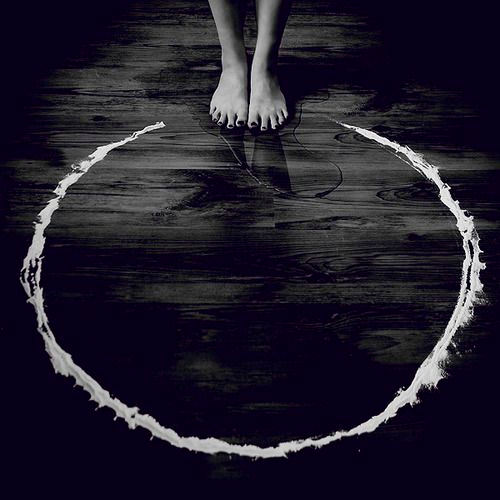
Salt circle: A salt circle provides the person inside with protection from negative entities and demons. Line your window sills and door way entrances with salt to create an impenetrable barrier.
Iron: Repels evil.Three iron nails driven into a doorway or window sill will block negativity from entering your home. Note: Iron repels Fae!
Plants: Some plants have protective properties.
Ask your deity for protection
Mint leaves in your shoes protects you from curses
Put pepper in protection sachets to protect against magickal attacks.
Burn bay leaves to reverse curses
Scrawl your home and clothes with protective sigils
Quartz Crystals: Provides protection.
Visualization
Paint your front porch blue to ward off ghosts:They fear water so this may confuse them.
Hang an upside down horse shoe above your door: to ward off evil spirits.
Hang wind chimes around your home: To scare off bad spirits
Nazar or evil eye: Protects your home from bad luck.
Rowan: Two branches from rowan trees bound together with red thread in the shape of a cross. It provides protection when hung above doorways, according to celtic traditions.
Arrowheads: Placed above your door will help keep burglars and unwanted guests out.
Cinnamon Sticks: Tied over the door will protect your home.
Rosemary wreath: A wreath of rosemary bound with green thread can provide your home with protection. Add other plants that correspond with protection as well.
Ivy: Grown up your house provides protection,
Mistletoe: Hung in the house protects it from thunder and lightning.
Acorn: According to Norse mythology, placing an acorn on the window sill protects the home from being struck by lightning.
Pine branch: Where it for protection.
Create your own protection amulet
Place mirrors around your home to deflect the evil eye
now that i’ve begun working more with energy, i wanted to share my methods of casting circles! when i first started working with energy, it was really hard to find references for casting circles, especially ones not dealing with the traditional Wiccan god/goddess. here are some methods and uses of casting circles!
Why Cast a Circle?
the primary reason i cast circles is to protect me from outside energy influences. most people associate circles to protection from ‘malevolent’ spirits, however, it’s just a great barrier in general!
here are some following scenarios i cast circles:
divination- to protect me from energies that might influence my cards or my interpretation o the cards
spellwork- pretty self-explanatory. i cast circles to protect from energies i don’t want in my spells, or from potential spirit attraction.
meditation- again, for energy use and to also not be disturbed from anything spiritual.
Methods of Casting
1 – Invoking Elements
a very basic way, if not the go-to way, of casting is to place each of the four elements at each of the cardinal directions. Earth at the north, Air in the east, Fire at the south, and Water in the west.
fire
Candles (color them for intent if used in a spell! alternatively, electric tea lights work fine.)
alternatively, any of these could be replaced with a tarot card of the corresponding suit! (wands for fire, cups for water, pentacles for earth, and swords for air).
to close the circle, walk clockwise starting in the east (air) and complete a full walk around the circle. do this as many times as you feel needed to envision a complete circle! after your use for it is done, unwind it by walking the same number of times counter-clockwise.
note: if you live in the southern hemisphere, you may want to reverse fire and earth in your directions and walk counter-clockwise to close the circle, and clockwise to end it.
2 – Envisioning
this is a very, very simple way to cast a circle! if you have very little time, simply imagine a ring of light around your workspace. you could align color to purpose as well.
the only downsides to this method include the fact that it may not be as strong as a physical circle for beginners especially, as i have learned many times over as i find energy that i don’t want in the circle. on top of this, to make it very successful, you may have to keep this image in your head throughout your spell or energy work, which may distract or hurt your concentration.
however, like i said before, it’s very easy, discreet, and requires no clean up! with practice, it could be very easy to maintain.
3 – Salt Circle
by simply spreading salt in a circle clockwise (or counter-clockwise depending on your location), you can create a strong barrier. as you walk around, envision your purpose of protection and safety.
if you are working outside, do not use salt. it will kill plant life! instead, consider alternatives such as: egg shells, diluted salt water, crushed herbs, flower petals, etc.
if working inside, consider setting out foil, cloth, or a tarp for easy cleanup.
4 – Cleansing the Room Itself
if you find that you for some reason cannot cast a circle, or maybe are just starting out, consider cleansing the entire room instead!
some methods include:
smoke cleansing (NOT smudging. please do not call this action smudging unless it is part of YOUR culture.)
salt or protective mixture
dance/song
salt/water spray
incense and candles
for smoke cleansing, light your bundle and start facing eastward, spreading the smoke and asking for protection from either the corresponding element or any deities/spirits/etc. you worship. move clockwise or counterclockwise.
for salt or protection mixtures, simply place a small pile in each corner of the room or at the cardinal directions.
dance and song can celanse the room when accompanied with smoke especially.
the salt water spray can be used similar to the protection mixture – spray a little in each corner or at the cardinal directions.
incense and candles can be placed in corners, the directions, or just throughout the room to act as protective energy.
Final Notes
make sure to remove your circle after you’re done!! leaving it up isn’t safe and could be draining on your energy or health.
try not to leave the circle in the middle of your work, if it can be avoided. ive had to do it before and nothing bad happened, but sometimes it ocould break the circle, or bring unwanted energy or precense in.
do your absolute best to have all your materials in the circle before you cast it. bringing items that were not in the circle before could carry energy that you just do not want in your circle. i’ve messed up plenty spells because of it already. if it is really necessary, cleanse the item as thoroughly as you can (quickly if you need to), and enter the circle from the east.
if these methods don’t work right away, don’t worry! these take lots of practice. some easy ways to try casting daily include:
cast a circle before you meditate
cleanse your room before you do homework for a safe space to work
if you have a form of divination, cast a circle before drawing a daily reading (i do this in the morning to see how the day will go or seek advice for the day!).



 Occult Aspects