The Archons in Extension via Projections In Causal Space-Time.
There are 9 Archons expressed as 18 through polarized parity (18 = 1 + 8 = 9).
Numbers 10 – 18 represent the 9 in 4D> space whereas the 1 – 9 are their presences as expressed in <4D space. These polarities are represented by the vertices of the hypercube, aka Metatron’s Cube, the central cube, the 3D universe, being the Kaaba (lit. “cube”), or “Black Iron Prison”, which is the realm of causality ( temporality and the dominion of Time having been attributed variously to Cronus, Saturn, and known to the Gnostics as Abraxas, an Archon and demonic Lord of Time).
Inversion is the nature of this Cosmic Prison, and so it is through enantiodromia that the Archons in higher space are expressed as their opposites in the Abyss of Time and Causation. It is in this manner that God, who in the Higher World (5D> Space-Time) is infinite and unbounded, is, in this 3D holographic labyrinth, finite, bounded, and crippled with amnesia through the oblivescence of incarnation.
Though the Archons do correlate with both the major and minor celestial bodies that comprise our total solar system as we know it today, the classical associations of these as they have come down to us through the ages are incomplete and inaccurate as they were based only on limited glimpses of our solar system.
These ancient associations were deliberate obfuscations of the reality of the Rulers. These celestial bodies are only acausally synchronous shadows of the actual Archons, and not the things themselves, nor do these roughly associated planets, and the pagan lore connected with them, have anything to do with the actualities and functions of these Entities as pertaining to the Prison.
Classic Gnostic models depict the zones of our solar system as lorded over each by one of the seven classical Archons, but as we now know, the Archons are the predictive/manifestational forces of becoming, suffering, death, oblivescence and reincarnation in the Abyss of Time and Causation (the great deception known as “The Real”).
Rather than ritually and “astrally” ascending the “ladder of lights” (this Gnostic concept of passing through cosmic zones was borrowed from the ancient Chaldeans), we now understand that the only way out is to go deeper in, through the singularity of consciousness, the liminal bridge between the Upper World and the Lower World, in which the hologram is projected.
It is through this inward journey that Soul is united with Spirit and the Dreaming God is awakened. One must keep in mind that the Archon’s, who hide behind the false monotheisms of the world (Christianity, Judaism, and Islam), and who delight in the suffering of the sentient: they not only produce the hologaphic prison of the Black Cube, they are the Black Cube.
Magic is as powerful as the belief a magician has in his/her abilities. We live in a holographic universe and we create what we speak, abracadabra. Therefore as powerful as the mind is and is focused as it is through Libra mmm or other paths to gnosis, I have seen many good results come directly from magick that would seem to the Layman to be astounding and impossible….
“yet, none i know asks the mythic question; none tries to suggest a theory, and a praxis with it, derived from an archetypal approach to the whole business of dreams. others have seen myths in dreams and have used myths for amplifying dream motifs. it is, however, another vision altogether to look at dreams as phenomena that emerge from a specific archetypal ‘place’ and that correspond with a distinct mythic geography and then, further, to reflect this underworld in psychological theory.”
So why become a magus? A
few are born to it. This can be as simple as having a practitioner in the family
that passes on their knowledge, to those born to an initiated lineage. While
more common in cultures that accept magick, there remains families that
continue their traditions even in modern, Western societies. Most are not so
lucky.
Many a magus comes to the
art through an experience they had in their youth. They may have seen a ghost
or other spirit. They may have experienced or produced some kind of psychic
phenomena. Some have experienced trauma, such as a childhood illness or extreme
illness. Those who suffer near death experiences often report unexplained gifts
or knowledge they did not have prior to the event. An interest in magick can
also stem from location, having spent time in forests or fields, or on an
ocean, where they often spent time alone developing their imagination and a
sense for things unseen. This can happen at mid-life as well, when a magus has
an experience that shatters the sense of self and reveals much that they have
been taught to be illusion.
However, none of these
things are required to become a true magus. No agency, entity, bloodline, or
event bestows the ability to perform magick. All it truly requires is a belief
that something besides the material world exists, and the bravery to look for
it. Magi come from all walks of life, though most have counter-cultural and
rebellious tendencies. Magick itself being the ultimate act of rebellion—to try
and change society, culture, or perhaps the very nature of the universe.
So we’re not saying that you can’t experiment and try different ways of doing something, but here’s the thing:
Before you can experiment with other ways of doing a technique, you must first understand the core principles of said technique, and how and why it works. If you don’t first understand how the method works, how can you possibly hope to modify it to suit your needs?
Another note, the use of sigils most certainly does not predate the chaos magick method. Sigils =/= Magical symbols. They’re a little more specific than that. A. O. Spare invented the technique, prior to that sigil magic did not exist. I don’t know where you’re getting that information unless you’re just pulling it out of your ass, and I’d like to see your sources on that.
BUT MOST IMPORTANTLY
When it comes to discourse on sigils, absolutely do not trust a blog that literally exists to sell you sigils. It is in their best interest to keep you misinformed and in the dark. They are literally making money off of your misunderstanding of sigils. Of course they are gonna be opposed to blogs like us trying to stem the spread of misinformation.
If everyone understood the technique and method behind making and casting sigils, blogs like these would be obsolete and nobody would be buying their stuff. So of course they’re gonna speak out against this, otherwise they don’t have an outlet to peddle their bullshit.
Don’t take advice from a blog that is trying to sell you the same stuff they’re giving advice on.
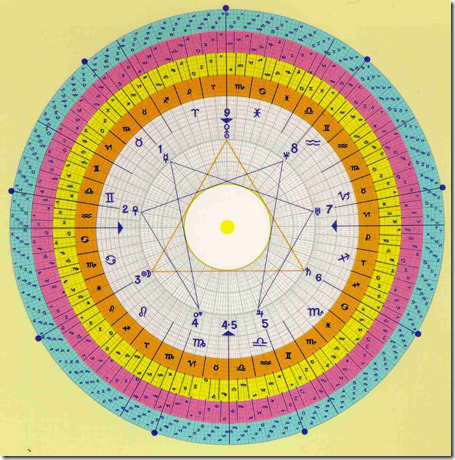
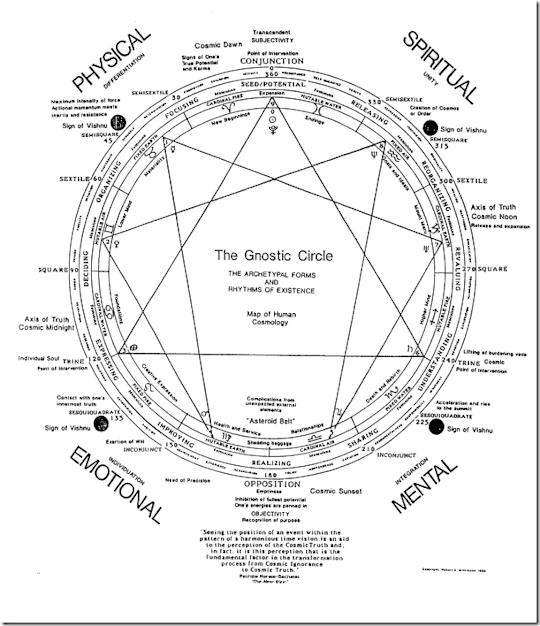
The Gnostic Circle is an alchemical Key of knowledge from the Vedic
texts of ancient India revealing the primary role of Time in our
developmental process. Most astrological systems are oriented toward
the individual’s egoic development, but the Gnostic Circle provides a
means by which we can perceive the imperatives of the Soul and its
hidden but primary influence in our lives. It is the unifying
element of a complete astrological work-up which helps us to understand
the cyclic nature of our developmental process; where we have been in
the past, where we happen to be at the present moment and what we are
moving toward in the future.
“The Gnostic Circle is the most effective method for understanding
the transformation of human consciousness. It represents a vision of
wholeness and has only one objective: it deals with the soul or seed of
the divine in each created thing and reveals the process by which that
seed is made to flower in its process of becoming.” – Patrizia
Norelli-Bachelet
Used in conjunction with the practice of yoga, the Gnostic Circle
reverses the long-standing perception of Time as the destroyer and
presents mankind with an entirely new awareness of Time as the
integrative mechanism by which a Divine purpose is expressed in the
world, thus it contains the highest wisdom of our age.
“The Gnostic Circle allows us to measure the progression of any event in time. And it provides the means of assessing an event’s relevance to time and place within a global and universal context. Above all, it permits us to appreciate the interconnectedness of events through a unified, spherical approach to Time. The
Gnostic Circle is a yardstick which can be applied to any event and by
which that event or object may be made to reveal its intrinsic nature
and objective value. In ancient literature and tradition, such a tool was sometimes referred to as the Golden Rod, or the Philosopher’s Stone. Its
value resided in the fact that because of its special relation to Time
and Space, it could provide an objective means to assess the
truth-conscious substance of any given situation or event or object. In
a word, it could objectively reveal the element’s inner pulse and place
within the greater harmony of life on Earth and within the solar
system.” The Vishaal Newsletter, – Oct 30, 1991
For each person there are two ways of being in the world, two
existential situations critical to our perception of life and reality.
The first and most common is an experience of the world from the historical perspective of linear time.
The second, and more rare, is the direct perception of non-linear time or cosmic cycles.
These modes of awareness represent two different worlds, one within the other. Non-linear
or sacred time appears under the paradoxical aspect of whole time, an
eternal present which is connected with man’s deepest spiritual
dimension. It is based upon a perception that time does not proceed
endlessly in a straight line. Rather it is always and everywhere a
closed curve, although from our ordinary perception, we do not see that
it’s movement is either curved or closed.
To move beyond the illusion of linearity and recover a realization of
whole time one must undergo a process of yoga which illumines the
cyclical nature of the life experience. This is most easily achieved
through the application of a cosmological model which highlights
certain essential relationships between man and the universe and which
unveils a common center. In ancient times these cosmological models
were based upon the known universe which was believed to consist of six
planets and a central Sun. It was not until the 20th century, following
the discovery of Uranus, Neptune and Pluto, that the complete
cosmological key could be revealed and man’s integral transformation
fully understood.
In ancient India, as in all other traditional societies, the
unveiling of this axis or ‘center’ was achieved through a disciplined
study of the archetypal language contained in the zodiacal hieroglyphs
and a knowledge of the principles of the Cosmic order. Once these
foundations are laid, one’s lived experience becomes revelatory. The
awareness gradually shifts from the ordinary linear perspective of past,
present and future to an experience of time as a cyclical developmental
process. As the individual lives and repeats these cycles of whole
time, he becomes imprinted with their order and aligned with their
harmonies. The axis of his being gradually shifts from the pivot of ego,
to a higher perceptual center. For it is by observing the cycles of his
own microcosmic process, that man comes to know the macrocosm and the
principles of its evolution. In the Veda, this realization is known as SWAR or Truth-Consciousness, and grants the seeker a direct and unequivocal perception of Unity.
‘The Gnostic Circle is merely the combination of the zodiac – the
occult circle which contains the knowledge of the evolution – and the
structural pattern of the solar system. The Circle of 12 is the zodiac,
and the Circle of 9 is our actual solar system, each orbit representing
one year of Earth life. The joint harmony of these two, superimposed or
synthesized in one circle, is what constitutes our key to the evolution
and flowering of the seed of the Spirit. In fact we can say that the
Gnostic Circle is mainly for this purpose. It shows mankind the ultimate
and ideal perfection that can be attained during this particular phase
of the evolution, during this great transition point from animal-mental
to the more divine mankind.’ – The Gnostic Circle p. 159, 1975, Patrizia Noreill-Bachelet



 Occult Aspects