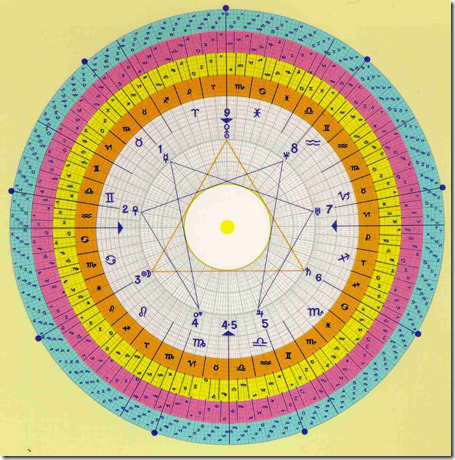
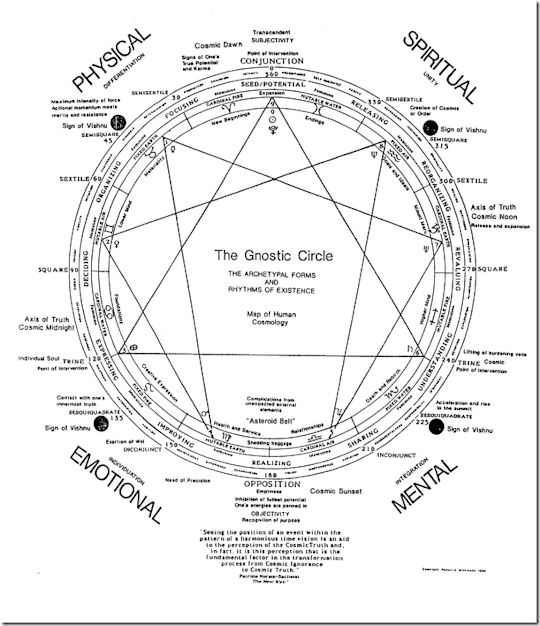
The Gnostic Circle is an alchemical Key of knowledge from the Vedic
texts of ancient India revealing the primary role of Time in our
developmental process. Most astrological systems are oriented toward
the individual’s egoic development, but the Gnostic Circle provides a
means by which we can perceive the imperatives of the Soul and its
hidden but primary influence in our lives. It is the unifying
element of a complete astrological work-up which helps us to understand
the cyclic nature of our developmental process; where we have been in
the past, where we happen to be at the present moment and what we are
moving toward in the future.
“The Gnostic Circle is the most effective method for understanding
the transformation of human consciousness. It represents a vision of
wholeness and has only one objective: it deals with the soul or seed of
the divine in each created thing and reveals the process by which that
seed is made to flower in its process of becoming.” – Patrizia
Norelli-Bachelet
Used in conjunction with the practice of yoga, the Gnostic Circle
reverses the long-standing perception of Time as the destroyer and
presents mankind with an entirely new awareness of Time as the
integrative mechanism by which a Divine purpose is expressed in the
world, thus it contains the highest wisdom of our age.
“The Gnostic Circle allows us to measure the progression of any event in time. And it provides the means of assessing an event’s relevance to time and place within a global and universal context. Above all, it permits us to appreciate the interconnectedness of events through a unified, spherical approach to Time. The
Gnostic Circle is a yardstick which can be applied to any event and by
which that event or object may be made to reveal its intrinsic nature
and objective value. In ancient literature and tradition, such a tool was sometimes referred to as the Golden Rod, or the Philosopher’s Stone. Its
value resided in the fact that because of its special relation to Time
and Space, it could provide an objective means to assess the
truth-conscious substance of any given situation or event or object. In
a word, it could objectively reveal the element’s inner pulse and place
within the greater harmony of life on Earth and within the solar
system.” The Vishaal Newsletter, – Oct 30, 1991
For each person there are two ways of being in the world, two
existential situations critical to our perception of life and reality.
The first and most common is an experience of the world from the historical perspective of linear time.
The second, and more rare, is the direct perception of non-linear time or cosmic cycles.
These modes of awareness represent two different worlds, one within the other. Non-linear
or sacred time appears under the paradoxical aspect of whole time, an
eternal present which is connected with man’s deepest spiritual
dimension. It is based upon a perception that time does not proceed
endlessly in a straight line. Rather it is always and everywhere a
closed curve, although from our ordinary perception, we do not see that
it’s movement is either curved or closed.
To move beyond the illusion of linearity and recover a realization of
whole time one must undergo a process of yoga which illumines the
cyclical nature of the life experience. This is most easily achieved
through the application of a cosmological model which highlights
certain essential relationships between man and the universe and which
unveils a common center. In ancient times these cosmological models
were based upon the known universe which was believed to consist of six
planets and a central Sun. It was not until the 20th century, following
the discovery of Uranus, Neptune and Pluto, that the complete
cosmological key could be revealed and man’s integral transformation
fully understood.
In ancient India, as in all other traditional societies, the
unveiling of this axis or ‘center’ was achieved through a disciplined
study of the archetypal language contained in the zodiacal hieroglyphs
and a knowledge of the principles of the Cosmic order. Once these
foundations are laid, one’s lived experience becomes revelatory. The
awareness gradually shifts from the ordinary linear perspective of past,
present and future to an experience of time as a cyclical developmental
process. As the individual lives and repeats these cycles of whole
time, he becomes imprinted with their order and aligned with their
harmonies. The axis of his being gradually shifts from the pivot of ego,
to a higher perceptual center. For it is by observing the cycles of his
own microcosmic process, that man comes to know the macrocosm and the
principles of its evolution. In the Veda, this realization is known as SWAR or Truth-Consciousness, and grants the seeker a direct and unequivocal perception of Unity.
‘The Gnostic Circle is merely the combination of the zodiac – the
occult circle which contains the knowledge of the evolution – and the
structural pattern of the solar system. The Circle of 12 is the zodiac,
and the Circle of 9 is our actual solar system, each orbit representing
one year of Earth life. The joint harmony of these two, superimposed or
synthesized in one circle, is what constitutes our key to the evolution
and flowering of the seed of the Spirit. In fact we can say that the
Gnostic Circle is mainly for this purpose. It shows mankind the ultimate
and ideal perfection that can be attained during this particular phase
of the evolution, during this great transition point from animal-mental
to the more divine mankind.’ – The Gnostic Circle p. 159, 1975, Patrizia Noreill-Bachelet
Every individual rises again in the very form which his Work
(in the alchemical sense) has fixed in the secret (esoteric) depth of
himself.
— SHAIKH AHMAD AHSA’I —
S I N C E P A R A C E L S U S (1493-1541), salt has played a role
in alchemy as the physical “body” which remains after combustion, the
corporeal substance that survives death to reinaugurate new life. It was
both ‘corruption and preservation against corruption’ (Dorn); both the
‘last agent of corruption’ and the ‘first agent in generation’ (Steeb). As such, the alchemical salt functions as the fulcrum of death and
revivification. The idea that the agent, instrument and patient of the
alchemical process are not separate entities but aspects of one reality
prefigures the significance accorded in this study to ‘the Hermetic
problem of salt’. Just as in chemistry a salt may be defined as the
product of an acid and a base, alchemically, salt is the integral
resolution to the primordial polarities embodied in the mineral symbolique of cinnabar (HgS), the salt of
sulphur and mercury. In the alchemy of René Adolphe Schwaller de Lubicz
(1887-1961), salt forms the equilibrium between an active function
(sulphur, divinity, peras) and its passive resistance (mercurial substance, prima materia, the apeiron),
aspects which are latently present in the primordial (pre-polarised)
unity, but crystallised into physical existence as “salt”. With
Schwaller’s concept, one is dealing with a juncture of the metaphysical
and proto-physical. As will be seen, however, this also inheres in the
body as a fulcrum point of death and palingenesis.
Leap, Salve, Balsam
‘Salt arises from the purest sources, the sun and the sea’. —Pythagoras
In
order to understand the nature of alchemical salt one must first
understand the nature of common salt. In doing this, however, it is soon
realised that salt is anything but common; like many everyday things,
salt is so familiar that its singular peculiarity is taken for granted.
Visser, in an extraordinary study of the elements of an ordinary meal,
aptly encapsulates the cultural purview of salt in the following words:
Salt
is the only rock directly consumed by man. It corrodes but preserves,
desiccates but is wrested from the water. It has fascinated man for
thousands of years not only as a substance he prized and was willing to
labour to obtain, but also as a generator of poetic and of mythic
meaning. The contradictions it embodies only intensify its power and its
links with experience of the sacred.
European languages derive their word ‘salt’ from Proto-Indo-European *sāl- (*sēl-) reflected directly in Latin as sal, ‘salt, salt water, brine; intellectual savour, wit’, Greek hals, ‘salt, sea’ (cf. Welsh halen) and in Proto-Germanic as *saltom (Old English sealt, Gothic salt, German Salz). In addition to its mineral referent, sal also gives rise to a number of cognates that help crystallise its further semantic and symbolic nuances. Saltus, saltum, ‘leap’, derives from the verb salio, ‘leap, jump, leap sexually’, whence Saliī,
‘priests of Mars’ from the ‘primitive rites (practically universal) of
dancing or leaping for the encouragement of crops’; saltāre, ‘dance’, salmo, ‘salmon’ (leaping fish), (in)sultāre, (‘insult’, literally ‘leap on, in’; figuratively, ‘taunt, provoke, move to action’), all from Indo-European *sēl-, ‘move forth, start up or out’, whence Greek ἁλλομαι, άλτo, ἁλμα (hallomai, halto, halma), ‘leap’; Sanskrit ucchalati (*ud-sal-),
‘starts up’. Importantly for the alchemical conception, alongside
‘leap’ one finds the meanings at the root of English ‘salve’ (balm,
balsam), derived from Indo-European *sel-p-, *sel-bh-, and giving rise to Cyprian elphos (butter), Gothic salbōn, Old English sealfian; in Latin: salus, ‘soundness, health, safety’; salūbris, ‘wholesome, healthy’; salūtāre, ‘keep safe, wish health, salute’; salvus, ‘safe, sound’; salvēre, ‘be in good health’; salvē, ‘hail!’; cf. also *sēl-eu-; Avestan huarva, ‘whole, uninjured’; Sanskrit sarva-, sarvatāti, ‘soundness’ and Greek ὁλοειται, ὁλος (holoeitai, holos), ‘whole’. These meanings are further connected to solidus, sollus, sōlor, with an ultimate sense of ‘gathering, compacting’, hence ‘solidity’.
In
addition to its salvific, balsamic and holistic aspect, which must be
regarded as the meaning most central to the alchemical perception, the
significance of salt as both ‘leap’ and ‘solidity’ must also be
recognised as integral. In particular, it pertains to Schwaller’s
conception of salt as the fixed imperishable nucleus (solidus)
regarded as the hidden mechanism underpinning the ontological ‘leaps’ or
mutations of visible evolution (contra the Aristotelian dictum, natura non facit saltum,
‘nature does not proceed by a leap’). For Schwaller, the seemingly
disconnected leaps of biological mutation are in fact bound by a hidden
harmony grounded in the saline alchemical nucleus.
Although it is
the intention of this study to explore the deeper meaning of salt in the
work of Schwaller de Lubicz—alchemically configured as the determiner
of an entity’s form—a number of studies have pointed to the crucial role
of salt as a significant shaper of civilisation. Perhaps the
earliest point of departure for this is the fact that salt only rises to
especial prominence with the emergence of an agricultural economy. Salt
intake, initially bound to blood and meat, had to be supplemented.
Comments Darby:
When man first learnt
the use of salt is enshrouded in the mists of the remotest past.
Parallel to the Ancient Greek’s ignorance of the seasoning, the original
Indo-Europeans and the Sanskrit speaking peoples had no word for it.
This apparent lack of salt-craving in early people could have been a
result of their reliance on raw or roasted meat. Later, when with the
invention of boiling the sodium content of meat was reduced, and when
the shift to an agricultural economy introduced vegetables in increasing
amounts, sodium chloride became a basic need to provide an adequate
sodium intake and, more important still, to counterbalance the high
potassium content of plants.
Commodity histories show that
salt was not always the easily available resource it is today; it had to
be striven for; it required effort and ingenuity (perhaps even wit).
It created trade and war; it was used as pay and exploited as a tax.
Nor did salt have the current stigma of being an unhealthy excess (a
problem symptomatic of modern surfeit). Quite to the contrary, salt
was typically a sign of privilege and prestige. ‘Salt like speech is
essentially semiotic’, Adshead remarks; ‘As such it could convey a
variety of meanings, of which the clearest in early times was social
distance: high cooking, low cooking, above and below the salt’. Considerations such as these help contextualise many of the ancient
values surrounding salt, some of which have become proverbial. In the New Testament,
for instance, but also elsewhere, the sharing of salt (often with bread
at a table), represented a deep bond of trust, of communal solidarity,
while the spilling of it was considered a grave faux pas.
Indeed, if salt was as freely available for liberal exploitation as it
is today, such ethical and social implications would scarcely carry any
weight at all.
Most of salt’s social meanings reflect its deepest functional value as a preservative. Just
as salt keeps the integrity of plants and meats intact, so salt was
seen to keep the integrity of a body of people together. As a prestige
substance that could preserve food through the death of winter and bind
people in communal solidarity, salt was highly regarded; during Roman
times, salt even became a form of currency, whence our word ‘salary’
(from Latin salārium, ‘salt money’) after the Roman habit of
paying soldiers in pieces of compressed salt (hence the phrase: ‘to be
worth one’s salt’). Because of its integrating character, salt
bridges opposites. Paradoxically, however, the more one attempts to pin
salt down in a strictly rational manner, the more the contradictions it
embodies abound.
‘There are totally different opinions concerning
salt’, writes Plutarch (c. 46–120 CE), who preserves a number of
contemporary beliefs, including the view that salt possesses not only
preservative qualities, but animating and even generative power:
Some
include salt with the most important spices and healing materials,
calling it the real ‘soul of life’, and it is supposed to possess such
nourishing and enlivening powers that mice if they lick salt at once
become pregnant.
Consider also
whether this other property of salt is not divine too […] As the soul,
our most divine element, preserves life by preventing dissolution of the
body, just so salt, controls and checks the process of decay. This is
why some Stoics say that the sow at birth is dead flesh, but that the
soul is implanted in it later, like salt, to preserve it […] Ships
carrying salt breed an infinite number of rats because, according to
some authorities, the female conceives without coition by licking salt.
The connection of salt to the soul, a balsam to the body,
will be explored in more detail when the alchemical contexts of salinity
are examined. Its fertilising, generative power, on the other hand,
bears obvious comparison to salt’s known capacity to stimulate the
growth of the earth—a leavening function extended to the role of the
Apostles in the Christian Gospels: ‘Ye are the salt of the earth’.
And yet too much salt will make the earth sterile.
In ancient
times, offerings to the gods were made with salt among the Israelites:
‘with all thine offerings thou shalt offer salt’, but without salt
among the Greeks: ‘mindful to this day of the earlier customs, they
roast in the flame the entrails in honour of the gods without adding
salt’. The Egyptian priests favoured rock salt in sacrifices as
purer than sea salt; and yet ‘one of the things forbidden to them
is to set salt upon a table’; they ‘abstain completely from salt as
a point of religion, even eating their bread unsalted’. Although
the Egyptians ‘never brought salt to the table’, Pythagoras, who
according to the doxographic traditions studied in the Egyptian temples,
tells us that:
It should be brought to
the table to remind us of what is right; for salt preserves whatever it
finds, and it arises from the purest sources, the sun and the sea.
The understanding of salt as a product of sun and sea, i.e. of fire and water, ouranos and oceanos,
touches on its broader esoteric and cosmological implications, not all
of which were peculiar to Pythagoras. These aspects become central
in alchemy, where, as will be seen, salt acts as the earthly ligature
between fire (sun) and water (sea), the arcane substance whose patent
ambiguities stem from its role as embodiment and juncture of opposites:
purity and impurity, eros and enmity, wetness and desiccation, fertility
and sterility, love and strife. One thing that the present discussion
of the mythological and historical aspects of salt hopes to emphasise is
that none of these ideas are really born of speculation or abstraction;
rather, they are all intimately linked to the basic phenomenology of
the substance itself.
Above all, salt is ambiguous. While some of
these ambiguities may be attributed to the unevenness of the sources,
and while some points of contradiction may be cleared up upon closer
examination (the negative Egyptian views on salt, for instance, mainly
seem to apply to times of ritual fasting), this does not eclipse the
overarching sense that salt, by its very nature, defies strict
definition.
Unity manifests itself as Trinity. It is the
“creatrix” of form, but still not form itself; form emerges through
movement, that is, Time and Space. —Schwaller de Lubicz
Schwaller’s understanding of the tria prima
as the creatrix of form is essentially consonant with the trinitarian
conceptions of Egyptian (and later Pythagorean) cosmogonic theology.
Here, the creator’s divine hypostases—Hu, Sia and Heka—manifest as the
extra- or hyper-cosmic forces that exist before creation; they are the forces necessary to the establishment of creation rather than creation per se.
This may be compared to the identical conception that emerges in
Iamblichean theurgy, which distinguishes between hypercosmic and
encosmic divinities, or the same essential principles as carried through
into the trinitarian theology of Eastern Orthodoxy, which distinguishes
between uncreated and created energies. Beyond these general point of
orientation, Schwaller’s hermetic metaphysics accorded the tria prima some very specific characteristics:
The
Trinity, that is to say the Three Principles, is the basis of all
reasoning, and this is why in the whole “series of genesis” it is
necessary to have all [three] to establish the foundational Triad that
will be[come] the particular Triad. It includes first of all an abstract
or nourishing datum, secondly a datum of measure, rhythmisation and
fixation, and finally, a datum which is concrete or fixed like seed.
This is what the hermetic philosophers have transcribed, concretely and
symbolically, by Mercury, Sulphur and Salt, playing on the metallic
appearance in which metallic Mercury plays the role of nutritive
substance, Sulphur the coagulant of this Mercury, and Salt the fixed
product of this function. In general, everything in nature, being a
formed Species, will be Salt. Everything that coagulates a nourishing
substance will be Sulphur or of the nature of Sulphur, from the
chromosome to the curdling of milk. Everything that is coagulable will
be Mercury, whatever its form.
The image of coagulation—with
Sulphur as the coagulating agent, Mercury as the coagulated substance,
and Salt as the resulting form—is used repeatedly by Schwaller. The
formal articulation of this idea, as published in his mature œuvre, connects the motif to the embryological process:
In
biology, the great mystery is the existence, in all living beings, of
albumin or albuminoid (proteinaceous) matter. One of the albuminoid
substances is coagulable by heat (the white of the egg is of this type),
another is not. The albuminoid substance carrying the spermatozoa is of
this latter type. The albuminoid sperm cannot be coagulated because it
carries the spermatozoa that coagulate the albuminoid substance of the
female ovum. As soon as one spermatozoon has penetrated the ovum, this
ovum coagulates on its surface, thus preventing any further penetration:
fertilisation has occurred. (In reality, this impenetrability is not
caused by a material obstacle, the solid shell, but by the fact that the
two equal energetic polarities repel one another). The spermatozoon
therefore plays the role of a “vital coagulating fire” just as common
fire coagulates the feminine albumin. This is the action of a
masculine fire in a cold, passive, feminine environment. Here also,
there are always material carriers for these energies, but they manifest
the existence of an energy with an active male aspect and a passive
female aspect that undergoes or submits to it. Ordinary fire brutally
coagulates the white of an egg, but the spermatozoon coagulates it
gently by specifying it into the embryo of its species. This image shows
that the potentiality of the seed passes to a defined effect through
the coagulation of a passive substance, similar to the action of an acid
liquid in an alkaline liquid, which forms a specified salt. Now the
sperm is no more acid than the male albumin, but it plays in the animal
kingdom [animalement] the same role as acid; ordinary fire is
neither male nor acid and yet it has a type of male and acid action.
This and other considerations incline the philosopher to speak of an
Activity that is positive, acid and coagulating, without material
carrier, and of a Passivity, a substance that is negative, alkaline, and
coagulable, also without material carrier. From their interaction
results the initial, not-yet-specified coagulation, the threefold Unity, which is also called the “Creative Logos” (Word, Verbe) because the Logos, as speech, only signifies the name, that is, the definition of the “specificity” of things.
To
salt as the mean term between the agent and patient of coagulation, he
occasionally adds other revealing expressions, such as the following:
In geometry, in a triangle, the given line is Mercury, the Angles are Sulphur, and the resultant triangle is Salt.
Whereas here, Schwaller identifies Salt with a ‘datum’ or ‘given’ which is ‘fixed like seed’ (une donnée concrète ou fixée comme semence), elsewhere he identifies the active, sulphuric function with that of the seed (semence).
What this means is that the neutral saline product, once formed, then
acts in the sulphuric capacity of a seed and ferment, but also
foundation:
It can only be a matter of an
active Fire, that is, of a seminal “intensity”, like the “fire” of
pepper, for example, or better: the “fire” of either an organic or a
catalysing ferment. The character of all the ferments, i.e. the seeds,
is to determine into Time and Space a form of nourishment—in principle
without form; clearly, therefore, it plays a coagulating role. The
coagulation of all “bloods” is precisely their fixation into the form of
the species of the coagulating seed, the coagulation being, as in other
cases, a transformation of an aquatic element into a terrestrial or
solid element, without desiccation and without addition or diminution of
the component parts.
In the identification of both sulphur and salt as semence,
one discerns a specific coherence of opposites that, in elemental
terms, is described by the expression ‘Fire of the Earth’. The salt is
described in the passage quoted above as a seed (semence). This seed “becomes” seed again through the process of tree and fruit (growth, ferment, coagulation). It is at once a beginning and a finality (prima and ultima materia).
The reality described is non-dual. Beginning and end partake of
something that is not describable by an exclusively linear causality;
and yet it is seen to “grow” or “develop” along a definite “line” or
“path” of cause and effect; at the same time it partakes of a cyclic or
self-returning character; and yet, for Schwaller, it is not the circle
but the spherical spiral that provides the true image of its
reality: a vision which encompasses a punctillar centre, a process of
cyclic departure and return from this centre (oscillation), as well as
linear “development”, all of which are merely partial descriptors of a
more encompassing, and yet more mysterious, reality-process. The
fundamental coherence of this vision to the Bewußtwerdungsphänomenologie of
Jean Gebser (1905–1973) consolidates the significance of Schwaller’s
perception for the ontology of the primordial unity which is at once
duality and trinity. For Gebser, consciousness manifests through
point-like (vital-magical), polar-cyclic (mythic-psychological) and
rectilinear (mental-rational) ontologies, each being a visible
crystallisation of the ever-present, invisible and originary ontology
which unfolds itself not according to exclusively unitary, cyclic or
linear modalities of time and space, but according to its own innate
integrum.
Thus there is no contradiction in finding the presence
of fiery sulphur in the desiccating dryness of the salt, for it is
precisely in the one substance that the sulphuric seed (active function)
and saline seed (fixed kernel) cohere. The fixed, concrete seed-form
(itself a coagulation of mercury by sulphur) contains the active
sulphuric functions (the coagulating rhythms) which it will impose upon
the nutritive mercurial substance (unformed matter). ‘One nature’, as a
Graeco-Egyptian alchemical formula puts it, ‘acts upon itself’.
Images are from the Tarot deck designed by de Lubicz himself.
Among
the various perspectives that have been surveyed on the nature and the
principles inherent to salt, it is perhaps the Pythagorean
statement—‘salt is born from the purest sources, the sun and the
sea’—that pertains most directly to the deeper meaning of Schwaller’s
hermetic phenomenology. Salt for Schwaller was placed in a septennial
relationship comprising the tria prima and the four elements.
Elementally, salt was situated by Schwaller at the end of a progression
beginning with fire and air and ending in water and earth. Fire and air
form a triad with sulphur; air and water form a triad with mercury;
water and earth form a triad with salt. But salt was also understood to
join the end of this progression to a new beginning, to a new
fire/sulphur, exactly as the octave recapitulates the primordial tonos in
musical harmony. For Schwaller, it was precisely this ‘juncture of
abstract and concrete’ (fire and earth) that was identified with the
formation of the philosopher’s stone (or at least the key to the formation of the philosopher’s stone):
Relationship between Tria Prima
and Tetrastoicheia. Trinity (Sulphur-Mercury-Salt) begets quaternary
(Fire-Air-Water-Earth). The juncture of Fire and Earth (abstract and
concrete) is the means by which the end of the series is linked to its
beginning. Diagram after Schwaller and VandenBroeck.
In
this configuration (which prefigures the discussion of de Lubicz’s
colour theory undertaken elsewhere), one begin to see the hermetic
“problem” of salt, i.e. its mysterium. Salt partakes of something that
stands between water and fire (Pythagoras’ ‘purest sources’) in a way
that is intimately related to earth, to which it imparts its dryness.
Here one finds an imbroglio that suggests at once an element and a
principle. Its connection to fire is felt in the hermetic associations
of the elements (the sulphuric triad, fire and air, is characterised by
heat; the mercurial triad, air and water, is characterised by humidity
or wetness, while the saline triad, water and earth, is characterised by
coldness; however, it salt’s dryness—its desiccating quality—can only come from fire. Visser’s remarks, once again, prove cogent and penetrating:
Salt,
once isolated, is white and glittering. It is the opposite of wet. You
win it by freeing it from water with the help of fire and the sun, and
it dries out flesh. Eating salt causes thirst. Dryness, in the
pre-Socratic cosmic system which still informs our imagery, is always
connected with fire, heat, and light.
Thus, inherent to salt
is an equal participation in fire, sulphur and heat (+) and water,
mercury, and wetness (–), such that it may be analogised with a chemical
neutralisation reaction in which the positive and negative values
become electrically equalised. This neutral condition is for Schwaller
the very ground of being in which we are existentially and
phenomenologically situated (‘everything in nature, being a formed
Species, will be Salt’). Thus, to see existence—reality as we know it—as
a neutralisation reaction between an active sulphuric function (divinity, logos, eidos) and passive mercurial substance (prima materia),
to perceive the coagulating sulphur and the nourishing mercury through
the “cinnabar” of all things, this is to “find” the philosopher’s stone.
It is fundamentally, for Schwaller, a metaphysics of perception.
Aleister Crowley defined magick as the “Science and Art of causing
Change to occur in conformity with Will”. However, all magical working
concerns the manipulation of glamours, and none of these results or the
desires that fuel them have any substance or reality in themselves.
Hadit is the Magician and the Exorcist, and all phenomena appear
spontaneously—there are no causes and no effects.— Hermetic Qabalah Initiation Workbook
Advaita or Non-Dual reality is often ascribed exclusively to Eastern
mysticism, as though it had no part in the Western Hermetic Tradition.
And yet, the Hermetic Tree of Life does not begin with Kether, the
‘One’, or Chokmah, the ‘Two’. The three veils of Negativity that precede
Kether—Ain, Ain Soph and Ain Soph Aur—have a vital role in all
practical working, whether the aim is mystical, magical or both. When we
begin meditation on the Tree of Life with Kether, or the Rituals of the
Pentagram with the word “IAO”, aspiring upwards, there is a momentary
pause. In that pause, we clear our minds of all thought and sensation,
and contemplate the Ain as no-thing, no object, no subject—pure
emptiness and spaciousness. Then when we utter the first words, Kether
is truly formulated from the three veils of the infinite.
Kether and Atziluth as a concentration of the three veils of Negative Existence
The Mexican sorcery or shamanism that
is described in the writings of Carlos Castaneda is none too different
from the magick of the Hermetic tradition. The trick of following a
symbol back to its source with the infinite—analogous thought as opposed
to analytical thought—is vital to both traditions. With the Mexican
sorcerers, there is more emphasis on the natural world, whereas the
urban magician is usually inclined towards more abstract ciphers. The
hieroglyphs are ‘out there’ in nature, in rocks, plants, mountains,
physical places and their genius loci.
However, this is no
different than the magick practiced by our ancient Egyptian forebears.
Every bird, animal, creature, stone, plant, building or place is a
cipher of the infinite. The word “cipher” itself is derived from the
Arabic sifre , meaning “zero”, and there is a meaningful correspondence between sifre and sephira or “number”. In the Egyptian Book of the Law, Liber AL vel
Legis, Nuit says: “Every number is infinite; there is no difference.”
The teachings of Castaneda’s Don Juan insist that the nagual —the
Mexican word for the formlessness and space that is the true nature of
matter—is the only source of real power to the magician or shaman. The nagual—more
or less equivalent to the thread of the Ain Soph of the Qabalah—is the
timeless source of all magick and sorcery. It is said that if a sorcerer
has enough power, then he or she can enter the nagual and leave
it at any point in space or time. A shaman can thus disappear from one
place and in an instant be transported to some other place a thousand
miles away. The Mexican shaman gains knowledge of every thing, object,
creature or plant, by entering into the formless reality that is veiled
by the object. Likewise, the Kemetic and Hermetic magician follows every
symbol back to its source with the infinite.
Lightning Flash
One unique thing about the Hermetic practice is that we start at the top
and then draw down the force, before working upwards again. In other
traditions, it is more common to begin from the ground and work your way
up. So it appears from our practical work that we begin with Kether the
Crown, the first emanation of the Tree of Life. Kether more or less
approximates with the Atman of Eastern philosophy. The Egyptian god Atem
or Atem Ra embodies much the same principle. However, numbers begin
from zero, not one. The idea of negative existence or Non-Being is as
integral to the Hermetic tradition as it is to Eastern Advaita. In the
Qabalah we have three veils of the negative light, the Ain, the Ain Soph
and the Ain Soph Aur—No-thing, Limitless Space, and Limitless Light.
Kether is the first appearance, and is really a concentration or mirror
reflection of those three veils of the infinite. The traditional name of
Kether in Atziluth is AHIH, “I Am”, the pure existence,
undifferentiated. If we say “I Am” backwards, we declare “Maya”—that
the ‘One’ is the root of the delusion of appearances. The Ain, Ain Soph
and Ain Soph Aur reflected in Kether is Light in Extension, the LVX
formulation of the Hermetic Order of the Golden Dawn. When this is
reversed, we formulate NOX or Night, the threefold eye of Ain, Not-Self
or Non-Being. The word Ain is closely related to the letter and word
Ayin, the eye of the void.
The Qabalist bears in mind at all times that the sephiroth of the
Hermetic Tree exist at four worlds or levels, and that there is a tree
in every sphere. The divine world, Atziluth, is more or less the plane
of the gods at the cosmic level. The Egyptian gods are Neters,
“Principles”, that are the divine expressed in nature by natural laws.
Nuit and Hadit, the primary gods of the Egyptian Book of the Law, Liber
AL vel Legis, are the most cosmic or absolute of all the gods. As such,
their first place on the Hermetic Tree is with the Ain and the Ain Soph.
There is some correspondence with Shiva and Shakti of the Eastern
Tantras.
On the plane of time and space, the temporal world, all things, objects
and creatures appear to be a result of causes. We therefore tend to
perceive everything as a chain of cause of effect. Malkuth in Assiah is
the world of action and elements, identical to the Sanskrit “karma”. In
the cosmic world of Nuit and Hadit, there are no causes and no
effects—there is no time. The notion of time where there seems to be a
past that is no more, a present that is ‘here’, yet constantly moving
forward, and a future that is as yet unborn, does not come about until
the midpoint of the Tree, Tiphereth. Even then, time does not fully
obtain until we reach Malkuth, the world of manifest appearances. The
perception of cause and effect, although real enough on its own plane,
is a trick of how we perceive things.
Form vs. Formless Reality
The argument between the advocates of a formless absolute and those that
revere gods, divinities, is an exceedingly ancient one. The great Hindu
sage Ramakrishna proposed a satisfying solution to that argument. The
story goes that one day Ramakrishna encountered some ardent followers of
Shiva, and they said to him, “Why are you worshipping this goddess? She
is Maya, the great delusion. We are followers of Shiva, who is Formless
and absolute, the only Reality.” Ramakrishna went away to think and
meditate on this. When he returned, he found the Shivaites again and
told them, “You are right! However, so am I! The goddess that I love is
the Form of the Formless. Ultimately, the Form and Formless are
perfectly equal and amount to an expression of the same Reality.”
The thread of the Ain Soph does not only exist ‘above Kether’, for it is
the key to transformation at every conceivable level. How does Geburah,
the 5th sephira, become Tiphereth, the 6th? How does the world of
Yetzirah become the world of Assiah? It is through the thread of the Ain
Soph that weaves throughout the worlds. In the numerical scheme of
things, Malkuth is ‘below’ and Kether is ‘above’. And yet, Malkuth is
Kether, but after another fashion. The Ain Soph is hidden in Malkuth—and
so present at all times—as much as it is ‘above’ even Kether.
In the practice—whether it is a meditation on the Hermetic Tree, the
Lesser Ritual of the Pentagram, or an operation to consecrate a
talisman, we start at the ‘top’, the most absolute that we can conceive,
then work towards manifestation. And that is the transformation or
Great Work that is essential to magick and alchemy, the working upon the
plane of matter. When this is reversed, so that each symbol is followed
back to its source in the infinite, the Non-Dual reality may be
realised. To use the Eastern terminology, which is more familiar to many
than the symbolism of the Hermetic tradition, Jnanamudra leads naturally to Mahamudra. According to “The Rites and Ceremonies of Hormaku”, Ritual Magick
:The adept embraces both heaven and hell, becoming at the last a
flame—and then the fire itself. Enoch provides the primary example of
magical invisibility since, after the translation of his Ka into spirit
or Khu, he was never seen again on earth by mortals. When the adept
knows that which he loves even as he is known and loved, a universe is
crushed to nought (i.e. returned to Nuit). “That which remains” (Liber
AL, II: 9) is not created from the substance of the earth—for it is not
of created things. The adept—unless he falls back into time and space at
the crossroads—is therefore invisible to all men, even while dwelling
in the body of flesh.
The True Will in the tradition of Thelema is a wonderful conception, and
can be truly liberating. It is inevitably confused, though, with the
personal will that appears to drive choices and decisions that, in turn,
seem to affect changes in the material life. If too much personal
energy is applied to effecting change on its own plane , that
energy becomes depleted and the Ka (vital body) becomes a vampirical
force. Although vampires and ghouls are a glamorous concept, especially
to those that have never experienced the psychic planes directly, the
(relative) reality of such things is unpleasant, to put it mildly.
The Great Work of magick and alchemy is identical, and the work of
transformation is effected downwards on the planes, “As above so below”.
The world of Assiah is ‘negative’ to the ‘positive’ of the world of
Yetzirah. Geburah is negative to Binah and Chesed, but positive to
Tiphereth and Hod. To work upon Malkuth, the plane of material illusion,
one does not begin with a wish or desire—though such a wish may have
served as a lever to turn the magician towards the Great Work. With the
Ain or non-conceptual reality there is no subject, no object and no will
to do anything or to change anything. There are no things or objects
with Ain, there is no-thing to desire or crave and no one to desire it.
Yet it is from Ain that magick is worked and it is only by embracing
Non-Being that the true Will is known. Magick and mysticism can easily
be seen as two entirely different paths, one leading this way, the other
leading that way. The magick of the true Will, however, works
simultaneously from the Formless to Form, and from Form to the Formless.
This mirroring or doubling of the worlds is described in the writings
of Kenneth Grant as the “Aeon of Zain”, named after the 17th path of the
Hermetic Tree to which the symbol of the sword is referred.
The downward striking action of the Flaming Sword or Lightning Flash—the
word or utterance of Kether which is itself a mirror of the void of Ain
Soph—automatically invokes a reflex, a current of return from Malkuth.
This simultaneous, two-way relationship between the Formless void and
its expression in matter and substance weaves the very fabric of
anything we can perceive as existence. By travelling to and fro across
the planes, a ‘substance’ is created that has an existence outside of
the gates of matter and time. This is no different than the immortal
stone or elixir of life that was described by medieval alchemists.
Referring once more to the writings of Carlos Castaneda, Don Juan was
always insistent that the ‘tricks’ of the shamans, whether to travel
over vast distances, to effect magical transmutations upon things,
creatures or humans, or to play some humiliating practical joke upon an
unwary acolyte, has deadly serious intent. And that intent is the
ultimate liberation of the soul from all constraints of matter, time and
death. This is no different in any way from the Great Work of the
Hermetic tradition or the goal of liberation of the Advaitans.


 Occult Aspects