If your a closeted witch, or just want to know some knowledge about various magics like myself. Here is a list of 5 magical alphabets I find very interesting.
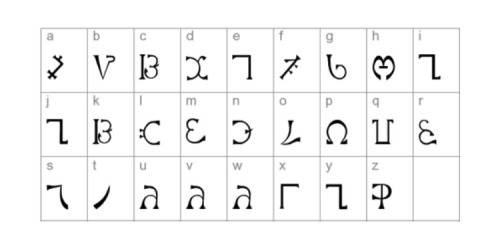
1. The Enochian Alphabet
The Enochian Alphabet was created by John Dee and Edward Kelley before the 16th century. The real dates are unknown. They calmed to have received this Alphabet through various visions, which consisted of invoking and commanding spirits. In Dee’s journals, was this script with various other numerous correspounces tables. This documented their research and secrets which are hidden in the Book of Enoch. This language was suppose to be the language God had used to create the Universe, for man to speak to God, and name all things in existence. This Alphabet is mainly known through its appearances in the American Television series, Supernatural. Interestingly, there is also an entire language around this Alphabet as well.
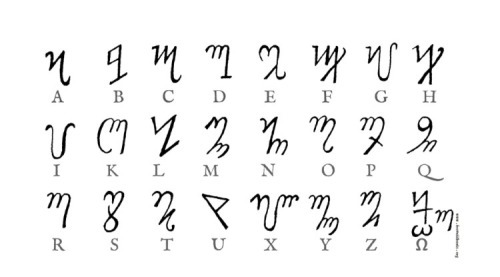
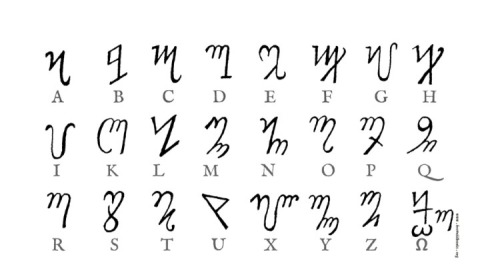
2. The Theban Alphabet
When I was a baby witch I saw this Alphabet come up when I was researching. I used this one when I was still a closet witch. The Theban Alphabet, also known as the Honorian Alphabet, first appeared in a book by Johannnes Trithemius called Polygraphia. Which was written in 1518. Now known as the Witches Alphabet, due to how often it is used by witches still today.
3. The Celestial Alphabet
This Alphabet was made by Agrippa, who was a major influence on people such as John Dee. He argued for magic to be systematic, combining both the natural world and spiritual world by a human participation. This is also known as the Angelic Alphabet, that many use to inscribe things with the element of air. He created in total 3 alphabets from the Hebrew alphabet.
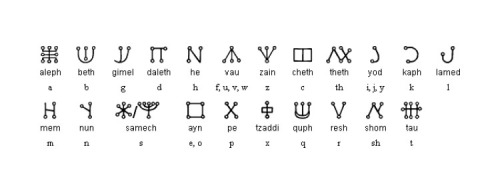
4. Malachim Alphabet
Another Alphabet made by Agrippa, this one is for the element of earth. The original Hebrew alphabet being for fire.
5. Transitus Fluvii
The third Alphabet made by Agrippa, representing the water element. You could guess this due to the translation being, “passing through the river.”
“The peregrinations of John Dee and Edward Kelley in Poland and Bohemia are one of the more interesting episodes in the history of Western esotericism. The meticulous records of their crystallomantic seances and conversations with angels attracted attention of many scholars, especially from the English-speaking countries. However, they were not particularly concerned with the local contexts, concentrating on the relationships between the two Englishmen and their families. This paper presents partial results of our larger project of identifying persons and places noted by John Dee in Poland, concentrating on two houses in Cracow and their owners. One of them was rented by Dee for a year and it was there that the so-called Enochian language texts and related revelations were dictated to the English Doctor by angels (or his companion).”
If your a closeted witch, or just want to know some knowledge about various magics like myself. Here is a list of 5 magical alphabets I find very interesting.
1. The Enochian Alphabet
The Enochian Alphabet was created by John Dee and Edward Kelley before the 16th century. The real dates are unknown. They calmed to have received this Alphabet through various visions, which consisted of invoking and commanding spirits. In Dee’s journals, was this script with various other numerous correspounces tables. This documented their research and secrets which are hidden in the Book of Enoch. This language was suppose to be the language God had used to create the Universe, for man to speak to God, and name all things in existence. This Alphabet is mainly known through its appearances in the American Television series, Supernatural. Interestingly, there is also an entire language around this Alphabet as well.
2. The Theban Alphabet
When I was a baby witch I saw this Alphabet come up when I was researching. I used this one when I was still a closet witch. The Theban Alphabet, also known as the Honorian Alphabet, first appeared in a book by Johannnes Trithemius called Polygraphia. Which was written in 1518. Now known as the Witches Alphabet, due to how often it is used by witches still today.
3. The Celestial Alphabet
This Alphabet was made by Agrippa, who was a major influence on people such as John Dee. He argued for magic to be systematic, combining both the natural world and spiritual world by a human participation. This is also known as the Angelic Alphabet, that many use to inscribe things with the element of air. He created in total 3 alphabets from the Hebrew alphabet.
4. Malachim Alphabet
Another Alphabet made by Agrippa, this one is for the element of earth. The original Hebrew alphabet being for fire.
5. Transitus Fluvii
The third Alphabet made by Agrippa, representing the water element. You could guess this due to the translation being, “passing through the river.”
I wrote this for my friends awhile ago and thought it may be of interest to some people. This is just a brief explanation on the subject of demonology, a topic of interest that I have been studying for quite some time now. It is in no way meant to convince or discourage anyone from studying demonology for themselves, and I encourage skepticism and constructive criticism where appropriate. I am simply publishing this article to shine some light upon what otherwise may be a rather confusing subject matter. This is just the tip of the iceberg, as there are a lot of other similar topics to consider – fallen angels, watchers, Jinn, there are so many different cultural interpretations of “demons” that you can look into. For this, I mainly focus on the Ars Goetia.
I study demons, I believe in actively trying to invoke and evoke them. The typical reaction to such a concept is fear or loathing, but this is because the common interpretation of demonology is one which lacks any insight into the realm of etymology – people fear the very word “demons” as though all of them are the same, as though they have no history, as though they are just utterly representative of evil incarnate. The general conception of demonology is therefore one which lacks insight into spirituality, the occult, and even linguistics.
Let’s begin with the issue of the very word demon. It is derived from the Greek word, Daimon, which simply means a spirit or divine power, much like the Latin words Genius (similar to a guardian angel) and Nurmen (divine will). Further, the Greek word Eudaimonia literally translates to “happiness” and “welfare” and “human flourishing,” and another Greek word, Agathodaemon, translates to “noble spirit.” Daemons in much of classical mythology are simply godlike or divine spirits; this is all to say that most demons are neutral or even positive in their essence.
So where does the idea that demons are innately evil beings come from? From linguistics and an understanding of antiquity, there are indeed spirits associated with what we could typically think of as modern day demons: A Cacodemon is for example is one such negative type of demon and it is once again a Greek concept. With the rise of Abrahamic faiths such as Judaism, Christianity, and Islam, many older entities deemed as Pagan idols were cast into a negative light. The Cannanite Baal (or Ba’al) was once a title meaning “Lord” and was associated with solar worship, but the more zealous Abrahamic faiths took over and erased culture from history, this title alone began to mean something more sinister, as the church demonized all Pagan deities.
A brief matter to consider before progressing: There is quite an interesting history to be found in the treatment of Pagan imagery and symbolism as it pertains to Christianity, as some of the themes, motifs, visuals, etc. they use even to this day actually originated with and/or have strong associations with Paganism and likewise, it is advised for those who would like to know more about such matters to look into early schools of Gnosticism, which shares some connections to Christianity but in a far more mystical sense (some people have made the argument that Gnosticism is the “true” Christianity" or at least that arrived prior to the more widely understood forms of Christianity).
Now, another matter pertaining to demonology: Are demons connected to Satan? People who are active in the occult tend to have different answers, but the short answer is no. For me personally, I will preface this matter by saying that the closest thing I have to an external “God” is Lucifer, and although many confuse him for Satan, this is due to major discrepancies and fallacies in translating ancient texts. His real nature is that of the “light bringer,” and he is associated with the planet Venus, with goddesses such as Sophia (in fact, Lucifer could just as well be a female or transcend sex/gender entirely – in Hermetic philosophy, one of the seven principles of wisdom is that everything has a gender to it. This is different from the cultural/socially constructed gender, however). Some schools of thought will consider Lucifer and Satan to be one side of the same being, with Lucifer representing the spiritual side and Satan representing the earthly side, in a similar manner to concepts such as the Trinity. Lucifer and Satan both share similarities and certainly have a number of connections, but whether you view them as the same or not depends on individual belief.
My point in bringing Lucifer up is to say that, in simplest terms, Lucifer is not a demon. He is traditionally considered a fallen angel, once the most glorious and favorite son of God prior to Christ (in fact, there are a number of connections you can look into comparing Lucifer and Christ, much like you can compare any number of figures to one another throughout the whole of religious history – just examine syncretism). Further, some accounts of Lucifer based in Gnostic tradition, which I follow more closely, put Lucifer as separate from being created by God. From here, it is important to understand that whether it be Lucifer or Satan, these figures are frequently associated with commanding demons but if you recall the former points I made about what exactly constitutes a demon, you’ll realize this does not mean that Lucifer and/or Satan are in charge of some sort of chaotic and bloodthirsty horde. Much like numerous archangels play a role in leading other angels/spirits, and much like there are fierce and powerful angels, there is a wide variety to be found in the legions of beings associated with demonology.
Another means of addressing the idea that demons are all just repugnant and frightening creatures is by studying grimoires and various occult works throughout history. If you are interested in learning about demons, the Ars Goetia, one of five books contained within the 17th century Lesser Key of Solomon, is perhaps the most major source of knowledge on the subject. The Lesser Key of Solomon, known either as Clavicula Salomonis Regis or Lemegeton contains 144 spells, and is separated into the Ars Goetia, Ars Theurgia-Goetia, Ars Paulina, Ars Almadel, and Ars Notoria. The Goetia is heavily inspired by the 1577 Pseudomonarchia Daemonum, which was written by Johann Weyer. Weyer’s work was incredibly thorough and well researched, providing a hierarchy of various demons (e.g. their ranking, their roles, etc) but it was technically written as a means of suggesting that witchcraft does not exist and instead is within the mind, possibly even suggestive of mental illness. At the time of writing this, this was actually a very progressive concept because of course, the typical response to things like witches and spirits was to call blasphemy and devil posession. Other works such as those of earlier occultists like Heinrich Cornelius Agrippa were also considered.
The Lesser Key of Solomon is decidely an “extension” of sorts of The Greater Key of Solomon, dating back to the 14th or 15th century and serving as one of the most crucial texts of Renaissance magic. Whereas the Lesser Key could be considered black magick (at least from a rudimentary perspective), The Greater Key deals more with angels and astrological work. Both texts are representative of King Solomon’s work in constructing his temple in Jerusalem in about 587AD; it is believed that Solomon utilized the spirits to aid in construction (the temple itself has also been argued to be a metaphorical construct, and various connections can be made to psychology or the highly spiritual concepts of Boaz and Jachin, which are important pillars – literally – in numerous faiths). From the Lesser Key, from drawings made by artists like Collin de Plancy and Eliphas Levi, and from the work of writers such as Weyer, you can get a better feel for the incredibly diverse range of demons. In the Goetia, there are 72 major demons (72 being quite an important number). The demons range from tall dark and handsome to horrific. The point is, the Goetia and the whole of demonology is a diverse melting pot that deserves to be studied. In fact, one of the literal translations of Goetia is “jugglery,” which to me indicates that there is a lot of information for those who are interested to play with; there is something to learn from each glance at its text.
With regards to physical appearance of demons, numerous magicians tend to agree on certain characteristics of the major spirits. Each demon has their own unique aesthetic, and it is the work of Jacques Collin de Plancy in particular which shows us their most well-known and popular depictions. Technically speaking, demons are capable of altering their form. In many cases, if the magician performing an evocation commands them to appear or speak in a more human-like form, they will. Some accounts such as those of James Donahue have linked Goetic demons to extraterrestrial sources, even. In more modern forms of magick such as chaos magic, there are ways to manifest/evoke spirits in dramatically differenet ways as well, but all of this depends on preference, ability, and the will of the spirit itself as well.
In any case, it is also important to dispell the notion that all demons are ugly and terrifying creatures. To prove this, researh descriptions of demons such as Stolas (he teaches astronomy and the knowledge of poisonous plants, herbs and precious stones) who is frequently seen as an owl. Caim is another great example, as he appears as a rather silly looking black bird (he is a good disputer, gives men the understanding of the voices of birds, dogs, and other creatures, and of the noise of the waters too, and gives true answers concerning things to come. Truthfully, “terror” is something subjective, as are things such as disgust and repulsion. If someone did not know anything of Christ and saw his corpse nailed to a cross, without the context, they may think it is a demonic symbol itself! And likewise, how a spirit of any kind appears and acts can largely vary in accordance to your mind, to your emotional state, and any number of factors. Sometimes when people have unpleasant experiences with spirits, whether they be demons or angels or anything else, it is possible that their mental state was negatively impacting the relationship; this creates ugliness in the physical and mental world, and is a testament to the fact that if you are trying to do spirit work, you must try and remain calm, collected, and confident in yourself and of course, respectful of the spirit.
Notice how, in any case, that the abilities and physical appereances are not alll that “demonic” in the sense that people are typically used to understanding. And what’s more, the way people commonly view demons is through very distinctly Westernized sources – there are demons in Eastern religions but what I mean specifically is that, the typical portraits of major demons such as Bael, Astaroth, etc. could have possibly looked much less “malignant” had they been constructed in different cultural landscapes; Bael is often depicted as having three heads but they are always shown as rather disgusting. Meanwhile, in Hinduism for instance, certain entities may have multiple heads and yet they have historically been portrayed as looking non-intimidating and far more colorful and psychedelic than Western versions. So it could all be a matter of perspective, and that especially holds true when you consider the Christian church is far more content with letting demons be, well, demonized (to the point of fear mongering and inciting “the flames of damnation” more than any other religion. And to the point of Eastern versus Western aesthetics, it could be very possible that people were having experiences with deities of the opposite faith/geographic location and because they did not understand, therein lies the panic and demonization.
Also, as far as the looks and temperment of demons go, the generalized idea in popular culture is to compare them to angels, but herein lies a bizarre matter: Angelic beings in the traditional sense are not all winged and haloed humanoid beings. Some of their descriptions, straight from the Bible for instance, have portrayed them as rather terrifying creatures. Much like the stories of people who withered away upon seeing the true face of Zeus, Ra, Vishnu, and other ancient deities, angels are complex beings with dramatic features that in some ways, overshadow the “flare” of many demons. Samael for instance has a “height… so great, it would have taken five hundred years to cover a distance equal to it.” The traditional understandings of angels and God as being associated with beauty and lightness is made all the more bizarre to know if you research the Gnostic perspective of the demiurge and Yaldabaoth (essentially the idea that the “God” who created the universe created us inside of a prison system, or that the demiurge represents the illusory and entrapping nature of the physical world, which is cut off from divinity).
What you need to understand with angelic beings and with God, is that just like demons, there can still be a danger in working with these forces because as humans, we posses limited understanding of realms beyond our immediate comprehension: Perform a spell the wrong way, do something heinous, misunderstandings, they could yield negative effects. Likewise, one of the most universally accepted rituals for accessing your guardian angel is an arduous process that takes a whopping 18 months (Aleister Crowley advocates that those who wish to partake in demonology first purify themselves and connect to their holy guardian angels before then diving into the Bornless Ritual, which serves as a gateway to the Ars Goetia).
In any case, I should clarify that I enjoy communing with spirits of all types – demonic, angelic, natural, etc – but my personal preference lies in demons because they are often easier to get in touch with, at least due to my own personal spiritual path. Demons can be thought of as subconscious manifestations of inner wants, desires, knowledge, or even the divinity of the higher self – they don’t have to be external entities that slither into your ears and whisper darkness into your mind. It’s also interesting to forge relationships with demons because it represents the idea of literally confronting your demons – confronting your fears and your psyche. In Buddhism, in the transitional phase of life and death, there may be demons awaiting. If you run and cower, you may be reincarnated in a less than favorable position. Similarly, in Nordic Paganism, the warrior mentality is encouraged in order to enter Valhalla. Even Christ himself faced much torment and madness upon being crucified. It’s an integral part of understanding who we are, our roles, our true wills, but we must learn to overcome fear.
You may be the judge of your own experiences, but I wrote this to help clear up some of the bad air circulating around this topic, and to help instill the idea that we should work in tandem with various cosmic forces, not just limit ourselves to “good” ones, because morality is a blurred line when dealing with matters that extend far beyond human existence and materialism. If you are interested in trying a quick exercise in demonology, my advice is to research demons and find one you like, then look up their demonic enn. A demonic enn is essentially an invitation, request, call, admiration, protection chant for a demon (their origins and their language is largely unknown but major sources include Alexander Willit in the 16th century). For me, if I am looking to get in touch with Lucifer, I will say “RENICH TASA UBERACA BIASA ICAR LUCIFER” which roughly is a protection and cleansing spell on the air around me, and is a means to further invoke Lucifer. You may try saying an enn a few times and see how it makes you feel, if you notice anything; meditate and say it aloud or in your mind (you may call forth a demon but more than anything, enns are meant to establish a rapport rather than necessarily being full scaled invocation or evocations).
Do not fear spirits, they are all around us, chances are they may be around you: Perhaps literally, perhaps figuratively. Awhile ago, I discovered that the word “alcohol” derives from the Arabic “Al-khul,” which translates into “body eating spirit” and is the origin of the term “ghoul.” Notice how when hard liquor is around, it is referred to as “spirits.” The point here is that by consuming alcohol, as a creation of industrialization and commercialization in mankind’s capitalistic state, you are willingly invoking spirits into yourself; the more you drink, the more they overtake your personality and behavior. This is why natural mind altering substances such as cannabis, LSA, San Pedro mescaline, and mushrooms are among the most healing and restorative mind-altering substances (because it can be argued they all possess direct linkage with nature, and more benevolent spirits); compared to alcohol which makes us experience zombie states of consciousness.
My point there is not to stay no to alcohol or non-naturally occurring substances, but to be aware of how they affect you and to make sure that you maintain a strong mind through studying, developing your spirituality and philosophy, honing your critical thinking abilities; make it so that if any dark forces try to contact you, you hang up the phone immediately; retain a strong will, a sense of knowledge and balance, and even if you’re attempting to summon the likes of Lucifuge Rofocale, you will then have the mental fortitude to handle the situation properly.
Magick is no joke. Beyond the nonsensical and cliche imagery of arrogant teenagers who go and draw blood and make circles and light sigils in the woods to dark forces, “just for fun,” there is also the fact that magick can be used to help us better understand our wills, our desires, our hearts, our chakras, our minds, the nature of the universe, who we are, etc. And again, magick is not purely supernatural, it has developed connections to modern science in numerous ways (for instance, the occult has played a role in the development of NASA, quantum physics connects deeply into the realm of metaphysics, it is reflected in psychology and neurology, and so forth). Crowley stated “magick is the Science of understanding oneself and one’s conditions. It is the Art of applying that understanding in action.” Everything is connected; as above, so below, the microcosm and the macrocosm, notice the similarities between all systems of philosophical, science, and spiritual thought and conjoin them to truly harness the will and beyond.
Addendum: I believe in the right for all those who are interested in the occult, in magick, in witchery, in Paganism, esoteric mysticism, etc. to be free to pursue whichever avenues of magick they deem appropriate for themselves, whether that means chaos magick, Enochian magick, or anything else out there. This also includes the right for practitioners to perform black magick as they see fit. In accordance to left-hand-path principles, black magick is a valid option to consider so long as you know what you are doing and can use it carefully.






 Occult Aspects