“The Hermetic Teachings go much further than do those of modern science. They teach that all manifestation of thought, emotion, reason, will or desire, or any mental state or condition, are accompanied by vibrations, a portion of which are thrown off and which tend to affect the minds of other persons by “induction.” This is the principle which produces the phenomena of “telepathy”; mental influence, and other forms of the action and power of mind over mind, with which the general public is rapidly becoming acquainted, owing to the wide dissemination of occult knowledge by the various schools, cults and teachers along these lines at this time. Every thought, emotion or mental state has its corresponding rate and mode of vibration. And by an effort of the will of the person, or of other persons, these mental states may be reproduced, just as a musical tone may be reproduced by causing an instrument to vibrate at a certain rate –just as color may be reproduced in the same way– By a knowledge of the Principle of Vibration, as applied to Mental Phenomena, one may polarize his mind at any degree he wishes, thus gaining a perfect control over his mental states, moods, etc. In the same way he may affect the minds of others, producing the desired mental states in them. In short, may be able to produce on the Mental Plane that which science produces on the Physical Plane–namely, “Vibrations at Will.” This power of course may be acquired only by the proper instruction, exercises, practice, etc., the science being that of Mental Transmutation, one of the branches of the Hermetic Art.”
The Demons of King
Solomon is the innovative sequel to JournalStone Publishing’s
bestselling anthology The Gods of H.P. Lovecraft. This anthology
explores the legendary demonic bestiary of King Solomon by bringing
together popular authors in horror, occultism, and dark fantasy,
including many NY Times bestsellers, as well as featuring original
artwork by John Coulthart and descriptions of the demons by Richard
Smoley.
The Trans-Saturnian 3 (Part 2) □ This is the symbol for Neptune, the 8th planet from the sun that was officially named in 1846. ■ The planet is named after the Roman god Neptune, the god of the sea. □ We can see 2 of the ingredients for a planetary symbol: a cross & a crescent. The two are stylized to create a 3 pronged trident, which is a symbol attributed to the god Neptune hundreds of years before the discovery of the planet. ■ The Roman Neptune would correspond with the Greek god Poseidon. □ Again it is controversial to use Neptune in astrology, Kabbalah or Alchemy, but within Crowley’s book 4 Neptune is associated with Chockmah (the 2nd sphere on the tree of life). Though this doesnt make too much sense since Chockmah’s element is fire, and Neptune is clearly water. Syncretism is rarely orderly. ■ If you know any interesting facts about Neptunian symbolism comment below or PM me! □ Shmaysh that ♡ for me ■ Obliterate that follow button □ Annihilate that share option ■ Source Wikipedia Book 4 □
One of the most important concepts sweeping the vast settings of global consciousness are that of the energy centers within our body. These bio-energetic centers have been called many names throughout the world, but are mostly attributed to the most ancient, esoteric, and shamanic of the Hindu spiritual beliefs The Hindu Tantra. Out of the many profound wisdoms that are revealed by this dynamic mystical practice, it is the mysterious energy vortexes that have had the most practical application in today’s currents of esoterica.
Some facts about the “Chakras” :
– The word “chakra” (pronounced chuk-rah) translates most closely to “wheel” in the English language. Therefore a chakra is best considered a wheel or vortex-like organ of the subtle energetic body.
– According to The Tantra, there are actually thousands of energy centers and pathways in the body, but the chakras are specific centers where many connections intersect.
-The purpose of the chakras are to process and disseminate energetic information between our spiritual and physical bodies.
-There are seven major chakras that oversee the human body. They are generally referred to as: The Root, The Sacral, The Solar Plexus, The Heart, The Throat, The Third Eye, and The Crown.
– Negative, traumatic, or confusing experiences can cause blockages in the corresponding chakras. The Seven Deadly Sins of Christianity directly correspond the major signs of blocked or imbalanced chakras, as well as The Seven Blessed Virtues being representations of the chakras in their ideal form.
– The Chakras are also mentioned as the “Seven Seals” of The Book of Revelation.
– In traditional Chinese medicine, the seven energy wheels are connected on an energetic pole of light energy called the Taiji Pole. The individual names for each chakra are: Huiyin , Mingmen Jinsuo/Spirit Storehouse, Shendao, Heaven’s chimney/Bige Vertebrae, Yintang/Wind Palace, and Baihui.
-In Islamic Sufism, there are also seven bio-energetic centers acknowledged throughout the body called “The Seven Lata’if.”
Hopefully this will express the importance of entering into a working relationship with your chakras. The mystical balancing of bio-energetic centers is a global idea spread accross many cultures, not just India. Of course it is important to give respect to the culture and system that brought it’s wisdom to forefront of esoteric thought. That being said, the knowledge of the chakras are a human birthright, transcending culture and religion.
UNICITY – The primordial concept of a totally singular instance, or oneness.
LINEARITY – One of two dioriginate concepts of manifestation. Lacking depths, succeeding in lengths and distinctions.
CIRCULARITY – One of two dioriginate concepts of manifestation. Lacking distinction, succeeding in depths and interconnectedness.
CIRCUITRY – An attribution of Circularity in which instances are connective and interactive.
INSTANCE – An event of evolutive manifestation.
PROTRUSION & ENVELOPMENT – A universal simplification of ‘cause and effect’. With the same manner, it addresses the pattern of manifestation rather than the becoming of events.
CONCEPTUAL INTERROGATION – The act of deciphering concepts between its original features, adjacencies, or juxtapositions.
FORM/FORCE – A feature in consequence to manifestation. An object’s physicality and its effect on/in existence.
CONCEPT – The mental construction of something.
SUBJECT – The mental portrayal or projection of something.
OBJECT – The fixed existence of something.
SPECTRAL CORRESPONDENCE – The feature of existence in which things have a direct effect on their similarities and immediate dissimilarities.
POLAR CORRESPONDENCE – The feature of duality in which one thing is immediately effective towards its antithesis.
DIFFRACTALIZATION – The splitting of patterned event or concepts. Double fractalization.
CONCEPTUAL CONVENTIONALISM – The standard or immediately implied concept of something in consequence of its existence.
CROSS-FLUCTUATION – The constant oscillation of dominance between two or more concepts.
CONCEPTUAL ADJACENCY – Concepts that bear mutual qualities, but are not of the same subject.
CONCEPTUAL JUXTAPOSITION – The contrasting conceptualization of subjects/objects that do not bear mutual qualities.
CONCEPTUAL UNCONVENTIONALISM – The nonstandard or inappropriate capability of a subject/object.
DIORIGINATIONS – The term of a universal, fundamental duality in which all things originate.
GENESIS DUALITY – The fundamental duality.
PRIMORDIAL UNITY – The pretense of unity before Linearity and Circularity.
DURATION – An appropriation for ‘time’.
VARIATIONAL MANIFESTATION – The potentiality of fused fundamental duality.
MULTIPLEX ENVELOPMENT – A multidimensional resolution of an initial protrusion.
CONCEPTUAL GENERALIZATION – The simplification of a concept, usually in turn measuring towards one of two polarities.
CONCEPTUAL ASSIMILATION – The act of bringing concepts together for comparison.
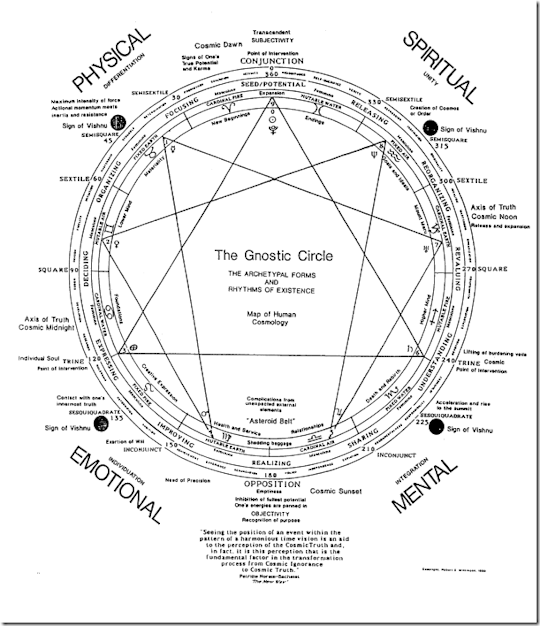
The Gnostic Circle is an alchemical Key of knowledge from the Vedic
texts of ancient India revealing the primary role of Time in our
developmental process. Most astrological systems are oriented toward
the individual’s egoic development, but the Gnostic Circle provides a
means by which we can perceive the imperatives of the Soul and its
hidden but primary influence in our lives. It is the unifying
element of a complete astrological work-up which helps us to understand
the cyclic nature of our developmental process; where we have been in
the past, where we happen to be at the present moment and what we are
moving toward in the future.
“The Gnostic Circle is the most effective method for understanding
the transformation of human consciousness. It represents a vision of
wholeness and has only one objective: it deals with the soul or seed of
the divine in each created thing and reveals the process by which that
seed is made to flower in its process of becoming.” – Patrizia
Norelli-Bachelet
Used in conjunction with the practice of yoga, the Gnostic Circle
reverses the long-standing perception of Time as the destroyer and
presents mankind with an entirely new awareness of Time as the
integrative mechanism by which a Divine purpose is expressed in the
world, thus it contains the highest wisdom of our age.
“The Gnostic Circle allows us to measure the progression of any event in time. And it provides the means of assessing an event’s relevance to time and place within a global and universal context. Above all, it permits us to appreciate the interconnectedness of events through a unified, spherical approach to Time. The
Gnostic Circle is a yardstick which can be applied to any event and by
which that event or object may be made to reveal its intrinsic nature
and objective value. In ancient literature and tradition, such a tool was sometimes referred to as the Golden Rod, or the Philosopher’s Stone. Its
value resided in the fact that because of its special relation to Time
and Space, it could provide an objective means to assess the
truth-conscious substance of any given situation or event or object. In
a word, it could objectively reveal the element’s inner pulse and place
within the greater harmony of life on Earth and within the solar
system.” The Vishaal Newsletter, – Oct 30, 1991
For each person there are two ways of being in the world, two
existential situations critical to our perception of life and reality.
The first and most common is an experience of the world from the historical perspective of linear time.
The second, and more rare, is the direct perception of non-linear time or cosmic cycles.
These modes of awareness represent two different worlds, one within the other. Non-linear
or sacred time appears under the paradoxical aspect of whole time, an
eternal present which is connected with man’s deepest spiritual
dimension. It is based upon a perception that time does not proceed
endlessly in a straight line. Rather it is always and everywhere a
closed curve, although from our ordinary perception, we do not see that
it’s movement is either curved or closed.
To move beyond the illusion of linearity and recover a realization of
whole time one must undergo a process of yoga which illumines the
cyclical nature of the life experience. This is most easily achieved
through the application of a cosmological model which highlights
certain essential relationships between man and the universe and which
unveils a common center. In ancient times these cosmological models
were based upon the known universe which was believed to consist of six
planets and a central Sun. It was not until the 20th century, following
the discovery of Uranus, Neptune and Pluto, that the complete
cosmological key could be revealed and man’s integral transformation
fully understood.
In ancient India, as in all other traditional societies, the
unveiling of this axis or ‘center’ was achieved through a disciplined
study of the archetypal language contained in the zodiacal hieroglyphs
and a knowledge of the principles of the Cosmic order. Once these
foundations are laid, one’s lived experience becomes revelatory. The
awareness gradually shifts from the ordinary linear perspective of past,
present and future to an experience of time as a cyclical developmental
process. As the individual lives and repeats these cycles of whole
time, he becomes imprinted with their order and aligned with their
harmonies. The axis of his being gradually shifts from the pivot of ego,
to a higher perceptual center. For it is by observing the cycles of his
own microcosmic process, that man comes to know the macrocosm and the
principles of its evolution. In the Veda, this realization is known as SWAR or Truth-Consciousness, and grants the seeker a direct and unequivocal perception of Unity.
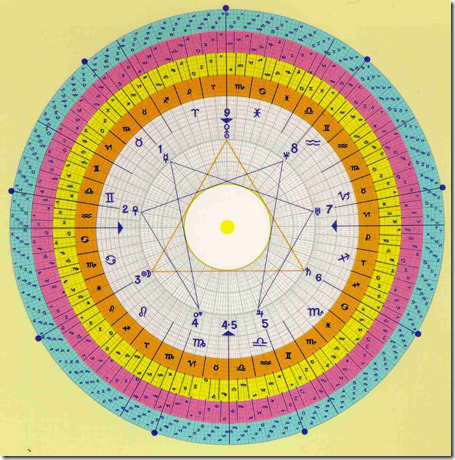
‘The Gnostic Circle is merely the combination of the zodiac – the
occult circle which contains the knowledge of the evolution – and the
structural pattern of the solar system. The Circle of 12 is the zodiac,
and the Circle of 9 is our actual solar system, each orbit representing
one year of Earth life. The joint harmony of these two, superimposed or
synthesized in one circle, is what constitutes our key to the evolution
and flowering of the seed of the Spirit. In fact we can say that the
Gnostic Circle is mainly for this purpose. It shows mankind the ultimate
and ideal perfection that can be attained during this particular phase
of the evolution, during this great transition point from animal-mental
to the more divine mankind.’ – The Gnostic Circle p. 159, 1975, Patrizia Noreill-Bachelet
My favorite general tarot spread technique Ive been working with recently and starts to be my very fav overall. It works with mystical properties of number nine. You cannot find this technique anywhere on the internet.
Simplified:
1) Throw cards on the table, play chaotically with them, shuffling them as a kid at least for a minute. Tell Spirit how you gonna draw cards: 3 for past, 3 for present, 3 for future.
2) Get deck into form, then cut the deck into 3 piles (1-2-3), fold the deck back to form (1-2-3). Bear in mind from the beginning what you are conceptually doing.
3) Now draw every ninth card while puttin each of these cards in a column, one under the other. You will get 3 columns: past, present, future – together 9 cards. Leave unused cards aside.
4) bonus: if you will continue drawing next 9ths of cards – they will also fit to reading.
I figured this out after I realized that there are 7 notes in a major scale and 12 notes altogether. C is the first note on any piano, and has no flat (technically B is a flat but it’s also part of the major scale – this lines up with the fact that the first classical planet is the Moon, which correlates to only one zodiac sign. The fourth note in the C Major scale is F, and also has no flat, just as the fourth classical planet, the Sun, has only one zodiac. The rest of the notes have flats, which are given the nocturnal sign of the planet (black key=night), and the white keys have the day signs. Works out perfectly, oddly enough.
A Occult, Esoteric, Magic(k), Mystical, Astrological, Metaphysical, or Pagan based Tumblr who DOES NOT support is or associated with: racism, nazi, nsbm, fascist or any other racist ideology, from any culture.
I want to know who Tumblrs are friendly and safe for everyone of any race to follow.






 Occult Aspects