David Bowie was a Narcissus (human) who woke up (”upgraded himself”).
Through his art and music he tried to communicate how to wake up, by increasing the number of experiences that humans alive right now have had gnosis of (c.f. “grokked”).
Because of his ability to do this so effectively to so many people, I would like to nominate David Bowie as a “Gnostic Saint”. I hope he would appreciate this – he certainly knew about the Kabbalah and the teachings of Aleister Crowley.
For evidence of this, see the first image above, from “Station to Station” (1976). Here the Thin White Duke is drawing a Qabalistic Tree of Life on the floor, where each sphere or circle is a “station” as referred to in the title of both the song and the album containing it.
In the background you can see a 3D version of the tree drawn on the walls and floor.
An example of explicit mentions of real occult groups is contained in the lyrics to “Quicksand” (1971):
“I’m closer to the Golden Dawn
Immersed in Crowley’s uniform
Of imagery
I’m living in a silent film
Portraying Himmler’s sacred realm
Of dream reality
I’m frightened by the total goal
Drawing to the ragged hole
And I ain’t got the power anymore
No, I ain’t got the power anymore
I’m the twisted name on Garbo’s eyes
Living proof of Churchill’s lies, I’m destiny
I’m torn between the light and dark
Where others see their targets, divine symmetry
Should I kiss the viper’s fang?
Or herald loud the death of Man
I’m sinking in the quicksand of my thought
And I ain’t got the power anymore
Don’t believe in yourself, don’t deceive with belief
Knowledge comes with death’s release
Aah-aah, aah-aah, aah-aah, aah-aah
I’m not a prophet or a stone-age man
Just a mortal with the potential of a superman
I’m living on
I’m tethered to the logic of Homo Sapien
Can’t take my eyes from the great salvation
Of bullshit faith
If I don’t explain what you ought to know
You can tell me all about it on the next Bardo
I’m sinking in the quicksand of my thought
And I ain’t got the power anymore
Don’t believe in yourself, don’t deceive with belief
Knowledge comes with death’s release
Aah-aah, aah-aah, aah-aah, aah-aah
Don’t believe in yourself, don’t deceive with belief
Knowledge comes with death’s release
Aah-aah, aah-aah, aah-aah, aah-aah”.
Adept (Latin) Adeptus, “One who has obtained.” In occultism, an adept is one who has reached the stage of Initiation and has become a Master in the science of esotericism.
There are four mental states that lead the neophyte to the ineffable summits of objective clairvoyance:
– First: To profoundly sleep
– Second: To sleep with dreams
– Third: Vigil state
– Fourth: Turiya or state of perfect illumination
Indeed, only the Turiya is an authentic clairvoyant. It is impossible to reach these heights without having been born in the Causal World. Whosoever wishes to reach the state of Turiya must thoroughly study the semi-unconscious psychic processes which actually constitute the origin of many forms of self-deception, self-suggestion, and hypnosis.
1. The Gnostic must first attain the ability to stop the course of his thoughts, the capacity to not think. Indeed, only the one who achieves that capacity will hear the Voice of the Silence.
2. When the Gnostic disciple attains the capacity to not think, then he must learn to concentrate his thoughts on only one thing.
3. The third step is correct Meditation. This brings the first flashes of the new Consciousness into the mind.
4. The fourth step is contemplation, ecstasy, or Samadhi. This is the state of Turiya (perfect clairvoyance).
Samael Aún Weor
The Perfect Matrimony
Art: “Peak Integration” by Sydwox
——————————————————
Clarividencia objetiva
Hay cuatro estados mentales que llevan al neófito a las cumbres inefables de la clarividencia objetiva:
– Primero: dormir profundamente
– Segundo: dormir con sueños
– Tercero: estado de vigilia
– Cuarto: Turiya o estado de iluminación perfecta
De hecho, solo el Turiya es un auténtico clarividente. Es imposible alcanzar estas alturas sin haber nacido en el mundo causal. Quienquiera que desee alcanzar el estado de Turiya debe estudiar a fondo los procesos psíquicos semiinconscientes que en realidad constituyen el origen de muchas formas de autoengaño, autosugestión e hipnosis.
1. El gnóstico primero debe alcanzar la capacidad de detener el curso de sus pensamientos, la capacidad de no pensar. De hecho, solo aquel que logre esa capacidad oirá la Voz del Silencio.
2. Cuando el discípulo gnóstico alcanza la capacidad de no pensar, entonces debe aprender a concentrar sus pensamientos en una sola cosa.
3. El tercer paso es la Meditación correcta. Esto trae los primeros destellos de la nueva Conciencia a la mente.
4. El cuarto paso es la contemplación, el éxtasis o el Samadhi. Este es el estado de Turiya (clarividencia perfecta).
Samael Aún Weor
El matrimonio perfecto
Arte: “Integración máxima” por Sydwox
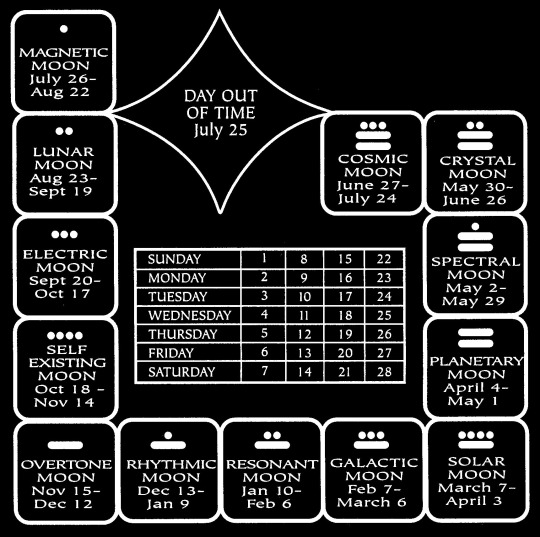
The 13 Moon calendar is not what it appears. It is a coded synchronization matrix that enters us into an
alternate universe to prepare our minds for entry into galactic
culture.
The 13 Moon/28-day count is not an earth-based system but a gift from
the Galactic Maya that serves as a type of dimensional doorway to
reorient the human mind to fourth-dimensional time.
It is only in the guise of a “calendar” as a mercy and a familiar
bridge for the people of Earth. It is actually a galactic template, a
Sirian template, that enters us into the vast realm of the synchronic
order. But it is not really something that can be talked about as it
has to be experienced.
The daily affirmations are mathematically coded fourth-dimensional
radiograms that open your mind to new potentialities. Like a Zen koan,
they are meant to bypass your conceptual mind and tune you into
higher-dimensional frequencies.
By learning our galactic signature,
we start thinking archetypally of our role within the collective,
rather than individually of the personal. Our galactic signature is our
password to the fourth dimension; it helps us to identify with the
larger story playing out in an objective way where our role is magical
and creative.
13 Moons as a Template of Peace
The 13 Moon calendar is a calendar of peace; peace that transcends
dogma. This is the whole point of it. It is based on the underlying mathematics of the Mayan calendar, based on the numbers: 4, 7, 13, 20, 52, 91, 260.
Mathematics are universal and far more creative than they have been
given credit for. Mathematics, inclusive of sacred geometries, define a
form that unlocks imaginal structures.
We live in an infinitely magical universe–not a close-ended linear
system where the only knowledge that exists was revealed thousands of
years ago. The universe is ever changing and creating itself anew. It is
happening now – as you read these words.
All the messengers, sages and galactic masters are here with us Now
to guide us through this shift of time. Past, future and present are
one. We live in a radial matrix of simultaneity that can be accessed
daily through the codes of the synchronic order via the 13 Moon
calendar.
13 Moon/28 days as Synchronization Template
The 13 Moon/28-day system embraces and synchronizes all true
calendrical and mathematical systems, from lunar calendars, to the Mayan
long count, to the Elder Futhark runes, to the I Ching hexagrams. In
other words this system reveals a master matrix, which contains all
other systems.
Keeping in mind also that the Maya used up to 17 calendars at once
because their perception of time was not linear, but based on
synchronization. The more cycles and systems you can track at once, the
more you can observe synchronic overlays.
13 Moons as a Sirian Timing Program
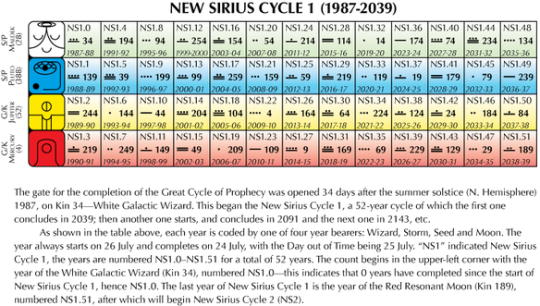
As a solar-galactic calendar with a July 26 synchronization date
based on the heliacal rising of the star Sirius, the 13 Moon Dreamspell
calendar is ultimately a Sirian timing program. (See graphic below: New Sirius Cycle).
In this way, the 13 Moon calendar and tools of the Law of Time are
intended to entrain our third-dimensional being into fourth- and
fifth-dimensional Sirian wisdom, or the realization of the supermental
superhuman.
By placing itself in the measure of the 13 Moon/28-day
synchronometer and its precise 52-year/orbital ring cycles, the human is
synchronized to the Sirius double universe star cycle, lifting it into a
truly galactic-cosmic consciousness and order of reality. —Valum Votan
This Sirian program is further unfolded in the various
fourth-dimensional tools such as Telektonon, 20 Tablets, 7:7::7:7 —
leading to the ultimate program of the Synchronotron 441 cube matrix system.
The 13 Moon calendar is also the key to enter the Cosmic History Chronicles. This
seven volume series lays out an entirely new galactic knowledge base so
that we can systematically begin to experience galactic/cosmic states
of consciousness in preparation for advanced telepathic technologies
including time travel and teleportation.
It is our duty to become multidimensional beings. The 13 Moon
calendar (synchronometer) is the key that opens the multidimensional
gate.
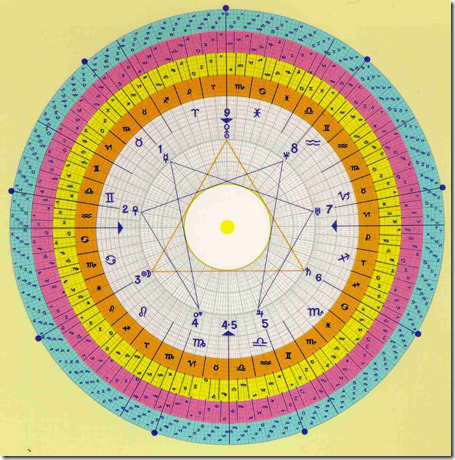
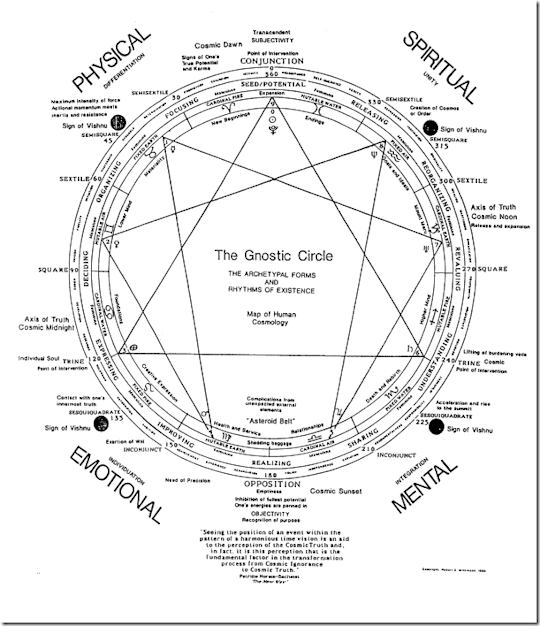
The Gnostic Circle is an alchemical Key of knowledge from the Vedic
texts of ancient India revealing the primary role of Time in our
developmental process. Most astrological systems are oriented toward
the individual’s egoic development, but the Gnostic Circle provides a
means by which we can perceive the imperatives of the Soul and its
hidden but primary influence in our lives. It is the unifying
element of a complete astrological work-up which helps us to understand
the cyclic nature of our developmental process; where we have been in
the past, where we happen to be at the present moment and what we are
moving toward in the future.
“The Gnostic Circle is the most effective method for understanding
the transformation of human consciousness. It represents a vision of
wholeness and has only one objective: it deals with the soul or seed of
the divine in each created thing and reveals the process by which that
seed is made to flower in its process of becoming.” – Patrizia
Norelli-Bachelet
Used in conjunction with the practice of yoga, the Gnostic Circle
reverses the long-standing perception of Time as the destroyer and
presents mankind with an entirely new awareness of Time as the
integrative mechanism by which a Divine purpose is expressed in the
world, thus it contains the highest wisdom of our age.
“The Gnostic Circle allows us to measure the progression of any event in time. And it provides the means of assessing an event’s relevance to time and place within a global and universal context. Above all, it permits us to appreciate the interconnectedness of events through a unified, spherical approach to Time. The
Gnostic Circle is a yardstick which can be applied to any event and by
which that event or object may be made to reveal its intrinsic nature
and objective value. In ancient literature and tradition, such a tool was sometimes referred to as the Golden Rod, or the Philosopher’s Stone. Its
value resided in the fact that because of its special relation to Time
and Space, it could provide an objective means to assess the
truth-conscious substance of any given situation or event or object. In
a word, it could objectively reveal the element’s inner pulse and place
within the greater harmony of life on Earth and within the solar
system.” The Vishaal Newsletter, – Oct 30, 1991
For each person there are two ways of being in the world, two
existential situations critical to our perception of life and reality.
The first and most common is an experience of the world from the historical perspective of linear time.
The second, and more rare, is the direct perception of non-linear time or cosmic cycles.
These modes of awareness represent two different worlds, one within the other. Non-linear
or sacred time appears under the paradoxical aspect of whole time, an
eternal present which is connected with man’s deepest spiritual
dimension. It is based upon a perception that time does not proceed
endlessly in a straight line. Rather it is always and everywhere a
closed curve, although from our ordinary perception, we do not see that
it’s movement is either curved or closed.
To move beyond the illusion of linearity and recover a realization of
whole time one must undergo a process of yoga which illumines the
cyclical nature of the life experience. This is most easily achieved
through the application of a cosmological model which highlights
certain essential relationships between man and the universe and which
unveils a common center. In ancient times these cosmological models
were based upon the known universe which was believed to consist of six
planets and a central Sun. It was not until the 20th century, following
the discovery of Uranus, Neptune and Pluto, that the complete
cosmological key could be revealed and man’s integral transformation
fully understood.
In ancient India, as in all other traditional societies, the
unveiling of this axis or ‘center’ was achieved through a disciplined
study of the archetypal language contained in the zodiacal hieroglyphs
and a knowledge of the principles of the Cosmic order. Once these
foundations are laid, one’s lived experience becomes revelatory. The
awareness gradually shifts from the ordinary linear perspective of past,
present and future to an experience of time as a cyclical developmental
process. As the individual lives and repeats these cycles of whole
time, he becomes imprinted with their order and aligned with their
harmonies. The axis of his being gradually shifts from the pivot of ego,
to a higher perceptual center. For it is by observing the cycles of his
own microcosmic process, that man comes to know the macrocosm and the
principles of its evolution. In the Veda, this realization is known as SWAR or Truth-Consciousness, and grants the seeker a direct and unequivocal perception of Unity.
‘The Gnostic Circle is merely the combination of the zodiac – the
occult circle which contains the knowledge of the evolution – and the
structural pattern of the solar system. The Circle of 12 is the zodiac,
and the Circle of 9 is our actual solar system, each orbit representing
one year of Earth life. The joint harmony of these two, superimposed or
synthesized in one circle, is what constitutes our key to the evolution
and flowering of the seed of the Spirit. In fact we can say that the
Gnostic Circle is mainly for this purpose. It shows mankind the ultimate
and ideal perfection that can be attained during this particular phase
of the evolution, during this great transition point from animal-mental
to the more divine mankind.’ – The Gnostic Circle p. 159, 1975, Patrizia Noreill-Bachelet
The
historical purview of what came to be called alchemy includes an
undeniable current of influence stemming from Pharaonic and Hellenistic
Egypt on one hand, and another stemming from ancient China, medieval
India and Tibet on the other―currents that appear to have
cross-fertilised before converging in Arabic alchemy, whence the term
proper: al-kīmiyā. Scholars have long known that the word alchemy points to an Arabic transmission (alkīmiyā becomes Spanishalquimia, Latin alchimia, French alchimie, German Alchemie, etc.) [The Arabic definite article al- points clearly to this, yet the precise origin of the lexeme kīmiyā is far from certain. Academic consensus has generally favoured Greek sources, notably those published by Marcellin Berthelot, suggesting an origin from the term chyma(‘that
which is poured out’; ‘flows, fluid’; ‘ingot, bar’; metaphorically,
‘confused mass, aggregate, crowd’; ‘materials, constituents’), whence chymeia, ‘the art of alloying metals’) named from its supposed inventor, Chymēs. As Harris observes in his 1704 Lexicon Technicum:
Chymisty,
is variously defined, but the design of this Art is to separate
usefully the Purer Parts of any mix’d Body from the more Gross and
Impure. It seems probably to be derived from the Greek word chymos, which signifies a Juice, or the purer Substance of a mix’d Body; though some will have it to come from cheein, to melt. It is also called the Spagyrick, Hermetick, and Pyrotechnick Art, as also by some Alchymy.
The
idea of fluid essences, extracts or elixirs is clearly central to the
alchemical purview, and as will be seen throughout this volume, it is
also inherent to the very names for alchemy in Chinese and Indo-Tibetan
traditions (Chinese dao jindan, Sanskrit rasāyana, Tibetan bcud len).
In addition, the Greek etymology distinctly emphasises the idea of
metallic fusibility, and the idea that metals are fundamentallyfusible entities proves central to the alchemical perception. The word ‘metal’ itself (metallon, metalleion) is homophonous with—and most likely derived from—a whole series of words indicating ‘transformation’, such as metalloiōsis, which is formed from the preposition meta– (‘between, with, after; taking a different position or state’) and the substantive alloiōsis (‘alteration’ or ‘change’).
Whether derived from chyma, chymeia, Chymēs, or chymos, the term alchemy appears to
come to the Latin west from late Greek sources through the same kinds
of channels that preserved Platonic and Aristotelian texts, in Arabic
translation, after the fall of the Greek Academy. While the lines of
historical transmission are well known, matters are not quite as simple
as they first appear. Egyptologists and Sinologists have both brought
forward diverging evidence that the origins of alchemy lay not in Greece
but in the Ancient Near or Far East.
The Egyptian Etymology
In addition to the Greek etymology, the root kīmiyā has also been traced to the Egyptian name for Egypt, km.t (Coptic keme, kēmi), which Plutarch gives as chēmia,‘the blackest earth’ (malista melangeion). The implications of this etymology are explored in detail elsewhere in this volume. Suffice
it to say for now that a wealth of theological and cosmological
significations deeply pertinent to alchemy emerge from Plutarch’s
identification of the name of Egypt with not only the blackness of the
soil, but also with the blackness of the pupil of the eye. On a basic,
symbolic level, this coheres with the fact that the Nilotic black earth,
which literally (and geographically) defined Egypt, was fertile soil—the
perfect receptor of life-giving seed; in the same way, the transparent
openness that forms the pupil of the eye is the perfect receptor of
light.
As will be seen,
these significations directly tie the early conception of alchemy to
genuine Egyptian theological conceptions on one hand, and to the Greek
Hermetic corpus on the other, a point that has already been articulated
in some detail by Erik Iversen with regard to the Memphite cosmology of
the Shabaka stone and its clear recapitulation in the Corpus Hermeticum itself. Furthermore,
as the late Algis Uždavinys makes abundantly clear, this current of
alchemy cannot be divorced from the numerous morphological continuities
that exist between Egyptian mortuary cult on one hand, and Homeric,
Orphic, Pythagorean, Platonic and hieratic Neoplatonic traditions on the
other. And as scholars such as
Peter Kingsley have shown, these morphological connections are not
merely apparent: they are deeply rooted in a fine web of mutual
historical and geographical interactions between the initiatic
traditions not only of Egypt itself, but those of southern Italy and
Sicily (whence the Pythagorean current that would retain such a strong
presence in the Hermetic tradition down through the centuries, from
Bolus of Mendes to the Turba Philosophorum).
The Chinese Origin of the Chem- Etymon
Joseph Needham, in the alchemical volumes of his magisterial Science and Civilisation in China, makes a very plausible case for the Greek and Arabic borrowing of the Chinese term jin (‘gold’) or jin i (‘gold
juice, gold ferment’), terms explicitly linked to aurifaction,
aurifiction and elixirs for perfecting bodies, all of which appears to
place kīmiyā in an original context not only of Taoist
metallurgical practices, but also of traditions of physical immortality
(macrobiotics). After one of the most lucid and thorough surveys of the existing etymological evidence for alchemy, Needham, concludes:
If some have found an influence of jin (kiem) on chēmeia (chimeia, chymeia) difficult to accept, there has been less desire to question its influence on al-kīmiyā.
No Arabic etymologist ever produced a plausible derivation of the word
from Semitic roots, and there is the further point that both jin i and kīmiyā could and did mean an actual substance or elixir as well as the art of making elixirs, while chēmeia does
not seem to have been used as a concrete noun of that kind. We are left
with the possibility that the name of the Chinese ‘gold art’,
crystallised in the syllable jin(kiem), spread over
the length and breadth of the Old World, evoking first the Greek terms
for chemistry and then, indirectly or directly, the Arabic one.
Needham
makes it saliently clear that alchemy is not simply a product of
Hellenistic culture. Although it is difficult to accept an exclusively Chinese
origin for alchemy, the copious evidence adduced by Needham and his
collaborators over four large volumes irrevocably transforms (and
complicates) the overall picture of the genesis of alchemy. In short,
not only must one come to terms with the Ancient Near Eastern influence
upon Hellenistic and Islamicate alchemical traditions, one must also
contend with the Ancient Far Eastern influences upon the intellectual
and technical history of alchemy. This is especially pertinent given the
attested lines of cultural exchange between the Asian, European and
African landmasses along the Silk Road, which were established during
the Han Dynasty (206 bce – 220 ce).
The most important Chinese term for alchemy was jindan,
or ‘golden elixir’, which was conceived in both an external sense (as a
macrobiogen) and an internal sense (as a spiritual embryo). Jindan also
referred especially to cinnabar, the red salt of sulphur and mercury,
and the raw ingredient from which mercury was refined. As such, cinnabar
points to one of the most ancient and pervasive mineral theophanies of
the world’s alchemical traditions: the marriage of mineral sulphur and
metallic mercury to form a red crystalline stone (mercuric sulphide).
Around this naturally occurring substance, multiple layers of
historical, cultural and mythological meaning would accrue not only in
Chinese and Indo-Tibetan but also in Islamicate and European alchemical
traditions.
With regard to
our previous remarks on metal as a quintessentially fluid substance, it
may also be added here that in ancient Chinese cosmology, metal (for
which jin was also a generic term) was regarded as one of the five elements (wu xing);
not only was it regarded as the ‘mother’ of the water element, the
metal element itself was defined precisely by its double capacity to melt and to solidify into new form (as in a mould). This
ability to revert from a solid form to an amorphous or liquid state,
and back again, is a very important principle. In the western alchemical
canon it would inhere in the formula: solve et coagula,
‘dissolve and coagulate’, a formula that possesses deep symbolic value
in regards to ontologies of ‘flux’ and ‘permanence’ (pointing to a more
paradoxical ontology embracing both ‘permanence in flux’ and ‘flux in
permanence’). It also underscores the universal value almost unanimously
given to mercury as the ‘essence’ of metals. For next to gold and
cinnabar, mercury figures as the most universal of all alchemical
substances in eastern and western traditions alike. When alchemically
refined, moreover, it came to be regarded less as a ‘substance’ per se, as more as the underlying principle of pure sublimity—of absolute volatility—with the unique power to penetrate and transform all things, especially minerals and metals (the most dense things).






 Occult Aspects