Every individual rises again in the very form which his Work
(in the alchemical sense) has fixed in the secret (esoteric) depth of
himself.
— SHAIKH AHMAD AHSA’I —
S I N C E P A R A C E L S U S (1493-1541), salt has played a role
in alchemy as the physical “body” which remains after combustion, the
corporeal substance that survives death to reinaugurate new life. It was
both ‘corruption and preservation against corruption’ (Dorn); both the
‘last agent of corruption’ and the ‘first agent in generation’ (Steeb). As such, the alchemical salt functions as the fulcrum of death and
revivification. The idea that the agent, instrument and patient of the
alchemical process are not separate entities but aspects of one reality
prefigures the significance accorded in this study to ‘the Hermetic
problem of salt’. Just as in chemistry a salt may be defined as the
product of an acid and a base, alchemically, salt is the integral
resolution to the primordial polarities embodied in the mineral symbolique of cinnabar (HgS), the salt of
sulphur and mercury. In the alchemy of René Adolphe Schwaller de Lubicz
(1887-1961), salt forms the equilibrium between an active function
(sulphur, divinity, peras) and its passive resistance (mercurial substance, prima materia, the apeiron),
aspects which are latently present in the primordial (pre-polarised)
unity, but crystallised into physical existence as “salt”. With
Schwaller’s concept, one is dealing with a juncture of the metaphysical
and proto-physical. As will be seen, however, this also inheres in the
body as a fulcrum point of death and palingenesis.
Leap, Salve, Balsam
‘Salt arises from the purest sources, the sun and the sea’. —Pythagoras
In
order to understand the nature of alchemical salt one must first
understand the nature of common salt. In doing this, however, it is soon
realised that salt is anything but common; like many everyday things,
salt is so familiar that its singular peculiarity is taken for granted.
Visser, in an extraordinary study of the elements of an ordinary meal,
aptly encapsulates the cultural purview of salt in the following words:
Salt
is the only rock directly consumed by man. It corrodes but preserves,
desiccates but is wrested from the water. It has fascinated man for
thousands of years not only as a substance he prized and was willing to
labour to obtain, but also as a generator of poetic and of mythic
meaning. The contradictions it embodies only intensify its power and its
links with experience of the sacred.
European languages derive their word ‘salt’ from Proto-Indo-European *sāl- (*sēl-) reflected directly in Latin as sal, ‘salt, salt water, brine; intellectual savour, wit’, Greek hals, ‘salt, sea’ (cf. Welsh halen) and in Proto-Germanic as *saltom (Old English sealt, Gothic salt, German Salz). In addition to its mineral referent, sal also gives rise to a number of cognates that help crystallise its further semantic and symbolic nuances. Saltus, saltum, ‘leap’, derives from the verb salio, ‘leap, jump, leap sexually’, whence Saliī,
‘priests of Mars’ from the ‘primitive rites (practically universal) of
dancing or leaping for the encouragement of crops’; saltāre, ‘dance’, salmo, ‘salmon’ (leaping fish), (in)sultāre, (‘insult’, literally ‘leap on, in’; figuratively, ‘taunt, provoke, move to action’), all from Indo-European *sēl-, ‘move forth, start up or out’, whence Greek ἁλλομαι, άλτo, ἁλμα (hallomai, halto, halma), ‘leap’; Sanskrit ucchalati (*ud-sal-),
‘starts up’. Importantly for the alchemical conception, alongside
‘leap’ one finds the meanings at the root of English ‘salve’ (balm,
balsam), derived from Indo-European *sel-p-, *sel-bh-, and giving rise to Cyprian elphos (butter), Gothic salbōn, Old English sealfian; in Latin: salus, ‘soundness, health, safety’; salūbris, ‘wholesome, healthy’; salūtāre, ‘keep safe, wish health, salute’; salvus, ‘safe, sound’; salvēre, ‘be in good health’; salvē, ‘hail!’; cf. also *sēl-eu-; Avestan huarva, ‘whole, uninjured’; Sanskrit sarva-, sarvatāti, ‘soundness’ and Greek ὁλοειται, ὁλος (holoeitai, holos), ‘whole’. These meanings are further connected to solidus, sollus, sōlor, with an ultimate sense of ‘gathering, compacting’, hence ‘solidity’.
In
addition to its salvific, balsamic and holistic aspect, which must be
regarded as the meaning most central to the alchemical perception, the
significance of salt as both ‘leap’ and ‘solidity’ must also be
recognised as integral. In particular, it pertains to Schwaller’s
conception of salt as the fixed imperishable nucleus (solidus)
regarded as the hidden mechanism underpinning the ontological ‘leaps’ or
mutations of visible evolution (contra the Aristotelian dictum, natura non facit saltum,
‘nature does not proceed by a leap’). For Schwaller, the seemingly
disconnected leaps of biological mutation are in fact bound by a hidden
harmony grounded in the saline alchemical nucleus.
Although it is
the intention of this study to explore the deeper meaning of salt in the
work of Schwaller de Lubicz—alchemically configured as the determiner
of an entity’s form—a number of studies have pointed to the crucial role
of salt as a significant shaper of civilisation. Perhaps the
earliest point of departure for this is the fact that salt only rises to
especial prominence with the emergence of an agricultural economy. Salt
intake, initially bound to blood and meat, had to be supplemented.
Comments Darby:
When man first learnt
the use of salt is enshrouded in the mists of the remotest past.
Parallel to the Ancient Greek’s ignorance of the seasoning, the original
Indo-Europeans and the Sanskrit speaking peoples had no word for it.
This apparent lack of salt-craving in early people could have been a
result of their reliance on raw or roasted meat. Later, when with the
invention of boiling the sodium content of meat was reduced, and when
the shift to an agricultural economy introduced vegetables in increasing
amounts, sodium chloride became a basic need to provide an adequate
sodium intake and, more important still, to counterbalance the high
potassium content of plants.
Commodity histories show that
salt was not always the easily available resource it is today; it had to
be striven for; it required effort and ingenuity (perhaps even wit).
It created trade and war; it was used as pay and exploited as a tax.
Nor did salt have the current stigma of being an unhealthy excess (a
problem symptomatic of modern surfeit). Quite to the contrary, salt
was typically a sign of privilege and prestige. ‘Salt like speech is
essentially semiotic’, Adshead remarks; ‘As such it could convey a
variety of meanings, of which the clearest in early times was social
distance: high cooking, low cooking, above and below the salt’. Considerations such as these help contextualise many of the ancient
values surrounding salt, some of which have become proverbial. In the New Testament,
for instance, but also elsewhere, the sharing of salt (often with bread
at a table), represented a deep bond of trust, of communal solidarity,
while the spilling of it was considered a grave faux pas.
Indeed, if salt was as freely available for liberal exploitation as it
is today, such ethical and social implications would scarcely carry any
weight at all.
Most of salt’s social meanings reflect its deepest functional value as a preservative. Just
as salt keeps the integrity of plants and meats intact, so salt was
seen to keep the integrity of a body of people together. As a prestige
substance that could preserve food through the death of winter and bind
people in communal solidarity, salt was highly regarded; during Roman
times, salt even became a form of currency, whence our word ‘salary’
(from Latin salārium, ‘salt money’) after the Roman habit of
paying soldiers in pieces of compressed salt (hence the phrase: ‘to be
worth one’s salt’). Because of its integrating character, salt
bridges opposites. Paradoxically, however, the more one attempts to pin
salt down in a strictly rational manner, the more the contradictions it
embodies abound.
‘There are totally different opinions concerning
salt’, writes Plutarch (c. 46–120 CE), who preserves a number of
contemporary beliefs, including the view that salt possesses not only
preservative qualities, but animating and even generative power:
Some
include salt with the most important spices and healing materials,
calling it the real ‘soul of life’, and it is supposed to possess such
nourishing and enlivening powers that mice if they lick salt at once
become pregnant.
Consider also
whether this other property of salt is not divine too […] As the soul,
our most divine element, preserves life by preventing dissolution of the
body, just so salt, controls and checks the process of decay. This is
why some Stoics say that the sow at birth is dead flesh, but that the
soul is implanted in it later, like salt, to preserve it […] Ships
carrying salt breed an infinite number of rats because, according to
some authorities, the female conceives without coition by licking salt.
The connection of salt to the soul, a balsam to the body,
will be explored in more detail when the alchemical contexts of salinity
are examined. Its fertilising, generative power, on the other hand,
bears obvious comparison to salt’s known capacity to stimulate the
growth of the earth—a leavening function extended to the role of the
Apostles in the Christian Gospels: ‘Ye are the salt of the earth’.
And yet too much salt will make the earth sterile.
In ancient
times, offerings to the gods were made with salt among the Israelites:
‘with all thine offerings thou shalt offer salt’, but without salt
among the Greeks: ‘mindful to this day of the earlier customs, they
roast in the flame the entrails in honour of the gods without adding
salt’. The Egyptian priests favoured rock salt in sacrifices as
purer than sea salt; and yet ‘one of the things forbidden to them
is to set salt upon a table’; they ‘abstain completely from salt as
a point of religion, even eating their bread unsalted’. Although
the Egyptians ‘never brought salt to the table’, Pythagoras, who
according to the doxographic traditions studied in the Egyptian temples,
tells us that:
It should be brought to
the table to remind us of what is right; for salt preserves whatever it
finds, and it arises from the purest sources, the sun and the sea.
The understanding of salt as a product of sun and sea, i.e. of fire and water, ouranos and oceanos,
touches on its broader esoteric and cosmological implications, not all
of which were peculiar to Pythagoras. These aspects become central
in alchemy, where, as will be seen, salt acts as the earthly ligature
between fire (sun) and water (sea), the arcane substance whose patent
ambiguities stem from its role as embodiment and juncture of opposites:
purity and impurity, eros and enmity, wetness and desiccation, fertility
and sterility, love and strife. One thing that the present discussion
of the mythological and historical aspects of salt hopes to emphasise is
that none of these ideas are really born of speculation or abstraction;
rather, they are all intimately linked to the basic phenomenology of
the substance itself.
Above all, salt is ambiguous. While some of
these ambiguities may be attributed to the unevenness of the sources,
and while some points of contradiction may be cleared up upon closer
examination (the negative Egyptian views on salt, for instance, mainly
seem to apply to times of ritual fasting), this does not eclipse the
overarching sense that salt, by its very nature, defies strict
definition.
From
numerous ancient sources describing the nature of salt, one arrives at
the view that salt’s piquant effect was seen to extend beyond the
sensation on the tongue. Salt stimulated not only the appetite but
desire in general. And because desire polarises the religious
impulse more than anything else—a path of liberation to some, a
hindrance to others—it is understandable why the Egyptians, according to
Plutarch, ‘make it a point of religion to abstain completely from
salt’. Equally, one can understand how salt, as an aphrodisiac, was
connected specifically to the cult of Aphrodite, the goddess of desire par excellence. As Plutarch notes, the stimulating nature of eroticism evoked by the feminine is expressed using the very language of salt:
For
this reason perhaps, feminine beauty is called ‘salty’ and ‘piquant’
when it is not passive, nor unyielding, but has charm and
provocativeness. I imagine that the poets called Aphrodite ‘born of
brine’ […] by way of alluding to the generative property of salt.
Plutarch
is referring to a tradition preserved by Hesiod, which will be looked
at presently, but before the origin of the ‘brine-born’ goddess is
examined, it is worth noting that our own language still preserves this
deep association between salt and provocative beauty. Latin sal
lies, phonetically and semantically, at the root of words such as salsa
and sauce (both meaning ‘salted’), whence the deep connection between
sexuality and food implicit in the habit of referring to provocative
objects of desire as ‘saucy’ or ‘sassy’ (both derivations of sal). And so the most stimulating flavours—the saltiest, those that make us salivate—are the ones most readily appropriated to express our desire.
The ancient etymology of Aphrodite as ‘brine-born’ (from aphros, ‘sea-spume’) is deeply mired not only in desire but also enmity, the twin impulses that Empedocles would call ‘Love and Strife’ (Philotēs kai Neikos). Aphrodite, one learns, is born from the primordial patricide (and perhaps a crime of passion). Hesiod’s Theogony
tells us how the goddess Gaia (Earth), the unwilling recipient of the
lusts of Ouranos (Heaven), incites the children born of this union
against their hated father. Not without Oedipal implications, Cronus
rises surreptitiously against his progenitor and, with a sickle of
jagged flint, severs his father’s genitals:
And
so soon as he had cut off the members with flint and cast them from the
land into the surging sea, they were swept away over the main a long
time: and a white foam (aphros) spread around them from the
immortal flesh, and in it there grew a maiden. […] Her gods and men call
Aphrodite, and the foam-born goddess […] because she grew amid the
foam.
As will be seen, these two primordial impulses prove
pivotal to the alchemical function of salt that is met in Schwaller—the
determiner of all affinities and aversions. And if Aphrodite is
connected to salt’s desire-provoking aspect, it will come as no surprise
to find that her ultimate counterpart was associated with just the
opposite: war and strife. As is well known, Aphrodite is paired with
Ares among the Greeks (as Venus is to Mars among the Romans), but the
origins of her cult are intimately bound to Ancient Near Eastern
origins; [33] moreover, in her Phoenician incarnation
(Astarte), she embodies not only eros and sexuality, but war and strife.
Presumably because of these traits, the Egyptian texts of the early
Eighteenth Dynasty saw fit to partner her with their own untamed
transgressor god, Seth-Typhon—a divinity who, like Aphrodite, was
associated specifically with sea-salt and sea-spume (aphros).
Typhon’s Spume
Tomb of Typhon, Tarquinia, first century BCE.
‘Sea’,
writes Heraclitus, ‘is the most pure and the most polluted water; for
fishes it is drinkable and salutary, but for men it is undrinkable and
deleterious’. For the Egyptians, anything connected with the sea
was, in general, evaluated negatively. Sea-salt in particular was
regarded as impure, the ‘spume’ or ‘foam’ of Typhon (ἀφρος τυφωνις, aphros typhōnis). Plutarch explains this by the fact that the Nile’s pure waters run
down from their source and empty into the unpalatable, salty
Mediterranean. This natural phenomenon takes on cosmological
ramifications: because of the southern origin of the life-giving Nilotic
waters, south became the direction associated with the generative
source of all existence; north on the other hand—culminating in the Nile
delta where the river is swallowed by the sea—was regarded as the realm
in which the pure, living waters were annihilated by the impure, salty
waters. Comments Plutarch:
For this
reason the priests keep themselves aloof from the sea, and call salt the
‘spume of Typhon’, and one of the things forbidden to them is to set
salt upon a table; also they do not speak to pilots; because these men
make use of the sea, and gain their livelihood from the sea […] This is
the reason why they eschew fish.
While sea salt was avoided,
salt in rock form was considered quite pure: Egyptian priests were known
to access mines of rock salt from the desert Oasis of Siwa. Arrian, the third century BCE historian, remarks:
There
are natural salts in this district, to be obtained by digging; some of
these salts are taken by the priests of Amon going to Egypt. For
whenever they are going towards Egypt, they pack salt into baskets woven
of palm leaves and take them as a present to the king or someone else.
Both Egyptians and others who are particular about religious observance,
use this salt in their sacrifices as being purer than the sea-salts.
Thus, like the arid red desert and the fertile Nilotic soil,
the briny sea was contrasted with the fresh waters of the Nile to oppose
the foreign with the familiar, the impure with the pure, and,
ultimately, the Sethian with the Osirian. So too, sea salt and rock
salt.
The deeper implications of the Typhonian nature of seawater emerge in the Greek Magical Papyri
where the Egyptian deity Seth-Typhon is found taking on many of the
epithets typically accorded by the Greeks to Poseidon: ‘mover of the
seas great depths’; ‘boiler of waves’; ‘shaker of rocks’; ‘wall
trembler’, etc.—all intimating the vast, destructive powers deriving
from the ocean’s primal depths. This numinous power must be understood
as the potency underpinning the materia magica prescribed in
the invocations to Seth-Typhon, where, among other things, one finds the
presence of seashells or seawater in Typhonian rituals. One does
not have to look far before one realises that magic employing shells
from the salt-sea forms part of a wider genre within the magical
papyri—spells that have the explicit aim of effecting intense sexual
attraction. The role of Typhon in such spells is clear: he is invoked to
effect an affinity so strong that the person upon whom this agonistic
and erotic magic is used will suffer psychophysical punishments (e.g.
insomnia: ‘give her the punishments’; ‘bitter and pressing necessity’,
etc.) until their desire for the magician is physically consummated.
Interestingly, the premiere substance sympathetic to
Seth-Typhon was iron: the metal most drastically corrupted by salt.
Moreover, iron and salt-water are the primary constituents of human
blood, a microcosmic recapitulation of the primordial salt ocean
(mythologically conceived: the cosmogonic waters; evolutionarily
conceived: the marine origin of species). Blood is the symbol par excellence
for intense passion, and its two poles are love and war, a fact which
precisely explains Seth-Typhon’s overwhelming functions in the magical
papyri: eros and enmity. Again, it is no surprise that intense sexual
attraction (desire, affinity, union) and intense hatred (repulsion,
aversion, separation) evoke Empedocles’ principles of ‘Love and
Strife’—the very functions governing the unification and separation of
the four elements. Moreover, the connection of Seth with redness, blood,
eros, war and the like equates with everything that the Indian sages
placed under the rubric of rajas, the excited passions, which,
as has been seen, are distinctly associated with the stimulating power
of salt. Be that as it may, the same divine energeia fed
and informed the functions of the Greek and Roman war gods, Ares and
Mars, both of whom take the association with iron in the scale of
planetary metals, as did Seth-Typhon among the Egyptians.
Seth is not only connected to salt, but to the power of the bull’s thigh,
the instrument by which the gods are ritually killed and revivified.
Here the connection of Seth to the power of the thigh suggests the
pivotal role played by this god in the quintessentially alchemical
process of death and rebirth, of slaying and nourishment. This theme
will be reiterated more than once in the course of this study, and it
should be pointed out that any deliberations on this myth are intended
as so many historical and phenomenological “circumambulations” around
the deep resonances generated by de Lubicz’s emphasis on the role of the
fixed femoral salt in palingenesis.
Although
the purview of hieratic alchemy was far wider than mere
proto-chemistry, chemical and technical processes were undeniably
integral to the alchemists’ savoir-faire. As such it is no
surprise to find salts of various kinds figuring in the earliest strata
of alchemical writings, East and West. In the Greek “proto-chemical”
texts that Marcellin Berthelot brought together under the rubric of
alchemy, several different salts are distinguished and listed in the
registers alongside the lists of planetary metals and other chemically
significant minerals. In addition to salt (halas), one finds common salt (halas koinon) and sal ammoniak (halas amoniakon). More importantly, however, is the significant prefiguration of the tria prima and tetrastoicheia (four
element) relationship that is found in Olympiodorus (late fifth century
CE). Olympiodorus depicts an ouroboric serpent to which some
important symbolic nuances are added. In addition to the usual henadic
(unitary) symbolism of this ancient motif, the text displays its serpent
with four feet and three ears. The glosses to the image inform us that
‘the four feet are the tetrasōmia’ (the four elemental bodies) while the three ears are ‘volatile spirits’ (aithalai).
As will be seen in the balance of this study, this relationship of
unity to duality, duality to trinity, and trinity to quaternary is
pivotal to the Hermetic physics that Schwaller would attempt to convey
in terms of an alchemical Farbenlehre (cf. the Pythagorean tetraktys).
The
four elemental bodies have been interpreted as lead, copper, tin and
iron, (Pb, Cu, Sn, Fe), while the three sublimed vapours have been
identified with sulphur, mercury and arsenic (S, Hg, As). Although
salt is not included in this depiction, what is significant is that here
one finds the exact framework in which salt would later be situated as
one of the three principles (tria prima: sulphur, mercury, salt) alongside the four Empedoclean elements (tetrastoicheia:
fire, air, water, earth); here salt may be seen to replace arsenic due
to its more integral relationship to sulphur and mercury in the form of
cinnabar (mercuric sulphide, HgS): the salt of mercury and
sulphur. In regards to the metaphysical and cosmological nuances of the
symbolism, it may be noted that the three ears are outside the circle
while the four legs are inside, a fact that coheres with the view of the
trinity as creative and therefore standing outside of creation, while
the four elements, being created, are circumscribed within (cf. the
distinction in Neoplatonism between hypercosmic and encosmic forces, or
in Eastern Orthodox theology between uncreated and created energies). The distinct relation of salt to the body and the elements may
account for the cross-like sign it takes in the Greek manuscripts.
In
Arabic alchemy, salt figures most prominently in an alchemical text
that became influential in the West via its Latin translation: The Book of Alums and Salts (Arabic: al qawl fīl ‘l-milh, ‘a tradition on salt’; Latin: Liber de aluminibus et salibus). This text appears to be a practical handbook describing various
substances and operations, such as alum, different kinds of salt
(including the use of alkaline and ammoniac salts), the preparation of
arsenic for laboratory use, the comparison of arsenic and sulphur, as
well as the features of silver, tin, lead, iron, copper and glass.
Contrary to the habit of many scholars of alchemy to attribute the
sulphur-mercury-salt theory to Paracelsus, the triad in fact emerged as
an alchemical motif before Paracelsus.
As both Eberly and Haage inform us, it was Abu Bakr Muhammad Zakariyya
Ar-Razi (d. 925) who added the third principle of salt to the
primordial alchemical principles (sulphur and mercury) inherited from
Greek antiquity (implicit in the exhalation theory of metallogenesis),
and already existing in Jabir’s system. This and related traditions
must be recognised as clear precursors to Paracelsus’s conception of
the tria prima. Comments Eberly:
Razi
had an extremely well equipped laboratory and followed all of the
essentials of Jabir’s systems. In one area in particular, he expanded
upon Jabir’s theory. Razi added a third principle, philosophically
representing Spirit [Sulphur] as Mind, and Mercury as Soul, while adding
Salt as the principle of crystallization or body. […] Razi’s
descriptions of alchemical processes were closely studied and put into
practice by later European alchemists including Nicolas Flamel and
Paracelsus.
In the earliest strata of medieval hermetic texts, such as the Turba Philosophorum and Rosarium Philosophorum, salt is already accorded an abundance of alchemical significations. In the Turba, salt water and sea water are synonyms for the aqua permanens. In the Rosarium, Senior
tell us that mercurius is made from salt: ‘First comes the ash, then
comes the salt, and from that salt by diverse operations the Mercury of
the Philosophers’. Arnaldus de Villanova (1235?-1313) reveals that
‘Whoever possesses the salt that can be melted, and the oil that cannot
be burned, may praise God’. (The idea of salt in connection to an
oil that cannot be burned will be seen to persist in de Lubicz’s
alchemical texts). Salt is both the ‘root of the art’ and ‘the soap of
the sages’ (sapo sapientum) and is described as ‘bitter’ (sal amarum). Perhaps the most interesting signification in the Rosarium,
in light of the role salt would take as the pivot of death and
revivification, is the description of salt as ‘the key that closes and
opens’.
Here one begins to meet the same duality of function
that gives salt its inherent ambiguity. However, its identification with
the function of a key (clavis) helps considerably in conceiving salt with more clarity. The Gloria Mundi
would later reveal that salt ‘becomes impure and pure of itself, it
dissolves and coagulates itself, or, as the sages say, locks and unlocks
itself’. Here one gains a good intimation of the function that
salt would be later accorded in the traditions that emerge in Schwaller.
Perhaps the most concise encapsulation, in relation to the idea of salt
as the pivot of death and palingenesis, is Johan Christoph Steeb’s
remark that sal sit ultimum in corruptione, sed & primum in generatione, ‘salt is the last in corruption and the first in generation’.
Quite apart from common table salt, or any other purely chemical salt
for that matter, the medieval alchemists refer to the ‘Salt of the
Philosophers’ or ‘Salt of the Sages’ (Sal Sapientie). One thing
that distinguishes what is often designated as “our Salt”—i.e.
“philosophical salt”—from common chemical salts is the fact that it is
seen to possess the ability to preserve not plants but metals. Basil Valentine, in Key IV of his Zwölf Schlüssel, states:
Just
as salt is the great preserver of all things and protects them from
putrefaction, so too is the salt of our magistry a protector of metals
from annihilation and corruption. However, if their balsam—their
embodied saline spirit (eingeleibter Salz-Geist)—were to die,
withering away from nature like a body which perishes and is no longer
fruitful, then the spirit of metals will depart, leaving through natural
death an empty, dead husk from which no life can ever rise again.
Once
again, through its dual nature—preserving and corrupting—a fundamental
ambivalence adheres to the reality embodied in salt. And yet, the key to
salt resides in its ultimately integrating function. It is the clavis which
binds and unbinds, preserves and corrupts. It itself does not undergo
the process which it enacts, embodies or disembodies. Importantly,
however, as one learns from Schwaller, salt acts as the permanent
mineral “memory” of this eternal process of generation and corruption.
Perhaps
the most interesting and influential synthesis of esoteric theological
and cosmological ideas on salt are those that crystallise in the
tradition of Jacob Boehme, where salt emerges as a spiritual-material
integrum central to a trinitarian theosophia. Here one learns that earthly or material salt recapitulates a heavenly potency called by Boehme salliter; this heavenly salt is an explosive force of light and fire likened to gunpowder (sal-nitre,
cf. Paracelsus’ ‘terrestrial lightning’). For Boehme, this
heavenly and earthly salt are indicated by the two “halves” of the
conventional salt symbol, which resemble two hemispheres, one turned
upon the other (one “giving” and the other “receiving”). These theories
reach a magnificent depth of expression in Georg von Welling’s Opus Mago-Cabbalisticum et Theosophicum
(1721). Welling (1655–1727), an alchemist for whom the books of
theology and nature were thoroughly complementary, worked as a director
of mining in the town of Baden-Durlach (a position that allowed him to
explore his extensive knowledge and passion for both the practicalities
and the mysteries of geology). His monumental Opus Mago-Cabbalisticum explores
how the rich relationship of salt as fire/air/sulphur on one hand, and
water/earth/mercury on the other, is played out in all its intricacies
to convey the mysterious dynamic of the fire-water juncture embodied in
heavenly and earthly salt (Welling uses the Hebrew term for heaven, schemajim, literally,
‘fire-water’ alongside the superimposed alchemical triangles of fire
and water to form the Star of David). In his initial chapters, Welling
describes the common symbol of salt as a ‘cubical’ figure and thus the
figure of an ‘earthly body’; ‘its form is diaphanous or transparent,
like glass’; it is ‘malleable and fluid and all bodies penetrate it with
ease’. ‘Its taste is sour or acidic and a little astringent’; it is of a
‘desiccating nature and character’; moreover, it is ‘cooling’ and yet
‘in its interior there is a natural or genuine fire’.
As
Magee has demonstrated, hermetic influences in general, and Paracelsian
and Boehmian ideas in particular, fed into and informed the work of G.
W. F. Hegel. ‘According to an ancient and general opinion’, writes
Hegel, ‘each body consists of four elements. In more recent times,
Paracelsus has regarded them as being composed of mercury or fluidity,
sulphur or oil, and salt, which Jacob Böhme called the great triad’. To
this, Hegel adds: ‘It should not be overlooked […] that in their essence
they contain and express the determinations of the Concept’. According
to Magee, this admission is highly significant, for Hegel is saying that
‘if the alchemical language of Paracelsus, Böhme, and others is
considered in a nonliteral way, its inner content is, in essence,
identical to his system’ (i.e. the ‘determinations of the Concept’).
Interestingly, despite Boehme’s known influence on mainstream
academic philosophers such as Schelling and Hegel, it is Nietzsche’s Zarathustra that
emerges from the modern German academic tradition with the most abiding
insights into the phenomenon of salt. Curiously, although it possesses
no apparent connections to esoteric or alchemical discourse, Zarathustra as
a whole is nevertheless pervaded with a pronounced Hermetic ambiance;
somehow, Nietzsche’s remarks on salt penetrate right to the heart of its
mysterium. At the end of book three, Zarathustra not only speaks of
salt as binding opposites, but also connects this to a desire for
eternity which cannot be satisfied through simple procreation:
If ever I drunk a full draught from that vessel of foaming spice, in which all things are well-blent: If ever my hand fused the nearest to the farthest, fire to spirit, desire to suffering and the worst to the best: If I myself were a grain of that redeeming salt that makes all things in the vessel well-blent:— —for there is a salt that binds good with evil; for even the most evil is worthy to be a spice for the final over-foaming— O how should I not be rutting after eternity and after the conjugal ring of rings—the ring of recurrence! Never have I found the woman by whom I wanted children, for it would be this woman that I love: for I love you, O Eternity! For I love you, O eternity!
Salt
as the redeeming juncture of opposites is framed by Nietzsche in terms
that evoke the themes of autonomous morality expressed in his Jenseits von Gut und Bösen.
Running deeper, however, is the surprising link that Nietzsche makes
between salt and a desire for eternity that cannot be met through
procreation; here one recognises not only the Indo-European ‘path of the
fathers’ versus the ‘path of the gods’, but also the two paths in
alchemy known as la voie humide and la voie sèche—the wet and the dry ways. Nietzsche taps directly into the crux of the human œuvre.
Genetic continuity, i.e. continuity of and through the species, does
not satisfy the soul’s desire for eternity; only the desire that is
fixed in the salt, deep in the bones, has the capacity to survive
biological generation and corruption. Nietzsche’s love for eternity
expresses the same reality that Schwaller articulated in terms of the
saline nucleus in the femur: the path of eternity, palingenesis and resurrection, hinges not on the chromosomes but upon a fixed mineral salt.
Aleister Crowley defined magick as the “Science and Art of causing
Change to occur in conformity with Will”. However, all magical working
concerns the manipulation of glamours, and none of these results or the
desires that fuel them have any substance or reality in themselves.
Hadit is the Magician and the Exorcist, and all phenomena appear
spontaneously—there are no causes and no effects.— Hermetic Qabalah Initiation Workbook
Advaita or Non-Dual reality is often ascribed exclusively to Eastern
mysticism, as though it had no part in the Western Hermetic Tradition.
And yet, the Hermetic Tree of Life does not begin with Kether, the
‘One’, or Chokmah, the ‘Two’. The three veils of Negativity that precede
Kether—Ain, Ain Soph and Ain Soph Aur—have a vital role in all
practical working, whether the aim is mystical, magical or both. When we
begin meditation on the Tree of Life with Kether, or the Rituals of the
Pentagram with the word “IAO”, aspiring upwards, there is a momentary
pause. In that pause, we clear our minds of all thought and sensation,
and contemplate the Ain as no-thing, no object, no subject—pure
emptiness and spaciousness. Then when we utter the first words, Kether
is truly formulated from the three veils of the infinite.
Kether and Atziluth as a concentration of the three veils of Negative Existence
The Mexican sorcery or shamanism that
is described in the writings of Carlos Castaneda is none too different
from the magick of the Hermetic tradition. The trick of following a
symbol back to its source with the infinite—analogous thought as opposed
to analytical thought—is vital to both traditions. With the Mexican
sorcerers, there is more emphasis on the natural world, whereas the
urban magician is usually inclined towards more abstract ciphers. The
hieroglyphs are ‘out there’ in nature, in rocks, plants, mountains,
physical places and their genius loci.
However, this is no
different than the magick practiced by our ancient Egyptian forebears.
Every bird, animal, creature, stone, plant, building or place is a
cipher of the infinite. The word “cipher” itself is derived from the
Arabic sifre , meaning “zero”, and there is a meaningful correspondence between sifre and sephira or “number”. In the Egyptian Book of the Law, Liber AL vel
Legis, Nuit says: “Every number is infinite; there is no difference.”
The teachings of Castaneda’s Don Juan insist that the nagual —the
Mexican word for the formlessness and space that is the true nature of
matter—is the only source of real power to the magician or shaman. The nagual—more
or less equivalent to the thread of the Ain Soph of the Qabalah—is the
timeless source of all magick and sorcery. It is said that if a sorcerer
has enough power, then he or she can enter the nagual and leave
it at any point in space or time. A shaman can thus disappear from one
place and in an instant be transported to some other place a thousand
miles away. The Mexican shaman gains knowledge of every thing, object,
creature or plant, by entering into the formless reality that is veiled
by the object. Likewise, the Kemetic and Hermetic magician follows every
symbol back to its source with the infinite.
Lightning Flash
One unique thing about the Hermetic practice is that we start at the top
and then draw down the force, before working upwards again. In other
traditions, it is more common to begin from the ground and work your way
up. So it appears from our practical work that we begin with Kether the
Crown, the first emanation of the Tree of Life. Kether more or less
approximates with the Atman of Eastern philosophy. The Egyptian god Atem
or Atem Ra embodies much the same principle. However, numbers begin
from zero, not one. The idea of negative existence or Non-Being is as
integral to the Hermetic tradition as it is to Eastern Advaita. In the
Qabalah we have three veils of the negative light, the Ain, the Ain Soph
and the Ain Soph Aur—No-thing, Limitless Space, and Limitless Light.
Kether is the first appearance, and is really a concentration or mirror
reflection of those three veils of the infinite. The traditional name of
Kether in Atziluth is AHIH, “I Am”, the pure existence,
undifferentiated. If we say “I Am” backwards, we declare “Maya”—that
the ‘One’ is the root of the delusion of appearances. The Ain, Ain Soph
and Ain Soph Aur reflected in Kether is Light in Extension, the LVX
formulation of the Hermetic Order of the Golden Dawn. When this is
reversed, we formulate NOX or Night, the threefold eye of Ain, Not-Self
or Non-Being. The word Ain is closely related to the letter and word
Ayin, the eye of the void.
The Qabalist bears in mind at all times that the sephiroth of the
Hermetic Tree exist at four worlds or levels, and that there is a tree
in every sphere. The divine world, Atziluth, is more or less the plane
of the gods at the cosmic level. The Egyptian gods are Neters,
“Principles”, that are the divine expressed in nature by natural laws.
Nuit and Hadit, the primary gods of the Egyptian Book of the Law, Liber
AL vel Legis, are the most cosmic or absolute of all the gods. As such,
their first place on the Hermetic Tree is with the Ain and the Ain Soph.
There is some correspondence with Shiva and Shakti of the Eastern
Tantras.
On the plane of time and space, the temporal world, all things, objects
and creatures appear to be a result of causes. We therefore tend to
perceive everything as a chain of cause of effect. Malkuth in Assiah is
the world of action and elements, identical to the Sanskrit “karma”. In
the cosmic world of Nuit and Hadit, there are no causes and no
effects—there is no time. The notion of time where there seems to be a
past that is no more, a present that is ‘here’, yet constantly moving
forward, and a future that is as yet unborn, does not come about until
the midpoint of the Tree, Tiphereth. Even then, time does not fully
obtain until we reach Malkuth, the world of manifest appearances. The
perception of cause and effect, although real enough on its own plane,
is a trick of how we perceive things.
Form vs. Formless Reality
The argument between the advocates of a formless absolute and those that
revere gods, divinities, is an exceedingly ancient one. The great Hindu
sage Ramakrishna proposed a satisfying solution to that argument. The
story goes that one day Ramakrishna encountered some ardent followers of
Shiva, and they said to him, “Why are you worshipping this goddess? She
is Maya, the great delusion. We are followers of Shiva, who is Formless
and absolute, the only Reality.” Ramakrishna went away to think and
meditate on this. When he returned, he found the Shivaites again and
told them, “You are right! However, so am I! The goddess that I love is
the Form of the Formless. Ultimately, the Form and Formless are
perfectly equal and amount to an expression of the same Reality.”
The thread of the Ain Soph does not only exist ‘above Kether’, for it is
the key to transformation at every conceivable level. How does Geburah,
the 5th sephira, become Tiphereth, the 6th? How does the world of
Yetzirah become the world of Assiah? It is through the thread of the Ain
Soph that weaves throughout the worlds. In the numerical scheme of
things, Malkuth is ‘below’ and Kether is ‘above’. And yet, Malkuth is
Kether, but after another fashion. The Ain Soph is hidden in Malkuth—and
so present at all times—as much as it is ‘above’ even Kether.
In the practice—whether it is a meditation on the Hermetic Tree, the
Lesser Ritual of the Pentagram, or an operation to consecrate a
talisman, we start at the ‘top’, the most absolute that we can conceive,
then work towards manifestation. And that is the transformation or
Great Work that is essential to magick and alchemy, the working upon the
plane of matter. When this is reversed, so that each symbol is followed
back to its source in the infinite, the Non-Dual reality may be
realised. To use the Eastern terminology, which is more familiar to many
than the symbolism of the Hermetic tradition, Jnanamudra leads naturally to Mahamudra. According to “The Rites and Ceremonies of Hormaku”, Ritual Magick
:The adept embraces both heaven and hell, becoming at the last a
flame—and then the fire itself. Enoch provides the primary example of
magical invisibility since, after the translation of his Ka into spirit
or Khu, he was never seen again on earth by mortals. When the adept
knows that which he loves even as he is known and loved, a universe is
crushed to nought (i.e. returned to Nuit). “That which remains” (Liber
AL, II: 9) is not created from the substance of the earth—for it is not
of created things. The adept—unless he falls back into time and space at
the crossroads—is therefore invisible to all men, even while dwelling
in the body of flesh.
The True Will in the tradition of Thelema is a wonderful conception, and
can be truly liberating. It is inevitably confused, though, with the
personal will that appears to drive choices and decisions that, in turn,
seem to affect changes in the material life. If too much personal
energy is applied to effecting change on its own plane , that
energy becomes depleted and the Ka (vital body) becomes a vampirical
force. Although vampires and ghouls are a glamorous concept, especially
to those that have never experienced the psychic planes directly, the
(relative) reality of such things is unpleasant, to put it mildly.
The Great Work of magick and alchemy is identical, and the work of
transformation is effected downwards on the planes, “As above so below”.
The world of Assiah is ‘negative’ to the ‘positive’ of the world of
Yetzirah. Geburah is negative to Binah and Chesed, but positive to
Tiphereth and Hod. To work upon Malkuth, the plane of material illusion,
one does not begin with a wish or desire—though such a wish may have
served as a lever to turn the magician towards the Great Work. With the
Ain or non-conceptual reality there is no subject, no object and no will
to do anything or to change anything. There are no things or objects
with Ain, there is no-thing to desire or crave and no one to desire it.
Yet it is from Ain that magick is worked and it is only by embracing
Non-Being that the true Will is known. Magick and mysticism can easily
be seen as two entirely different paths, one leading this way, the other
leading that way. The magick of the true Will, however, works
simultaneously from the Formless to Form, and from Form to the Formless.
This mirroring or doubling of the worlds is described in the writings
of Kenneth Grant as the “Aeon of Zain”, named after the 17th path of the
Hermetic Tree to which the symbol of the sword is referred.
The downward striking action of the Flaming Sword or Lightning Flash—the
word or utterance of Kether which is itself a mirror of the void of Ain
Soph—automatically invokes a reflex, a current of return from Malkuth.
This simultaneous, two-way relationship between the Formless void and
its expression in matter and substance weaves the very fabric of
anything we can perceive as existence. By travelling to and fro across
the planes, a ‘substance’ is created that has an existence outside of
the gates of matter and time. This is no different than the immortal
stone or elixir of life that was described by medieval alchemists.
Referring once more to the writings of Carlos Castaneda, Don Juan was
always insistent that the ‘tricks’ of the shamans, whether to travel
over vast distances, to effect magical transmutations upon things,
creatures or humans, or to play some humiliating practical joke upon an
unwary acolyte, has deadly serious intent. And that intent is the
ultimate liberation of the soul from all constraints of matter, time and
death. This is no different in any way from the Great Work of the
Hermetic tradition or the goal of liberation of the Advaitans.
Philosophical
Astrology consists of the links between philosophy and astrology, from
the mysticism of ancient religions and cultures based in part on
astrology to the mathematics common to both astrology, numerology and
Sacred Geometry, and to the curious aspects of astrological Symbolism which have profound philosophical implications.
The Ha QabalaandTree of Life,
for example, are fundamental to Jewish, Christian, and a host of other
ancient, medieval, and modern mystical traditions and/or mystery
schools. Together with Numerology and the Tarot, Astrology describes and identifies the characteristics of the many pathways between the Sephiroth in the Tree of Life. Everything
from the “dark night of the soul” (usually referred to as the 32nd
path) to all the varied manifestations of processes contained within the
Tree come within the purview of the so-called occult arts. Astrology provides one tool for identifying the meaning of the multiple transformations and transitions of life, all a part of The Fool’s Journey – the latter one of the better examples of a philosophy of living.
Astrology’s connection to the Tree of Lifecan also be seen in such things as the Tree’s column of severity, which is represented by the astrological planets: Uranus, Saturn and Mars. Uranus is revolutionary and sudden change, Saturn, limitation and boundaries, and Mars, aggressiveness and war). Meanwhile the Tree’s column of mercy is composed of Neptune, Jupiter and Venus (illusion and fantasy, benevolence and generosity, love and romance). In
essence, the attributes of the Sephiroth reflect what we know of the
astrology of the applicable planet being assigned to the Tree of Life. Saturn,
for example, is about government, citizen responsibilities, societal
rules, boundaries and limits; while the Sephiroth corresponding to
Saturn – Geburah – is about severity and strength, justice, strife,
loss in pleasure, and earthly trouble. Clearly a good definition of earthly trouble can be found in such government troubles as the IRS, FBI, CIA, DOD, ETC! Other
examples include the Sephiroth, Yesod (foundation), which is amply
personified by Mercury (communications, analysis, thinking, and so
forth).
Astrology shows up elsewhere in the cultural and philosophical traditions of everything from
ancient Egypt – where an astrology very similar to modern day
astrology is carved into the Temple of Denderra – to ancient Babylonia
– where Berossus predicted and wielded an astrology sufficient to grab
anyone’s attention. Astrology was
also a primary tool of Nostradamus (1503-1566 A.D.), who used astrology
as the basis for the timing of his many prophecies (many of which
profoundly affected royalty and influential leaders and whose validity
could thus be determined).
On a yet more fundamental level, astrology is based upon Sacred Geometry, which is in turn based on the Golden Mean (represented by the Greek letter, phi). Philosophy
can be written: phi-lo-sophia – wherein sophia (sophy) is “the study,
wisdom, or knowledge”, lo, “the amazing sight” (as in “lo and behold”),
and phi… just phi. Thus philosophy is “the study, wisdom, or knowledge” of “the amazing sight” of… phi! Sacred Geometry may then be said to connect astrology and philosophy. The latter can be said to be wholly within the purview of Sacred Mathematics, i.e. the universe is based on numbers. This
is not a definition of philosophy that many philosophers would accept,
but this is probably due only to their lack of mathematical acuity.
A philosophy of astrology, per se, is less obvious, but can be described by alluding to what are known as “Sabian Symbols.” These
symbols, according to Dane Rudhyar, “take events from the realm of
the fortuitous, the unprecedented, the unique and the incomprehensible
to the realm of ‘universals’.” “Expressed through symbols, life becomes condensed into a relatively few interrelated units of experience. Each unit is a concentrate of the experiences of millions of people.” Symbols
use “an imagery that is close to the foundations of the natural life –
and these foundations are still very real and active in the immense
majority of human beings.” The
Tree of Life, for example, is replete with symbols, and it is those
symbols which constitute its meaning – even when discussion and mere
words prove to be wholly inadequate.
The history of astrology’s Sabian Symbols is critical to their understanding. It
began in 1925, when Marc Edmund Jones (an astrologer) approached Elsie
Wheeler (a clairvoyant medium, who happened to be crippled by
arthritis). Jones had a novel idea. He
provided a deck of 360 cards, each card representing one degree of the
Zodiacal circle (and identified, for example, as one degree Aries, ten
degrees Scorpio, and so forth). In
Miss Wheeler’s presence, Jones shuffled the deck (and reshuffled many
times during the process), and then began pulling one card at random –
without his or her seeing what the card was. Miss Wheeler responded by describing what she saw. Apparently,
a scene flashed in her inner vision, which she quickly described, and
which Jones made a brief pen notation on the card of what she said. Not
only was the procedure entirely aleatory as far as the normal
consciousness of the two participants was concerned, but the amazing
thing was that the 360 symbols were obtained during a few hours in the
morning, and later in a few hours during the afternoon – at a rate of
roughly one symbol every ninety seconds.
What made the resulting Sabian Symbols
so incredible is that while the two individuals had proceeded at
fantastic speed and had operated purely at random, the result was a
series which, when carefully studied, yielded a definite and complex
internal structure. The entire 360 cards matched with one another in geometrical pattern. Dane
Rudhyar, for example, found that the symbols formed, among other
possibilities, a pentagonal five-step process – much in accord with
Sacred Geometry. Apparently, there was some kind of Consciousness at work. For
the symbols were not only operating at both an existential and
archetypal-structural level, but they could be considered as “phases of a cyclic process rather than as isolated images
– that is, when the possible interpretations are considered in the
light of preceding and following phrases in a characteristic five-fold
sequence, and in terms of wider relationships – any ambiguity usually
disappears.”
Possibly
of all the Sabian Symbols, which might garner your attention, is the
symbol for the North Node (aka the “Dragon’s Head”, and which represents
destiny), taken from the chart of 2012 A. D. (i.e. the end of the Mayan Calendar, and potentially the “end of Time as we know it.”) The symbol for this most incredible of all dates is “An X-Ray Photograph.” Rudhyar interpreted this to mean, “The capacity to acquire a knowledge of the structural factors in all existence.” He goes on to say, “The true philosopher is able to grasp and significantly evaluate what underlies all manifestations of life. His
mind’s eye penetrates through the superficialities of existence and
perceives the framework that gives an at least relatively permanent
‘form’ to all organized systems. Thus
if the structure is weak, deformed by persistent strain, or unbalanced,
the basic causes of outer disturbances and dis-ease can be discovered. This
symbol… provides the conscience of the individual who refuses to obey
his society with a depth-understanding of what is wrong in the
situation he faces. Beyond the
powerful feeling quality of ‘peak experiences’, the mind can understand
the great Principles of which they were the manifestations. This is STRUCTURAL KNOWLEDGE in contrast to existential knowledge.”
Interpreted as the end of time as we know it, implies that there may be much to learn in the ultimate “peak experience” of 2012 A.D., a time when Novelty and the TimeWave go to infinity, and the greatest changes of all human experience abruptly manifest! Similarly,
another date – based on the TimeWave theory – is November 11, 2011
(just over 384 days prior to the perceived ending date of roughly
12-21-2012). The Sabian Symbols (and a brief interpretation from Rudhyar) for this critical “beginning of the end” are:
Sun – “A Woman Draws Away Two Dark Curtains Closing the Entrance to a Sacred Pathway – The revelation to the human consciousness of what lies beyond dualistic knowledge. Plunge ahead into the Unknown”
Moon – “A Peacock Parading on a Terrace of an Old Castle – The personal display of inherited gifts. Consumation.”
Mercury & Venus “A Flag turns into an Eagle; the Eagle into a Chanticleer Saluting the Dawn – The spiritualization and promotion of great symbols of a New Age by minds sensitive to its precursory manifestations. (An Eagle is the first living creature to perceive the rising sun.) Annunciation”
Mars – “In a Portrait, the Significant Features of a Man’s Head Are Artistically Emphasized – The capacity to picture to oneself clearly the salient features and the overall meaning of any life situation.
Jupiter – “The Pot of Gold at the End of the Rainbow – Riches that come from linking the celestial and the earthly nature. Communion” [Jupiter always was the Santa Claus of the Zodiac!]
Saturn – “A Butterfly with a Third Wing on its Left Side – The ability to develop, for inner strengthening, new modes of response to basic life situations. Original Mutation”
Chiron – “In a Crowded Marketplace, Farmers and Middlemen Display a Great Variety of Products – The process of commingling and interchange which at all levels demonstrates the health of a community. (…what is stressed is the coming together, in a final experience of community, of all factors previously experienced.) Commerce”
Uranus – “A Woman Just Risen from the Sea. A Seal Is Embracing Her – Emergence of new forms and of the potentiality of consciousness. Impulse to Be”
Neptune – “A Butterfly Emerging from a Chrysalis – The capacity to utterly transform the character of one’s consciousness by radically altering the structural patterns of everyday living and the types of relationships one enters upon. Metamorphosis”
Pluto – “Ten Logs Lie Under an Archway Leading to Darker Woods – The need to complete any undertaking before seeking entrance to whatever is to be found beyond. Threshold”
The more complete interpretation for Pluto is perhaps worth noting. “Number 10 is a symbol of completion; it symbolizes even more the revelation of a new series of activities just ahead. [i.e. Death and Rebirth] Yet
unless the concluded series is brought to some degree of fulfillment,
nothing truly significant is likely to be accomplished by a restless
reaching out toward the as-yet-unknown. Number 10 is a symbol of germination, but the seed (Number 9) must have matured well. No natural process can be accelerated safely beyond certain limits. It establishes a foundation for what will follow.”
It
rather as if we’ll each have about three weeks (November 11, 2011 to
December 3, 2011) to complete all our stuff, toss off all our baggage,
and prime ourselves for the last 384 days of the TimeWave. Or we can begin to do all that shedding, right about now!
The Sabian Symbols are just one aspect of the philosophy of astrology. Determinism and Free Will also play a major role, as does the basics of how anyone interprets the symbolism of astrology. Pictures
– and astrological charts – convey a thousand words, and perhaps more
than most things, demonstrate the limits of language (or rather, why,
perhaps, language is considered a curse during the time of the Kali Yuga). Symbolism, in fact, conjures understandings and emotions far beyond a written sequence of words.
According to Dane Rudhyar, an astrological “birth chart is a person-centered symbol. That is to say, it carries a ‘message’ – the symbolic formulation of the individual’s dharma [destiny]. It suggests how [the individual] can best actualize the innate potentialities of his or her particular and unique selfhood. It is a symbol, a mandala, or logos, a word of power. Astrology, seen from this point of view, is a language of symbols. It implies a process of unfoldment of an idea of feeling-response.” “…a process of unfoldment, as Carl Jung might have said, of ‘individuation’.”
A person’s experiences “basically repeat themselves [Cycles!], even though [the individual] might respond to them differently at each new encounter.” “There are only a certain number of basic meanings
to be gathered by a human being in his or her lifetime, and that these
meanings can be seen in terms of structural and cyclic sequence.” “An
individual, however, acting as an individual and having succeeded in becoming free from collective patterns,
may break through the circle of limitations and tap into a deeper
source of life and consciousness; this indeed is what true occultism is
about.”
Rudhyar goes on to say, “Man should not seek tensely and self-protectively to avoid or control events. Events do not happen to an individual person; he or she happens to them. An individual meets them, and imparts to them his or her own meaning.” “All truly constructive, creative, or redeeming acts are performed through the individual person by a focalization of the whole universe. This is the ‘transpersonal way’ of which I have spoken for many years.” Astrology is thus, in many ways, transpersonal. It is part of the Creating Reality and Intermingled Realities, in which we all have a part.
Astrology can also be used for the most mundane and trivial purposes. But then again, so can all really useful tools in the hands of men and women with limited intentions.
I wrote this for my friends awhile ago and thought it may be of interest to some people. This is just a brief explanation on the subject of demonology, a topic of interest that I have been studying for quite some time now. It is in no way meant to convince or discourage anyone from studying demonology for themselves, and I encourage skepticism and constructive criticism where appropriate. I am simply publishing this article to shine some light upon what otherwise may be a rather confusing subject matter. This is just the tip of the iceberg, as there are a lot of other similar topics to consider – fallen angels, watchers, Jinn, there are so many different cultural interpretations of “demons” that you can look into. For this, I mainly focus on the Ars Goetia.
I study demons, I believe in actively trying to invoke and evoke them. The typical reaction to such a concept is fear or loathing, but this is because the common interpretation of demonology is one which lacks any insight into the realm of etymology – people fear the very word “demons” as though all of them are the same, as though they have no history, as though they are just utterly representative of evil incarnate. The general conception of demonology is therefore one which lacks insight into spirituality, the occult, and even linguistics.
Let’s begin with the issue of the very word demon. It is derived from the Greek word, Daimon, which simply means a spirit or divine power, much like the Latin words Genius (similar to a guardian angel) and Nurmen (divine will). Further, the Greek word Eudaimonia literally translates to “happiness” and “welfare” and “human flourishing,” and another Greek word, Agathodaemon, translates to “noble spirit.” Daemons in much of classical mythology are simply godlike or divine spirits; this is all to say that most demons are neutral or even positive in their essence.
So where does the idea that demons are innately evil beings come from? From linguistics and an understanding of antiquity, there are indeed spirits associated with what we could typically think of as modern day demons: A Cacodemon is for example is one such negative type of demon and it is once again a Greek concept. With the rise of Abrahamic faiths such as Judaism, Christianity, and Islam, many older entities deemed as Pagan idols were cast into a negative light. The Cannanite Baal (or Ba’al) was once a title meaning “Lord” and was associated with solar worship, but the more zealous Abrahamic faiths took over and erased culture from history, this title alone began to mean something more sinister, as the church demonized all Pagan deities.
A brief matter to consider before progressing: There is quite an interesting history to be found in the treatment of Pagan imagery and symbolism as it pertains to Christianity, as some of the themes, motifs, visuals, etc. they use even to this day actually originated with and/or have strong associations with Paganism and likewise, it is advised for those who would like to know more about such matters to look into early schools of Gnosticism, which shares some connections to Christianity but in a far more mystical sense (some people have made the argument that Gnosticism is the “true” Christianity" or at least that arrived prior to the more widely understood forms of Christianity).
Now, another matter pertaining to demonology: Are demons connected to Satan? People who are active in the occult tend to have different answers, but the short answer is no. For me personally, I will preface this matter by saying that the closest thing I have to an external “God” is Lucifer, and although many confuse him for Satan, this is due to major discrepancies and fallacies in translating ancient texts. His real nature is that of the “light bringer,” and he is associated with the planet Venus, with goddesses such as Sophia (in fact, Lucifer could just as well be a female or transcend sex/gender entirely – in Hermetic philosophy, one of the seven principles of wisdom is that everything has a gender to it. This is different from the cultural/socially constructed gender, however). Some schools of thought will consider Lucifer and Satan to be one side of the same being, with Lucifer representing the spiritual side and Satan representing the earthly side, in a similar manner to concepts such as the Trinity. Lucifer and Satan both share similarities and certainly have a number of connections, but whether you view them as the same or not depends on individual belief.
My point in bringing Lucifer up is to say that, in simplest terms, Lucifer is not a demon. He is traditionally considered a fallen angel, once the most glorious and favorite son of God prior to Christ (in fact, there are a number of connections you can look into comparing Lucifer and Christ, much like you can compare any number of figures to one another throughout the whole of religious history – just examine syncretism). Further, some accounts of Lucifer based in Gnostic tradition, which I follow more closely, put Lucifer as separate from being created by God. From here, it is important to understand that whether it be Lucifer or Satan, these figures are frequently associated with commanding demons but if you recall the former points I made about what exactly constitutes a demon, you’ll realize this does not mean that Lucifer and/or Satan are in charge of some sort of chaotic and bloodthirsty horde. Much like numerous archangels play a role in leading other angels/spirits, and much like there are fierce and powerful angels, there is a wide variety to be found in the legions of beings associated with demonology.
Another means of addressing the idea that demons are all just repugnant and frightening creatures is by studying grimoires and various occult works throughout history. If you are interested in learning about demons, the Ars Goetia, one of five books contained within the 17th century Lesser Key of Solomon, is perhaps the most major source of knowledge on the subject. The Lesser Key of Solomon, known either as Clavicula Salomonis Regis or Lemegeton contains 144 spells, and is separated into the Ars Goetia, Ars Theurgia-Goetia, Ars Paulina, Ars Almadel, and Ars Notoria. The Goetia is heavily inspired by the 1577 Pseudomonarchia Daemonum, which was written by Johann Weyer. Weyer’s work was incredibly thorough and well researched, providing a hierarchy of various demons (e.g. their ranking, their roles, etc) but it was technically written as a means of suggesting that witchcraft does not exist and instead is within the mind, possibly even suggestive of mental illness. At the time of writing this, this was actually a very progressive concept because of course, the typical response to things like witches and spirits was to call blasphemy and devil posession. Other works such as those of earlier occultists like Heinrich Cornelius Agrippa were also considered.
The Lesser Key of Solomon is decidely an “extension” of sorts of The Greater Key of Solomon, dating back to the 14th or 15th century and serving as one of the most crucial texts of Renaissance magic. Whereas the Lesser Key could be considered black magick (at least from a rudimentary perspective), The Greater Key deals more with angels and astrological work. Both texts are representative of King Solomon’s work in constructing his temple in Jerusalem in about 587AD; it is believed that Solomon utilized the spirits to aid in construction (the temple itself has also been argued to be a metaphorical construct, and various connections can be made to psychology or the highly spiritual concepts of Boaz and Jachin, which are important pillars – literally – in numerous faiths). From the Lesser Key, from drawings made by artists like Collin de Plancy and Eliphas Levi, and from the work of writers such as Weyer, you can get a better feel for the incredibly diverse range of demons. In the Goetia, there are 72 major demons (72 being quite an important number). The demons range from tall dark and handsome to horrific. The point is, the Goetia and the whole of demonology is a diverse melting pot that deserves to be studied. In fact, one of the literal translations of Goetia is “jugglery,” which to me indicates that there is a lot of information for those who are interested to play with; there is something to learn from each glance at its text.
With regards to physical appearance of demons, numerous magicians tend to agree on certain characteristics of the major spirits. Each demon has their own unique aesthetic, and it is the work of Jacques Collin de Plancy in particular which shows us their most well-known and popular depictions. Technically speaking, demons are capable of altering their form. In many cases, if the magician performing an evocation commands them to appear or speak in a more human-like form, they will. Some accounts such as those of James Donahue have linked Goetic demons to extraterrestrial sources, even. In more modern forms of magick such as chaos magic, there are ways to manifest/evoke spirits in dramatically differenet ways as well, but all of this depends on preference, ability, and the will of the spirit itself as well.
In any case, it is also important to dispell the notion that all demons are ugly and terrifying creatures. To prove this, researh descriptions of demons such as Stolas (he teaches astronomy and the knowledge of poisonous plants, herbs and precious stones) who is frequently seen as an owl. Caim is another great example, as he appears as a rather silly looking black bird (he is a good disputer, gives men the understanding of the voices of birds, dogs, and other creatures, and of the noise of the waters too, and gives true answers concerning things to come. Truthfully, “terror” is something subjective, as are things such as disgust and repulsion. If someone did not know anything of Christ and saw his corpse nailed to a cross, without the context, they may think it is a demonic symbol itself! And likewise, how a spirit of any kind appears and acts can largely vary in accordance to your mind, to your emotional state, and any number of factors. Sometimes when people have unpleasant experiences with spirits, whether they be demons or angels or anything else, it is possible that their mental state was negatively impacting the relationship; this creates ugliness in the physical and mental world, and is a testament to the fact that if you are trying to do spirit work, you must try and remain calm, collected, and confident in yourself and of course, respectful of the spirit.
Notice how, in any case, that the abilities and physical appereances are not alll that “demonic” in the sense that people are typically used to understanding. And what’s more, the way people commonly view demons is through very distinctly Westernized sources – there are demons in Eastern religions but what I mean specifically is that, the typical portraits of major demons such as Bael, Astaroth, etc. could have possibly looked much less “malignant” had they been constructed in different cultural landscapes; Bael is often depicted as having three heads but they are always shown as rather disgusting. Meanwhile, in Hinduism for instance, certain entities may have multiple heads and yet they have historically been portrayed as looking non-intimidating and far more colorful and psychedelic than Western versions. So it could all be a matter of perspective, and that especially holds true when you consider the Christian church is far more content with letting demons be, well, demonized (to the point of fear mongering and inciting “the flames of damnation” more than any other religion. And to the point of Eastern versus Western aesthetics, it could be very possible that people were having experiences with deities of the opposite faith/geographic location and because they did not understand, therein lies the panic and demonization.
Also, as far as the looks and temperment of demons go, the generalized idea in popular culture is to compare them to angels, but herein lies a bizarre matter: Angelic beings in the traditional sense are not all winged and haloed humanoid beings. Some of their descriptions, straight from the Bible for instance, have portrayed them as rather terrifying creatures. Much like the stories of people who withered away upon seeing the true face of Zeus, Ra, Vishnu, and other ancient deities, angels are complex beings with dramatic features that in some ways, overshadow the “flare” of many demons. Samael for instance has a “height… so great, it would have taken five hundred years to cover a distance equal to it.” The traditional understandings of angels and God as being associated with beauty and lightness is made all the more bizarre to know if you research the Gnostic perspective of the demiurge and Yaldabaoth (essentially the idea that the “God” who created the universe created us inside of a prison system, or that the demiurge represents the illusory and entrapping nature of the physical world, which is cut off from divinity).
What you need to understand with angelic beings and with God, is that just like demons, there can still be a danger in working with these forces because as humans, we posses limited understanding of realms beyond our immediate comprehension: Perform a spell the wrong way, do something heinous, misunderstandings, they could yield negative effects. Likewise, one of the most universally accepted rituals for accessing your guardian angel is an arduous process that takes a whopping 18 months (Aleister Crowley advocates that those who wish to partake in demonology first purify themselves and connect to their holy guardian angels before then diving into the Bornless Ritual, which serves as a gateway to the Ars Goetia).
In any case, I should clarify that I enjoy communing with spirits of all types – demonic, angelic, natural, etc – but my personal preference lies in demons because they are often easier to get in touch with, at least due to my own personal spiritual path. Demons can be thought of as subconscious manifestations of inner wants, desires, knowledge, or even the divinity of the higher self – they don’t have to be external entities that slither into your ears and whisper darkness into your mind. It’s also interesting to forge relationships with demons because it represents the idea of literally confronting your demons – confronting your fears and your psyche. In Buddhism, in the transitional phase of life and death, there may be demons awaiting. If you run and cower, you may be reincarnated in a less than favorable position. Similarly, in Nordic Paganism, the warrior mentality is encouraged in order to enter Valhalla. Even Christ himself faced much torment and madness upon being crucified. It’s an integral part of understanding who we are, our roles, our true wills, but we must learn to overcome fear.
You may be the judge of your own experiences, but I wrote this to help clear up some of the bad air circulating around this topic, and to help instill the idea that we should work in tandem with various cosmic forces, not just limit ourselves to “good” ones, because morality is a blurred line when dealing with matters that extend far beyond human existence and materialism. If you are interested in trying a quick exercise in demonology, my advice is to research demons and find one you like, then look up their demonic enn. A demonic enn is essentially an invitation, request, call, admiration, protection chant for a demon (their origins and their language is largely unknown but major sources include Alexander Willit in the 16th century). For me, if I am looking to get in touch with Lucifer, I will say “RENICH TASA UBERACA BIASA ICAR LUCIFER” which roughly is a protection and cleansing spell on the air around me, and is a means to further invoke Lucifer. You may try saying an enn a few times and see how it makes you feel, if you notice anything; meditate and say it aloud or in your mind (you may call forth a demon but more than anything, enns are meant to establish a rapport rather than necessarily being full scaled invocation or evocations).
Do not fear spirits, they are all around us, chances are they may be around you: Perhaps literally, perhaps figuratively. Awhile ago, I discovered that the word “alcohol” derives from the Arabic “Al-khul,” which translates into “body eating spirit” and is the origin of the term “ghoul.” Notice how when hard liquor is around, it is referred to as “spirits.” The point here is that by consuming alcohol, as a creation of industrialization and commercialization in mankind’s capitalistic state, you are willingly invoking spirits into yourself; the more you drink, the more they overtake your personality and behavior. This is why natural mind altering substances such as cannabis, LSA, San Pedro mescaline, and mushrooms are among the most healing and restorative mind-altering substances (because it can be argued they all possess direct linkage with nature, and more benevolent spirits); compared to alcohol which makes us experience zombie states of consciousness.
My point there is not to stay no to alcohol or non-naturally occurring substances, but to be aware of how they affect you and to make sure that you maintain a strong mind through studying, developing your spirituality and philosophy, honing your critical thinking abilities; make it so that if any dark forces try to contact you, you hang up the phone immediately; retain a strong will, a sense of knowledge and balance, and even if you’re attempting to summon the likes of Lucifuge Rofocale, you will then have the mental fortitude to handle the situation properly.
Magick is no joke. Beyond the nonsensical and cliche imagery of arrogant teenagers who go and draw blood and make circles and light sigils in the woods to dark forces, “just for fun,” there is also the fact that magick can be used to help us better understand our wills, our desires, our hearts, our chakras, our minds, the nature of the universe, who we are, etc. And again, magick is not purely supernatural, it has developed connections to modern science in numerous ways (for instance, the occult has played a role in the development of NASA, quantum physics connects deeply into the realm of metaphysics, it is reflected in psychology and neurology, and so forth). Crowley stated “magick is the Science of understanding oneself and one’s conditions. It is the Art of applying that understanding in action.” Everything is connected; as above, so below, the microcosm and the macrocosm, notice the similarities between all systems of philosophical, science, and spiritual thought and conjoin them to truly harness the will and beyond.
Addendum: I believe in the right for all those who are interested in the occult, in magick, in witchery, in Paganism, esoteric mysticism, etc. to be free to pursue whichever avenues of magick they deem appropriate for themselves, whether that means chaos magick, Enochian magick, or anything else out there. This also includes the right for practitioners to perform black magick as they see fit. In accordance to left-hand-path principles, black magick is a valid option to consider so long as you know what you are doing and can use it carefully.
When discussing alchemy, the first thing you must understand is that in relation to modern chemistry, alchemy is relevant only in terms of history. Moreover, the value of the alchemists philosophical system has nothing to do with the literal interpretation of alchemical operations; but rather the message is hidden behind allegories, symbols and formulas. So the essence of alchemy is not the transformation of metals, but rather the transformation of the self.
Alchemists tell us the story of the matter passing through four main states: nigredo, albedo, citrinitas, rubedo. In nigredo, the matter is full of impurities, “unpolished”, so that in the albedo to be “cleaned” divided into two opposing principles. Citrinitas represent the transmutation of silver into gold, or the stage of “wise old man” – according to Carl.G.Jung‘s analytical psychology. Finally, in the state of rubedo the two opposing principles come together (coniunctio), giving birth to the two-headed eagle (Atahnor logo ), which symbolizes the discovery of the authentic self, the last stage of consciousness.
A similar initiatic journey we can find in tarot, as Oswald Wirth notes, where the story begins with the fool, which in French is called Le Fou, resembling Le Feu (Fire), thus referring to the alchemical process of transforming lead into gold. Perhaps the word game may lead us to the principle always reminded by alchemist Theophrastus noted Ph. Paracelsus, who urges alchemists to pass their theories through the fire, i.e. to test, experiment. Fire also symbolizes the active principle, or libido – described by Jung as the [psychic] energy of the individual. Moreover, if we interpret fire as the potency or the will to transform of the individual, we conclude that the fire that burns in Athanor (the furnace of alchemists) is the necessary will that “burns impurities” – the fuel that turns lead into gold. Moreover, even Gaston Bachelard in “Psychoanalysis of Fire” talks about the Prometheus complex, wich is explained to be: “Oedipus complex in intellectual life“ – so fire is engine that makes us want to know more. Paracelsus said that no operation can be done without this fire.
It is reasonable to consider both alchemy and tarot philosophical systems expressed through allegory, which focuses on the hidden potential in every individual (i.e. nigredo, the fool), which with labor and continuous “polishing” is able to discover his authentic self:
„nigredo is the revelation of the incompleteness of substance, that needs processing to become gold. This is why the matter is crying for the help of a man, which, by knowing and understanding, will save its soul from the netherworld.”
Nigredo also symbolizes the shadow of self, or the self [unconsciously] confronting its shadow. In the state of albedo we become aware of the shadow of the self, and impurities (unnecessary, harmful concepts) are removed. Also, we become aware of the opposite concepts anima and animus, that will be joined togheter in an alchemical process in rubedo : the Sun (gold, male) and the Moon (silver, female) come together; thus this operation is also symbolizing the union of conscious and unconscious – the consciousness in its fullness. In this respect some Gnostics, and some psychoanalysts and historians of religions have concluded that The Great Art means combining masculine (Sulphur) and feminine (Mercury) – a process more or less sexual. Mircea Eliade, great historian of religions noticed:
„European alchemy defines the Great Art as the <secret> to combine the <Masculine> with the <feminine>.”
Another thing that Paracelsus and other alchemists repeated was that to fulfill the alchemic operation, each step needs to be done perfectly, in perfect order. This reminds us that we must be diligent, not to deviate from the path, otherwise we will not obtain the rubedo state. The alchemist is somebody that makes order out of chaos (ordo ab chao), and in a sense, I believe that two-headed eagle symbol is representative of the whole process of acceptance, integration and transformation of the shadow in the entire being. The two-headed eagle is anima and animus fusioned, it’s the man aware of its shadow – unconscious becoming conscious.
Oswald Wirth notes that these ancient mystical symbols and allegories used to be a bridge between the conscious mind, and the collective unconscious. As I mentioned above, nigredo can also symbolize shadow or [collective] unconscious – the source of archetypes and symbols. So the moment we get out of the darkness (nigredo) – that miserable state of ignorance and unawarness -, is the moment we become aware of our shadow, when we distinguish subject from the object in the process of shadow projection.
Anyway, the alchemists have used different formulas to write their “alchemical recipes” to keep the knowledge away from the profane. A thing that was pretty common between alchemists was to associate different metals and different stages of processing (e.g. rotting) with various mythological names, thereby converting an alchemical recipe into a story or a myth – or vice versa. For example, Apollo (Sun) corresponded to gold. Jean Marie Ragon goes further and states that in the Greek myth of Apollo killing the snake Python hides an alchemical process, a meeting between coarse material and the philosophical fire. Moreover, many psychoanalysts (e.g. Jung) were concerned with the interpretation of myths in a rather metaphorical way, believing there are hidden meanings behind metaphors, myths and alchemical works (see C.Jung’s interpretation of the text “Consurgens Aurora“) . I
wanted to mention this because most people are skeptical about alchemy
(I am one of them), but I think that in many cases, the skepticism is
due the literally interpretation of alchemical texts/ myths. And it seems clear that D’Espagnets alchemical recipe that included a red dragon and seven or nine clean eagles that turns into a swan, doesn’t ask us to get a red dragon itself (nor claimed it will turn into a swan). And regarding Count Saint-Germain’s The Most Holy Trinosophia, it would be really foolish to think that that fantastic trip really took place (in the physical world).
A conclusion, and also a review could be that alchemy is a complex philosophical system, well-built, revealed in stages. Behind the seemingly chemical formulas or mythological character, there are beautiful teachings hiding, and the ultimate knowledge is reserved to the one with a sharp mind, escaping from the labyrinths built by alchemists. I think that Mircea Eliade concluded very nice his work “Cosmogony and babylonian alchemy“, reminding us that everyone has the potential to become gold, to transform his flaws and troublesome self (lead) into gold:
„Transmutation of metals, which at one point becomes the basic idea of alchemy, has its justification in the belief that any metal can perfect itself to the ultimate stage of matter, turning into Gold.”
~Do not make the mistake of supposing that the little world you see around you–the Earth, which is a mere grain of dust in the Universe–is the Universe itself. There are millions upon millions of such worlds, and greater. And there are millions of millions of such Universes in existence within the Infinite Mind of THE ALL.~ The Kybalion
Human
beings have probably probed the cupola of the heavens in search of
meaning since the birth of ego consciousness. This was a time when
celestial and terrestrial events succeeded one another for reasons known
only to the divine autogenerator of the cosmos, when everything deemed
unconscious and inert could speak its mind, when magic was the world
language, and when the fundamental cohesion of all life was an
acknowledged and unspoken fact. Back then everything on the earth below
was thought to mimic and imitate conditions simulated in the Great
Above; the stars, planets, comets and other celestial bodies were the
shining genies whose words and whispers, actions and reactions,
agreements and disputations might incite minor and sometimes large-scale
consequences for the lives of all corporeal inhabitants. Eclipses,
conjunctions, oppositions, depressions, exaltations and other celestial
events worked like knee-jerk reactions, exacting benefic or malefic
influence, facilitating particular conditions, or awakening
transpersonal formative forces which would work through tribal
personalities. This Platonic-flavoured cosmos in which everything was
Aeolian, alive and functioned through a system of meaningful
correspondences entrenched itself deep in the collective psyche of human
beings and has never quite relinquished its hold.
Hence,
it would not be erroneous to suggest that the religious function of the
human psyche first found voice in archaic astrology, a philosophy which
assumes that the systematic, recurring but sometimes volatile
behaviours of the celestial inhabitants mediate over all corporeal
phenomena and their relationship to human life. Of course the mere fact
that exact situations involving the celestial bodies in the heavens are
recapitulated periodically and can be calculated with mathematical
precision can only mean that the qualities, influences and relevant
conditions that these events are inexplicably connected with are
predictable. If, then, the path of the human condition is foreseeable
through this sidereal divination then the oikoumene must, in
fact, have been hewn by a conscious and creative mind that transcribed
general details relating the fate of all its divine, semi-divine and
mortal inhabitants, as well as its own into the plastic and intangible
“ether” somewhere. Here we get a taste of the spiritual and holistic
origins of archaic astrology, which, when broken down anatomically,
consisted of three primary aims: to descry one’s future for a chance at
changing the trajectory of fate (astrology); for meteorological purposes
that included the prediction of weather (meteorology); and the
transcription of stellar cycles and arrangements whose movements would
have been tracked to determine an appropriate time for the inception of
agricultural endeavours (astronomy).
The
Chaldeans or Assyrians introduced tangible markers for the qualitative
and quantitative assessment of the heavens in the second millennium bce.
The star-gods, genies or divinities governed a pre-established and
insurmountable destiny that vacillated between auspicious and
inauspicious conditions brought on by specific stellar arrangements, and
all of life on earth basically swayed or reacted to the configuration
of these heavenly waters. Each was ascribed rulership over a specific
day or month, forcing a dissection of time. The Chaldeans proceeded to
define the band of sidereal space that encompasses the wheel of heaven
and interacts with the ecliptic orbit; the equinoctial markers, embraced
by the zodiacal signs of Aries and Libra, could be found at the
intersection of equator and ecliptic whilst their polar opposites, the
tropical or solstitial markers, were to be found in in Capricorn and
Cancer. The just mentioned zodiacal signs, twelve in all, were
represented zoomorphically, anthropomorphically or as composite
creatures using motifs derived from Babylonian mythology, and contained
an exact conformation of stars known as a constellation. With respect to
each individual “sign”, the stars contained in one constellation
pervaded the sidereal space taken up by the imagined zodiacal image in
the night skies.
Proceeding
along an analogous line of reasoning, the ancient Egyptians developed a
calendrical system by observing the heliacal rising and setting of
individual stars. In this arrangement the year was divided into
thirty-six ten-day periods known as decans, each heralded by the
heliacal rising of a particular star. The star Sothis or Sirius, a
celestial embodiment of the Egyptian goddess Hathor-Isis, stood sentry
over the thirty-six divisions as the inaugurator of the entire year. In
the third century bce,
when knowledge of oriental astrology and its esoteric philosophy of
astral determinism reached Egypt through a Hellenistic dispensation
enabled by Alexander the Great (356-323 bce),
the zodiacal and decanal systems merged and three decans were
incorporated into each zodiacal sign. A few acclaimed esotericists like René Adolphe Schwaller de Lubicz
(1887 – 1961) have argued against a Chaldean importation of astral
determinism into Egypt, claiming that the Egyptians were holistic
thinkers and believed that each part of the human body was under the
mediation of a different star-god or genie that could be invoked to heal
illnesses pertaining to its respective part. Despite its innovative
potential and viability, the theory is disparately related to the
current discussion and will not concern us for the time being.
A
little before Alexander’s conquest the holistic tradition of esoteric
astrology began to differentiate into subcategories. Meteorology became a
distinct branch but it wasn’t until the time of Johannes Kepler
(1571-1630) that the mechanistic natural protoscience known as astronomy
and the animistic qualitative cosmogony of astrology parted company.
The latter matured fully during the second century ce, a period when Claudius Ptolemy (90-168 ce) penned an astrological treatise entitled the Four Books, or Tetrabiblos
in Greek. It was a comprehensive volume of horoscopic astrology, a
subcategory of the divinatory art that seeks to comprehend meaning and
answer questions using a celestial chart or horoscope which captures an
exact moment in time. The work transcribed the qualities of the
astrological signs, the twelve zodiacal constellations on the wheel of
heaven that subsisted through the ages and remain both meaningful and
functional to this very day.
In
entertaining an esoteric interpretation on the zodiac one sees that the
universe is united as One but at the same time coloured by archetypal
forces or elemental blueprints that originate from a mother membrane and
act upon the existing spectrum of variegated consciousness. Of vital
importance is the acknowledgement of the twelve established signs as
functioning symbols; while our ancestors almost certainly imagined
shapes and signs in cupola of the star-studded night, their choice of
animals and figures , real or imagined, are not as random as some might
believe. As unlikely as it seems, the ascribed zoomorphic,
anthropomorphic or composite creatures exhibit qualities that correspond
dynamically to the inherent nature of the group of stars in their
respective corner of the heavens. To give an example the stars of Cancer
are symbolically depicted by the crab; the latter habitual tendency to
seek and never veer far from the comfort of its home, a trait almost
universal amongst all modes of being born under its section of the sky.
While individual stars may belong to a collective archetype in the
manner that a group of human cells belong to one organ and work in
conjunction with one another to achieve a common aim, their unique
positions, magnetism and gravitational force within the astral
configuration permits a degree of freedom from collective law. This is
why the zodiacal band of sidereal space was sometimes depicted in an
active state of unfurling like a parchment of Nile papyrus.
The name given to this precession of imagined figures that comprise real cosmic phenomenon–zoe-diac,
or circle of life–is wholly appropriate given that the general
archetypal patterns or transpersonal influences of being that exist
manifest through all complex life irrespective of time and space and are
deemed to repeat for all eternity like a broken record. The fiery,
restless, urgent and explosive Martian formative force that wishes to
subjugate, to divide and dissect, to compartmentalize, to create, to
own, to dominate and to ascend the evolutionary ladder, for instance, is
indigenous to the fixed stars of Aries. This energy seeps down into
consciousness, sometimes in copious amounts and sometimes in minute
quantities, depending on the trajectory of the sun’s annual circuit and
its conjunction with the stars of the respective constellation. In fact
the nature of the latter’s influence is determined by the conjunction of
the sun with the stars of the head, of the horns, of the hindquarters,
of the forepaws, and so forth. The bold head of the ram is aggression;
the horns raw abundance and virility; his hindquarters signpost stamina
but sometimes a gross overestimation of strength; his forepaws
vulnerability and restlessness. Notwithstanding its waxing and waning
powers, the Arian sign is ubiquitous and indestructible, an inhabitant
of the timeless zone that subjects and bends everything to its will.
This indissoluble will is why all animation is fated to endure an
endless cycle of everlasting repetition…


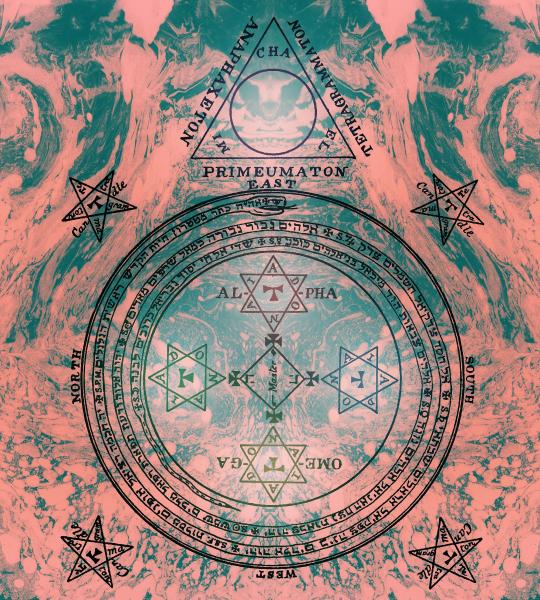


 Occult Aspects