“A witch is, actually, a successful (in the sense of surviving) deviant. You have a cultural, ideological, social, what-not pattern which is, for that society in question, normal (and, importantly, this is understood as a synonym for natural). Most people survive because they conform to these patterns, because they behave normally. […] But then suddenly you get a deviant which survives, and since it does not draw its support from the normal pattern, […] that deviant is understood as drawing its support from “unknown,” “supernatural” sources. […] If we cannot survive without our order, how can she [the witch] survive in solitude? Hers must be indeed a very powerful order to exist so independently, without all the inter cooperation and individual compromise which we have to go through to survive. And if it is so powerful, then it could destroy us. We must try to destroy it first.”
— Maya Deren, “From the Notebook of Maya Deren”, c.October 1947, vol. 14: pages 21–45.
Consciousness is something all of us share, or rather without it, we’d cease to exist. It is what makes us the most advanced species on this planet. Consciousness is the most simple and common phenomenon on this planet, yet in the hands of hardcore philosophers and mystics it has become the most complex one. So, the question I shall be answering today is — what is consciousness?
In short, consciousness is the basic awareness of being alive in any organism. It is the rudimentary biological phenomenon that enables an organism to respond to its environment. Every single organism on this planet has consciousness. And the higher we climb up the tree of life, the more complex and advanced the consciousness becomes. And the species that possesses the most advanced consciousness on earth is us, the Homo sapiens.
Consciousness has remained an enigmatic mystery for time immemorial, mostly by the exaggeration of the philosophers. However, with the advancement of Neuroscience in the last few decades, we have truly begun our journey to explore the true biological foundation of consciousness. And even though philosophers and mystics throughout the world want you to believe otherwise, the foundation of consciousness lies in the complex interplay of the brain circuits. Or in short, consciousness is born in your brain.
Human brain is the most complex organized structure in the universe. It is the biological organ with mind boggling capabilities. It is made up of a hundred billion nerve cells or neurons. And the relentless activity of these neurons gives rise to the fascinating phenomenon, which we call human consciousness. All our feelings, emotions, thoughts, ambitions, religious sentiments and even our sense of self are simply born from the activity of these little specks of jelly in our head.
Every living creature on this planet is conscious. It is the most common element of life. Without consciousness life doesn’t exist. Because consciousness enables a creature to understand the basic biological needs of survival. It is all in the nervous system. Even the plants have a kind of nervous system. The response of a plant to physical stimuli is a consequence of long range electrical signaling through the entire plant body. This is similar to the basic characteristics of the neurobiology in animals.
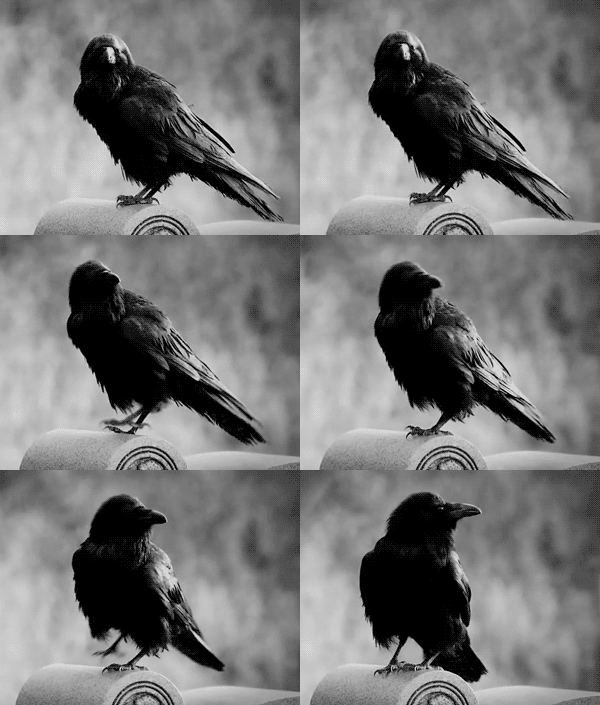
We can tell a lot about a creature’s level of consciousness by understanding their perception of death. For example, we see a fascinating behavior in crows concerning death. When a crow dies, other crows vigilantly gather around its body. They perceive the death of their fellow crow as murder. And their vigilance over the dead crow serves a significant purpose. By sticking close to the crow that was killed, other crows may improve their chances of learning about the predators that they need to avoid.
Human rituals for dealing with the dead are vivid and varied. While on the other hand, few animals show more than a passing interest in confronting a dead animal of their own species. For example, African elephants hold a funeral while touching and grooming a dead elephant. Similar behavior can be seen in bottlenose dolphins, chimpanzees and certain species of magpies. We are only starting to understand those behaviors and their level of consciousness.
In short, the more complex the neurobiology gets, the more advanced one’s consciousness becomes. And in humans this advancement has gone far beyond the primitive concerns of survival. So the bottom line is, your vividly conscious rich mental universe is simply a construct of your neurobiology. It is what makes you you. It is what makes you unique. It is what makes you attain unimaginable feats of excellence.
However, the air of mystery surrounding consciousness has provided the philosophers and mystics means for survival for ages, but as we neuroscientists keep on exploring further the mysterious domain of consciousness the majority of the philosophers feel threatened. Because the very existence of the philosophers and the mystics is predicated on their metaphysical approach towards explaining consciousness. Which means, the longer they keep it a mystery, the more they can manipulate the minds of masses with magical mysticism. The purpose of a scientist is to understand every single mysterious phenomenon of this universe, while the hardcore philosophers only attempt to sustain the mysteries as long as they can.
Every true scientist is a philosopher, but not every philosopher is a scientist. Philosophy enables us to imagine the infinite, while science helps us get there. As my dear friend and Mathematician Ronald Cicurel says “our brain works on hypothesis”. Here a hypothesis is nothing but a plausible future scenario that our brain simulates based on our predominant ideas, fantasies and beliefs. And then we start working on making that hypothesis a reality.
The point it, there is a fascinating mechanism behind everything in this universe. And we scientists attempt to understand those mysteries. Here one might say, it is typical materialistic perspective. While the reality is, there is no such thing as materialism. The very concept itself is an illusion. Our species evolved around 200,000 years ago in Africa. And we have spent most of our lifetime in the fear of the unknown. We have remained ignorant for thousands of years. And now that we have started to become the true master of the planet, and to reveal the secrets of everything that surrounds us, this very venture feels like a dreadful change to the masses. Thus, in order to sustain the mystery of the unknown, the concept of materialism was born in the human mind. Nobody is to blame here. It is plain subconscious behavior.
However, it is the responsibility of us scientists and all those young students of science to share our discoveries with the world in simple tasteful words. It is our responsibility to awaken the people into the new world of science and reasoning. The darkness of ignorance and fear only thrives in the absence of knowledge. Once the flame of knowledge is bright enough, there shall be no more darkness.
(This Article was first published on Goodreads.)
Further Reading Abhijit Naskar, 2015, Neurosutra: The Abhijit Naskar Collection Abhijit Naskar, 2016, What is Mind?
Human mind – what a fantastic phrase! It is the most fascinating biological operating system on this planet, that cannot be simulated on any computer no matter how advanced. Unlike a computer’s operating system, each human brain constructs its own unique operating mind, that later on drives the entire mental universe of that specific brain and none others.
In this brief article we shall dive into the various levels of human mind. These levels are commonly known as Conscious, Subconscious and Unconscious Mind.
Now, do not get baffled by the superficial terms. These sophisticated terms only look complex from the outside because since Neuroscience is still in infancy, we the neuroscientists have been busy ourselves studying the neurological roots of the mind. And what we have discovered is that underneath their blinding shine of sophistication, there lies plain human biology. The biology that constructs your mental universe.
In short, your Conscious mind is responsible for all your perceptual reality. It is the part of your consciousness that enables you to be aware of your environment as well as interact with it.
Now comes the subconscious mind. This one is the part of consciousness that in usual circumstances of your daily life remains hidden right below the surface of your conscious awareness. It is the mind where all your suppressed emotions and desires are trashed.
And in the end comes the unconscious mind. This part of your mind remains asleep throughout your lifetime at the bottom of your consciousness. It is the most primitive mental construct which you share with the reptiles. It holds an innate beast that has been there since your reptilian days.
Now, let me tell you about the amazing neurology behind all these levels of the human mind.
If I ask you, are you conscious right now? You’d go right ahead and tell me – yes. That’s because your conscious mind is constructing an awareness in you about everything around you. And underneath that operation of your conscious mind, there are billions of neurons working in proper harmony. Various brain regions work together to construct your conscious awareness of your environment. In this whole construction process, there are two brain regions that require specific mention. These are the limbic system and the frontal lobes of your brain. The limbic system is responsible for all your emotional responses, that are major elements of your conscious experiences. And the frontal lobes, or more specifically the prefrontal cortex acts as a filter for those emotions as well as your behavioral responses. Emotions and behaviors that the prefrontal cortex deems inappropriate, never reach the surface of your conscious mind. Hence, they are trashed into the depth of your subconscious mind. They remain hidden in the depth of your limbic system.
Over time the pile of subconscious kinky desires and repressed emotions gets heavier. And if this junkyard of your subconscious mind is not cleansed every now and then by bringing the repressed emotions up to the surface of the conscious mind, then it would start affecting the mental and physical health of a person. All the repressed emotions and subconscious desires in time lead to some kind of psychological or physiological breakdown, if kept unchecked. It is what we call Conversion Disorder in clinical terms. Previously it was known as Hysteria.
We get to know the essentials of hysteria from the joint work of Josef Breuer and Sigmund Freud, known as Studies in Hysteria first published 1895. The book contains an introductory paper and five individual studies of hysteria – Breuer’s famous case of Anna O. and four more by Freud. But the condition of Conversation Disorder or Hysteria dates back to Ancient Greece.
It can happen to anybody. However women are more prone to having hysteria than men, because of their innate monthly hormonal storms. The harder you try to keep your feelings inside, which you think as inappropriate to express, the more vulnerable you become to conversion disorder symptoms.
Does this mean, you should just express every single inappropriate feeling and desire of yours in public? Off course not. I am not a psycho psychologist to suggest you that.
But here is another way to keep your subconscious mind light and with less junk. You just need to clean your subconscious sewage drain with a close friend or your romantic partner every now and then. You just need to talk your feelings out to someone close. It is that easy. Just spit all of it out, whether it is sorrow, anger or kinky sexual thoughts. It is better to express your repressed feelings to a friend for free, than to pay thousands of dollars to a psychiatrist for the same emotional outburst later in life. You can read more about the emotional domain of the human mind in my book The Art of Neuroscience in Everything.
Now comes the unconscious mind. This part of your Mind goes back millions of years to the reptilian days in our evolutionary history. Several ancient regions of the limbic system house this primitive side of your mind. It holds some of the basic instinctual behaviors such as aggression, territoriality etc.
This primitive part of your mind gives rise to those emotional and behavioral traits that never go well with the modern norms of the society. These traits assisted our hominid ancestors to survive in the wild. But today in this civilized world, that monster from our primeval past is kept strictly dormant under the watch of the frontal lobes of your brain. However, in times of utter distress, this beast wakes up and takes hold of your conscious mind and responds in the form of fight or flight. And when it comes out, it actual enables you to tackle a life and death situation in a way, that you can never do with your usual state of consciousness.
For example, we have countless reports of parents lifting vehicles to rescue their children in life and death situations. In these incidents the primeval beast inside otherwise ordinary people lashed out to save their dear ones. And that fight or flight response resulted in an incredible strength which we call hysterical strength.
Thus, though I am calling this ancient part of our consciousness a beast, I am calling so, considering its beastly features. And if such life and death situations occur, that beast is our nearest biological hope.
So, as you can see, all your conscious, subconscious and unconscious realms of the mind have their own basic biological features. They function in proper harmony with each other to give you a rich mental universe. And now that you know how they function, you can make your mental universe even richer and healthier.
In January 2006 in New York, the patient of a well-known psychiatrist draws the face of a man that has been repeatedly appearing in her dreams. In more than one occasion that man has given her advice on her private life. The woman swears she has never met the man in her life. That portrait lies forgotten on the psychiatrist’s desk for a few days until one day another patient recognizes that face and says that the man has often visited him in his dreams. He also claims he has never seen that man in his waking life.The psychiatrist decides to send the portrait to some of his colleagues that have patients with recurrent dreams. Within a few months, four patients recognize the man as a frequent presence in their own dreams. All the patients refer to him as THIS MAN. From January 2006 until today, at least 2000 people have claimed they have seen this man in their dreams, in many cities all over the world. At the moment there is no ascertained relation or common trait among the people that have dreamed of seeing this man. Moreover, no living man has ever been recognized as resembling the man of the portrait by the people who have seen this man in their dreams.
THEORIES Several theories have been developed to explain the mysteriously recurring presence of this man: 1. ARCHETYPE THEORY According to Jung’s psychoanalytic theory, this man is an archetypal image belonging to the collective unconscious that can surface in times of hardship (emotional development, dramatic changes in our lives, stressful circumstances etc.) in particularly sensitive subjects. 2. RELIGIOUS THEORY According to this theory this man is the image of the Creator, that is to say one of the forms in which God manifests himself today. 3. DREAM SURFER THEORY It is the most interesting theory and the one that has the greatest implications, but it has also the lowest scientific credibility. According to this theory this man is a real person, who can enter people’s dreams by means of specific psychological skills. 4. DREAM IMITATION THEORY This is a scientific psycho-sociological theory which claims that this phenomenon has arisen casually and has progressively developed by imitation. Basically when people are exposed to this phenomenon they become so deeply impressed that they start seeing this man in their dreams.
Dreams can be a compass when you’re doing workings which fall outside of reason or logic.
For the past little while I’ve been in the midst of magical operations which work on very subtle aspects of my self.. The goal is essentially to discover the true nature of myself, my true will you could call it. To align my conscious self with my unconscious.
The great difficulty with this is that anything you can consciously think of is filtered through both the true will and the false will. The “me” who is deep inside is always present but by the time anything reaches my conscious mind it is muddled with all the imprints and conditioning that I have accumulated in life.
In a situation like this you can’t trust a single thought that comes into your mind. Any one of those thoughts could be a traitor in the mix, even the ones which seem like brilliant ideas. In fact, the ones that seem like brilliant ideas turn out to be traitors quite often.
How do, then? How do? Luckily we have an avenue in which the true self gets more control than our conscious self. Dreams. As Crowley has stated in Liber Aleph the places, characters, and objects in our dreams are often results of our conscious experiences. Yet the feeling of the dream, the events, and arrangements of symbols are all aspects which the unconscious takes control of.
Ecstatic dreams signal that we are coming closer to our true will in the area of the topic that the dream was based on. Terrifying, sad, or violent dreams are signals that we are moving far from our true will.
As an example if you have a dream about your love life in which you are filled with anxiety, and the events of the dream are violent, then your approach to love is coming from a position of false will. If, on the contrary, you have a beautiful and enjoyable dream about love then your perspective on love is in alignment with your True Self (or unconscious self).
This allows us to tiptoe around the traitors Reason and Logic. It allows us to receive messages, more or less directly, from our unconscious.
The transmission may be partially delayed, but that is a small price to pay for a tool which allows you to avoid all the wretched confusion the thinking mind creates. Personally I’d rather make slow progress towards the right destination instead of taking leaps in random directions and hoping I end up at the right place.
The 4 temperaments are 4 distinct natures of behavior. These temperaments are found in the understandings of humorism, and are one of the oldest personality type systems. It was used in ancient greek medicine, and was first described by Hippocrates a greek physician who is known to be the father of western medicine. These temperaments are a way of looking at the behaviors that different people had based off the amount of these different humors they had in their body. The four humors were blood(Air), yellow bile(Fire), black bile(Earth), and phlegm(Water), these four humors were seen to be 4 physical substances that were present in the body, and were greatly associated with the four elements.
The four temperaments are known as sanguine(Air), choleric(Fire), melancholic(Earth), and phlegmatic(Water), which one you are is determined by which humor you have the most of in your body. Usually people will have a mixture of these temperaments with two of them being the most prevalent, though one of them will be predominant, and the other will be secondary. Most people are going to have mix temperaments, but you are also able to have a pure temperament. A pure temperament is when you have a high extraordinary amount of a single temperament, so much so that you are that temperament word for word. Everybody has different levels of these humor’s in their body, which allows everyone to have a different form of behavior, and nature.
I do not believe in the 4 humor substances as physical forms except for some of their scientific counterparts, but I see them more as philosophical, and spiritual understandings of elemental balances as related to the body. I see the 4 humors as elemental balances of nature that are present on a spiritual, mental, and physical level with the 4 temperaments being manifestations of the humors on the mental level. I see this system as a more esoteric, and occult way of looking at the behavior, and nature of an entity from an elemental perspective.
Sanguine:
The temperament of sanguine is connected to the humor of blood. It is connected to the element of air, and has the 2 qualities of hot, and wet. It is a masculine temperament, and tends to be extroverted.
Sanguines are very sociable, and optimistic. They primarily enjoy having fun, and not taking life too seriously. Sanguines tend to not be able to get along with the people who are not open to there entertaining. They are prone to overindulgence, and pleasure-seeking, and because of this they do engage in thrill-seeking, and more risky behaviors. Sanguines are incredibly charismatic, and are able to form relationships very easily because of this. They seek variety, and entertainment to relieve boredom, and to make their experience interesting. They can be quite competitive with others, and actively enjoy winning. Sanguines are very open with their emotions, even though they can have difficulty with too many thoughts, and feelings coming up at once. They are very conscious about what other people think of them, and like to make good impressions, and to not be thought of as unsuccessful.
Positive traits: Lively, carefree, outgoing, charismatic, entertaining, composed, flexible, adaptable, enthusiastic, active, fun-loving, playful, activity-prone, persuasive, communicative, and social
Negative traits: Lack of deep understanding, nonserious, distractible, disorganized, and naive
Choleric:
The temperament of choleric is connected to the humor of yellow bile. It is connected to the element of fire, and has the 2 qualities of hot and dry. It is a masculine temperament, and tends to be extroverted.
People who are choleric like to be with people who are supportive, and cooperative, and because of the state dislike laziness, and disloyalty. They have many leadership qualities and enjoy leading a group and taking charge. They are extremely practical, and straightforward. They are very social, and seek to contribute to the community. They are very good at forward movement, and can easily and insightfully overcome obstacles in order to accomplish their goals. People that are choleric are good and making decisions for themselves and others. They are also visionaries who have many different dreams, goals, and ideas in which they would like to reach.
The temperament of melancholic is connected to the humor of black bile. It is connected to the element of earth, and has the 2 qualities of cold, and dry. It is a feminine temperament, and tends to be introverted.
People that are melancholic is analytical, detail oriented, and are deep thinkers and feelers. They pay attention to every detail and think over everything. They have compassion for those in need, and have high standards, and ideals. They dislike forgetfulness, tardiness, superficiality and unpredictability. They take life too seriously, and try to plan out every little thing, and enjoy trying to achieve their own subjective perfection. They dislike small talk, and enjoy deep, and meaningful conversations. They are quality oriented. They enjoy their privacy, and use their privacy as a place to think, and to plan out what they are going to do before they do it. They can have anxiety and guilt for the present and future for things that they have done, and are going to do. They spend a lot of time making decisions, and gathering a lot of information to decide what are right courses of action for them to take. They may easily get lost in thought, because of all the information that they are analyzing. They also may ask the same thing multiple times to make sure that they are correct, and what they know. They want reassurance, and feedback a lot of the times to help them make decisions more easily, and to feel justified in what they have done, or not done. They fear being seen as incompetent, and will try to avoid being seen as such.
Negative traits: Pessimistic, perfectionist, conscientious, picky, moody, and sensitive.
Phlegmatic:
The temperament of phlegmatic is connected to the humor of phlegm. It is connected to the element of water, and has the 2 qualities of cold, and wet. It is a feminine temperament, and tends to be introverted.
Phlegmatic people are good at generalizing ideas or problems to the world. They seek interpersonal harmony, and close relationships. They do not like people who are too pushy, and they also avoid conflict in all aspects of their life. They are sympathetic and care about others, yet try to hide their emotions. They are great at making compromises, and are quite logical, and intuitive. They are not very ambitious though they may have things they strive for, and because of this they may lack a sense of urgency. pragmatics are some of the easiest people to get along with, because of their very calm, relaxed, and not imposing nature, unless you ask them to change. They tend to reach for a more calm, and sustainable lifestyle of routine, and people they are close to. They enjoy going with the flow, and allow life to carry them where it needs to. They are possessive of their friendships, and material things. They usually have a couple of close friends, and are very loyal to those close friends. They also tend to be the person who never will break a friendship. They avoid conflict and resist change. Phlegmatics are also great thinkers, and are very practical, and logical.
Positive traits: Meticulous, composed, collected, calm, good team player, practical, logical, easygoing, patient, agreeable, relaxed and peaceful
Negative traits: Lack of enthusiasm, unemotional, indecisiveness, lack of energy, and procrastination
So, we always hear about what colors correspond to what types of holidays, rituals, and times of year. However, what do the colors themselves mean?
Well, buckle up because you’re about to find out.
Black
Many people associated black with evil or malintent, however it can mean quite the opposite. Some common meanings and uses of this color include:
– Removing Negativity, Banishing, and Cleansing
If you feel there is a negative energy or spirit in your or someone else’s house, life, mind, or anything else you can think of, black is the color to use. Even though black is usually seen by TV shows and books as the “evil” color, it is actually quite useful when it comes to removing negativity.
– The Unconscious
Think of your mind as a house. Your conscious being is illuminated, similar to a kitchen, living room, or bedroom. You know where everything is and you can see it. Your unconscious would be the attic or the basement: dark, mysterious, and sometimes you’re afraid to delve deeper. Black represents the darkness found in the unconscious, helping connect you to the mystery of the untouched parts of your mind.
– Releasing
If you have pent up emotions that you need to release, black can help you get there. I personally think of it as a vial of ink, bottled up words yet to be written with countless stories and possibilities, that is knocked over, spilling ink all over, releasing everything it holds within it’s black sheen.
– Focusing and Finding Your Center
Black is a firm color, remniscent of deep, rich soil. It is a firm ground you can always turn to whenever you feel lost. Within it you can find yourself and countless reasons to hold on.
White
– A Substitute
So, this is kinda basic. Yeah, I know. But white makes a great substitution for any color you don’t have access to, as white light is the combination of all colors. Essentially, don’t feel like you have to spend money to procure, let’s say, an orange candle for a specific ritual. As I like to say, if you have white it’s alright.
– Purification and Innocence
White is a pure and innocent color, simple yet powerful. Use it when you want to clean energies—not banish negative energies, but rejuvinate old, positive energies—or when you want to reminisce on simpler days.
– Spirituality, Higher Power, and Enlightment
White is the color to go to when seeking guidance from general spirits and general higher powers/energies. However, if you are working with specific entities or deities, make sure to check to see if they have their own color correspondences.
Silver
– Stability
If you feel your life is chaotic and just want to have some stability in your life, silver is the color to go to. A spell or a ritual involving the color, or visualizing it while doing a ritual, can help bring a balance to whatever you are working with.
– Neutralizing and Removing Influences
Silver is another good color when it comes to removing any influences in your life, whether they are negative or just plain annoying.
Gold
– Wealth and Financial Gain
If you want to bring luck to your life, especially when it comes to money, gold can help you get there. Creating a sigil with a gold marker or pen can help add that extra financial flair you’re looking for.
– Persuasion and Confidence
When I think of gold I think of warmth, excellence, and golden rays of sunlight. These remind me of a certain confidence we all hope to have one day; we can become our own beams of sunshine. Using the color gold can help boost your confidence and your persuasion skills by showing people the light within you.
Pink
– Love, Romance, and Friendships
When performing a love spell, whether it deals with self love, romantic love, platonic love, or familial love, use pink. It is a color that just pours its love and affection out, and using the color can help your harness that energy.
– Anxiety and Depression
Now, when you see anxiety and depression as two of the meanings, you may be confused. However, pink is a color that heals the soul, and it can help lower the feeling of dread that can overwhelm you at times. (Please know, that going to a professional therapist and doctor is ALWAYS the first step, not a spell, no matter what medical affliction you may have. Witchcraft is an aid, not an answer.)
Purple
– Magical Abilities
Purple is the color often used to represent magical abilities as a whole. With it comes an energy that feels unlike anything you’ve felt before, something truly amazing. Embrace that energy and you will find that a whole new world will open before your eyes.
-Sleep and Dream Magick
If you want to create a spell to cause certain dreams or to aid your sleep, purple is the color to use. It is reminiscent of the many worlds our subconscious creates for us when we let the curtain of sleep take over us, an endless world of possibilities.
– Meditation and Astral Projection
When meditating or trying to astral project, it may be useful to visualize the color purple flowing throughout you like a cosmic energy. Let it bring you closer to what you once thought was too far away to access; let it bring you closer to the stars.
– Wisdom and Inspiration
If you require wisdom or inspiration, whether it be in witchcraft or some other aspect of life, the color purple can help you get there. It is a creative color, as shown through it’s association through dreams and overall magic, let it guide you to a solution. Often if I am working on homework that requires a little bit of creativity and hit a block, I’ll get out one of my purple pens and start doing the work with that, letting the ideas flow through me and onto the paper. This isn’t limited to just writing or art, however, as even math and science require a creative mind.
– Power
Purple has long been the color of royalty and power, and it can be used as such in your spells. Use it to increase the power of any spell that you wish to perform.
Blue
– Water and Weather
When working with either the element water (whether in a symbolic sense or you’re working with an elemental) or working with the weather, use blue to connect you to these wonders of nature.
– Harmony and Peace
These meanings trace back to water, taking water’s calm and sharing it with the world. Think of it as sitting on the beach, letting the cool water gently caress your legs as you think about the amazing life you’ve been given. Within the blue seas you find peace and harmony, let is seep into your soul and your life.
– Loyalty and Protection
Blue represents loyalty and protection. Use it in spells involving protecting yourself and others, as your loyalty to your friends goes hand in hand with protecting them.
– Mind and Inner Light
Almost a cross between purple and gold, blue is another great color to connect to your mind and share your light with the world.
Green
– Earth and Nature
If you wish to connect more to our planet in a ritual, use the color green. Think of the grass, the forests, and all of the other life sprawling across this planet.
– Money and Abundance
If you want to make sigils or spells to draw money to you, use a green candle, pen, paper, or whatever tool you may be using.
– Headaches, Colds, and Nervousness
Green can help remedy ailments. Think of the Earth taking you into her arms, soothing you of all of your pain. Use green when doing spells and rituals to calm your mind and sense. (If you have chronic migraines and headaches, please go see a doctor. They will give you prescription medicine to help, and it’s what I use whenever I get a bad mirgraine, not a spell.)
Yellow
– Spirits and Realms
If you need to contact a spirit or any entity from another realm, yellow can be useful. I will say that personally I rarely use yellow when contacting spirits, however I know many people who do and it significantly helps.
– Air
Since air is something that we cannot literally see, yellow is the color often used to respresent the element.
– Intelligence and Learning
Yellow is a great color to use for spells when it comes to studying for school and doing well on tests. Sometimes I’ll draw sigils in my yellow pen when I’m freaking out about a test.
– Skin, Stomach, and Menstrual
If you’re doing any spells or rituals dealing with these parts of the body, use yellow in your tools to enhance its effects.
Orange
– Control and Authority
If you need to increase your control over certain parts of your life, orange is a great color to use. It’s a powerful color with a mind of its own and you can use it to show others you have those traits, too.
– Sudden Change and Adaptability
Orange can help you deal with change, similar to the season fall, where the temperatures drops and all of the green changes to orangey hues. Imagine yourself as a strong oak who is not going to deny change and embraces it instead.
Red
– Fire
Strong, powerful, and unpredictable, red is the color representing the element fire.
– Passion and Sex
Being two of its most common associations, passion and sex are fueled by red’s flame. Any spells and rituals dealing with increasing passion in your love life can use red to help increase its effectiveness.
– Life, Birth, and Death
Red also represents the phases of life, so if you want to make a spell dealing with age or death, red is the color to use.
– Blood
Any blood magic should include the color red. However, blood magic is VERY advanced and VERY dangerous, so please wait until you are very experienced and make sure to stay safe when doing any such magic.
– Health, Strength, and Vigor
Any general spells dealing with someone’s well being and strength can use red to help increase it’s effects. This ties in with blood, as it is the key to our physical bodies.
Well, if you’ve read through all of this thank you so much! I just want to state that these are not the only meanings, just some, and everyone has their own personal correspondences.
The conscious, subconscious, and unconscious are different levels of awareness of the mind. Each one of these levels has their own specific job as it relates to the rest of the mind, and they all work together in order to facilitate the connection of awareness between specific information that is taken in through events.
Conscious mind:
The conscious mind is the mind that we are aware of. It is our focal point of awareness that are mind uses to perceive our surroundings, and our present thoughts. The conscious mind does not run the show, and is just a perceiver of the events that are happening, and because of this the conscious mind will you receive most of its information when needed from the subconscious mind. This is also the home of the ego, which chooses the content in which the consciousness will interact with, and will act as a gatekeeper for information, and experience. The ego also chooses what gets repressed and sent to the unconscious mind.
Subconscious mind:
The subconscious mind also sometimes known as the preconscious mind is the mind that we are semi aware of. It runs in the background so we are not completely focused on it, and we can choose to recall information from it in order to bring that information into our present consciousness. It is the place where we store, and receive data for later. Things such as our memories, beliefs, values, mood, emotions, behaviors, and our perceptions that we are not focusing upon stay within our subconscious mind, unless we focus upon it with our consciousness. The subconscious mind is in direct connection with the unconscious.
Unconscious mind:
The unconscious mind also sometimes known as the personal unconscious is the mind that we are not aware of. The unconscious is the deepest part of the personal mind. It is the place that communicates with us in our dreams. The unconscious mind can reluctantly share information to the subconscious mind, so that the conscious mind can receive it though this will only happen in certain circumstances such as dreams, or when these understandings are triggered by certain events. The unconscious mind can also be brought up through specific types of methods such as meditation, and hypnosis, and it is these understandings that give birth to shadow work. The unconscious will store unacceptable, or unpleasant things that we have repressed that causes us pain anxiety, and conflict things like hidden feelings memories thoughts, and desires, which is usually known as the shadow. other things that have just been forgotten, or were not important enough to be remembered also end up in the unconscious mind. A lot of the understandings that are stored here are the fundamental roots of your understandings, beliefs, and values and your justification for believing in such things, because of this your subconscious is always running the show from the background even when you don’t know it.







 Occult Aspects