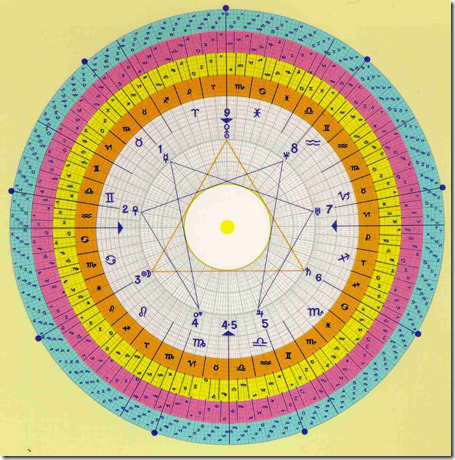
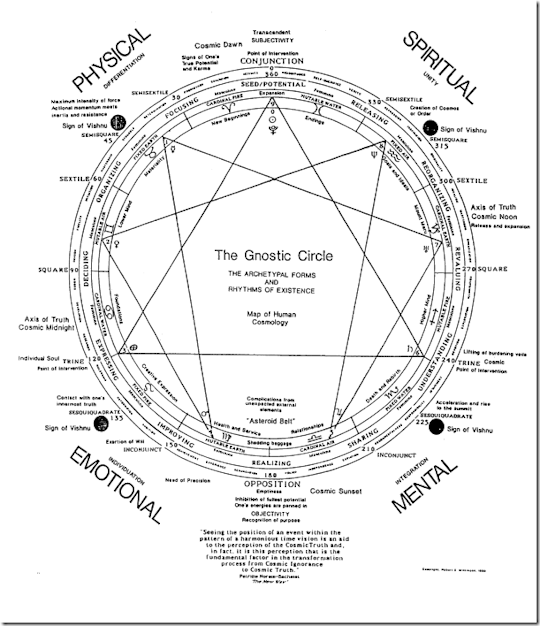
The Gnostic Circle is an alchemical Key of knowledge from the Vedic
texts of ancient India revealing the primary role of Time in our
developmental process. Most astrological systems are oriented toward
the individual’s egoic development, but the Gnostic Circle provides a
means by which we can perceive the imperatives of the Soul and its
hidden but primary influence in our lives. It is the unifying
element of a complete astrological work-up which helps us to understand
the cyclic nature of our developmental process; where we have been in
the past, where we happen to be at the present moment and what we are
moving toward in the future.
“The Gnostic Circle is the most effective method for understanding
the transformation of human consciousness. It represents a vision of
wholeness and has only one objective: it deals with the soul or seed of
the divine in each created thing and reveals the process by which that
seed is made to flower in its process of becoming.” – Patrizia
Norelli-Bachelet
Used in conjunction with the practice of yoga, the Gnostic Circle
reverses the long-standing perception of Time as the destroyer and
presents mankind with an entirely new awareness of Time as the
integrative mechanism by which a Divine purpose is expressed in the
world, thus it contains the highest wisdom of our age.
“The Gnostic Circle allows us to measure the progression of any event in time. And it provides the means of assessing an event’s relevance to time and place within a global and universal context. Above all, it permits us to appreciate the interconnectedness of events through a unified, spherical approach to Time. The
Gnostic Circle is a yardstick which can be applied to any event and by
which that event or object may be made to reveal its intrinsic nature
and objective value. In ancient literature and tradition, such a tool was sometimes referred to as the Golden Rod, or the Philosopher’s Stone. Its
value resided in the fact that because of its special relation to Time
and Space, it could provide an objective means to assess the
truth-conscious substance of any given situation or event or object. In
a word, it could objectively reveal the element’s inner pulse and place
within the greater harmony of life on Earth and within the solar
system.” The Vishaal Newsletter, – Oct 30, 1991
For each person there are two ways of being in the world, two
existential situations critical to our perception of life and reality.
The first and most common is an experience of the world from the historical perspective of linear time.
The second, and more rare, is the direct perception of non-linear time or cosmic cycles.
These modes of awareness represent two different worlds, one within the other. Non-linear
or sacred time appears under the paradoxical aspect of whole time, an
eternal present which is connected with man’s deepest spiritual
dimension. It is based upon a perception that time does not proceed
endlessly in a straight line. Rather it is always and everywhere a
closed curve, although from our ordinary perception, we do not see that
it’s movement is either curved or closed.
To move beyond the illusion of linearity and recover a realization of
whole time one must undergo a process of yoga which illumines the
cyclical nature of the life experience. This is most easily achieved
through the application of a cosmological model which highlights
certain essential relationships between man and the universe and which
unveils a common center. In ancient times these cosmological models
were based upon the known universe which was believed to consist of six
planets and a central Sun. It was not until the 20th century, following
the discovery of Uranus, Neptune and Pluto, that the complete
cosmological key could be revealed and man’s integral transformation
fully understood.
In ancient India, as in all other traditional societies, the
unveiling of this axis or ‘center’ was achieved through a disciplined
study of the archetypal language contained in the zodiacal hieroglyphs
and a knowledge of the principles of the Cosmic order. Once these
foundations are laid, one’s lived experience becomes revelatory. The
awareness gradually shifts from the ordinary linear perspective of past,
present and future to an experience of time as a cyclical developmental
process. As the individual lives and repeats these cycles of whole
time, he becomes imprinted with their order and aligned with their
harmonies. The axis of his being gradually shifts from the pivot of ego,
to a higher perceptual center. For it is by observing the cycles of his
own microcosmic process, that man comes to know the macrocosm and the
principles of its evolution. In the Veda, this realization is known as SWAR or Truth-Consciousness, and grants the seeker a direct and unequivocal perception of Unity.
‘The Gnostic Circle is merely the combination of the zodiac – the
occult circle which contains the knowledge of the evolution – and the
structural pattern of the solar system. The Circle of 12 is the zodiac,
and the Circle of 9 is our actual solar system, each orbit representing
one year of Earth life. The joint harmony of these two, superimposed or
synthesized in one circle, is what constitutes our key to the evolution
and flowering of the seed of the Spirit. In fact we can say that the
Gnostic Circle is mainly for this purpose. It shows mankind the ultimate
and ideal perfection that can be attained during this particular phase
of the evolution, during this great transition point from animal-mental
to the more divine mankind.’ – The Gnostic Circle p. 159, 1975, Patrizia Noreill-Bachelet
The tetractys also known as a tetrad, the mystic tetrad, the tetractys of the decad, and the pyramid of emanation is a equilateral triangular figure consisting of ten points arranged in four rows. The Tetractys is a reality map that can be used to understand more about existence through the connection, and relativity of the points, or emanations that make up it. The Tetractys is a geometrical representation of the fourth triangular number in mathematics, and creates a perfect equilateral triangle. It is also connected to pythagoreanism, which is the teachings, and beliefs held by Pythagoras, and his followers, who saw the symbol as very important mathematically, and philosophically. Pythagoras understood that the tetractys was a symbol of the musical, arithmetic and geometric ratios upon which the universe is built, and because of this it was considered sacred geometry.
The first row consists of 1 point, the second row consists of 2 Points, third row consists of 3 Points, and the fourth row consists of 4 Points. The Tetractys is a combination of the monistic understanding of source, the dualistic system of the metaphysical law of gender, the triadistic system of the three principles of alchemy, and the tetradistic system of the 4 western classic elements. All of the points of the tetractys add up to ten, which corresponds to unity, completion, and higher order, and makes the Paradigm a decadistic system.
Monistic:
The Monistic row of the Tetractys represents:
Source
Monad
Unity
Singularity
Divinity
Divine wisdom
This is the first point of divinity where all other emanations are created from. It represents all the raw power of being, while also acting as a divine essence of everything.
Dualistic:
The dualistic row of the tetractys represents:
The Dyad
Masculine/Feminine
Creation/Destruction
God/Goddess
Yin/Yang
Love/Strife
Light/Darkness
Activity/Passivity
Limit/Unlimited
Peras/Apeiron
The dualistic row of the tetractys is the first separation of the whole, and the beginning of motion. Where two forces of the whole push against each other changing, creating, and destroying as they do so.
Triadistic:
The triadistic row of the tetractys represents:
Sulfur, Mercury, Salt
Mother, Child, Father
Body, Mind, Spirit
The triadistic row of the tetractys separates out the states of being, and the canvases in which the universe will be painted upon.
Tetradistic:
The tetradistic row of the tetractys represents:
Fire, Air, Water, and Earth
Hot, Dry, Wet, and Cold
The tetradistic row of the tetractys is the separation of the core aspects of existence mostly being elements, and qualities that make up everything, and put the rest of existence into being.
I have already mentioned
that Anaximenes considers Air to be the First
Principle (Arkhê) of the cosmos; it
is infinite, eternal, ever-moving and divine; he
calls Air the Father of the Gods (which recalls
Zeus’s common title: Father of Gods and Humans).
Anaximenes also says, “Just as our Breath-Soul
(Psukhê), being Air
(Aêr), governs us, so Spirit-Breath
(Pneuma) and Air (Aêr)
encompass the whole cosmos.” This suggests that
the governance of the cosmos is accomplished by the
Spirit-Breath of the World Soul. Indeed, Philemon
says that Air, who is called Zeus, knows everything
done by Gods or mortals, because He is everywhere
at once. So also Empedocles points to the God’s
subtle nature: "He is a Spirit-Mind
(Phrên), holy and ineffable, and
only Spirit-Mind, which darts through the whole
cosmos with its swift thoughts.“ (Note that the
term translated Spirit-Mind, Phrên,
is the singular of Phrenes, Breast.) Here
again we see Air as a medium of communication and
governance, but on the cosmic scale.
However, just as we all breathe the same Air,
and the Air in my breast is continuous with that in
yours, so also the World Soul is continuous with
individual souls (an idea we also find in the
Upanishads, where Brahman, the World Soul
identified with Prâna (Breath), is
identical to Âtman, the individual
Life-breath). As the nervous system integrates the
activities of individual organs to work for the
sake of the organism, so the Air binds our
individual souls into one World Soul. Microcosm
and macrocosm unite.
Philo of Biblos (64-140 CE) translated a
“Phoenician History,” which was supposed to have
been written by Sanchuniathon before the Trojan War
(which is not unlikely) and to be based on Egyptian
scriptures attributed to Thoth. According to this
myth, in the beginning there was a Primal Wind, a
breath of mist and darkness (i.e.
Aêr); also there was
Môt, the muddy chaos of Erebus
(khaos tholeron Erebôdes), that is,
the formless Primal Mud. The Primal Wind
fertilized itself and became Desire
(Pothos, perhaps corresponding to Semitic
Rûah, which means Breath but also
connotes Desire). Further, Môt became the
Cosmic Egg, and the cosmos was born when Desire
opened the Cosmic Egg (as also in the Orphic
cosmogonies), which led to a separation of the
Elements.
According to Eudemus (4th cent. BCE), the
Phoenicians who lived in Sidon also believed that
the universe was born of Air. In the beginning was
Time (Khronos), Desire (Pothos)
and Fog (Omikhlê). Desire and Fog
united, giving birth to Aêr and
Aura (Moving Air).
~Do not make the mistake of supposing that the little world you see around you–the Earth, which is a mere grain of dust in the Universe–is the Universe itself. There are millions upon millions of such worlds, and greater. And there are millions of millions of such Universes in existence within the Infinite Mind of THE ALL.~ The Kybalion
In
retrospect, the clusters of stars that represent the twelve zodiacal
signs of the macrocosm are like organs of the digestive, circulatory,
respiratory, reproductive, endocrine, and nervous systems of the human
being, the microcosm. They are all associated with different formative,
vital and archetypal energies, just like the various operative and
anatomical systems of the human body are all responsible for the
mediation of different tasks. The passage of the solar orb through the
physical space of each zodiacal cluster ensouls the archaeus or
“ethereal tissue” of its corresponding disposition which in turn
vibrates at the frequency of the physical world and energizes all living
and evolving forms of matter. Naturally, the presence of the qualities
characteristic of the vital force in the end product itself is a
vindication of this hidden transmutational process and a teleological
exponent of tidal interactions between the energetic macrocosm and its
constituent, the receptive microcosm.
The
force working through each zodiacal sign is at its apogee during a
2150-year period in which the stars of its constellation occupy the
vernal point of 21-22 March, a time when the formative forces of Mother
Nature have regenerated enough to infuse life back into our hallowed
planet. This is made possible through slight changes that occur in our
planet’s rotational axis known as axial precession, or precession of the equinoxes.
Those untutored to astronomy would be unfamiliar with this phenomenon,
and so it is quite necessary to engage brief explanation here. Most
people know that the axis of our earth is not vertical but tilted on an
angular radius of 23 degrees 27 arcminutes, an obliquity which generates
seasonal rotation as the solar orb seemingly ascends and descends 23.5
degrees from the equator over the course of the year. During this time
it will cross over the equator twice; these occurrences are called
equinoxes. As the sun rises on the day of an equinox it sluices through
an intersection formed by the celestial equator and the ecliptic. This
is otherwise called the vernal point, which is not fixed but shifts by
about a degree every seventy-two years due to rotational wobble of the
earth’s axis. It takes a period of about 26,000 years (the Platonic
Year) for the axial pole to trace out an imaginary circle around the
ecliptic pole on a radius equivalent to the axis and return to the same
spot. The direction is retrograde to the earth’s daily rotation. Save
for changing the coordinates of stars and constellations which would
otherwise seem fixed into the heavens from the perspective of an
observer, the volatile movement allows the vernal point to inhabit a
zodiacal constellation for a period of about 2160 years before moving
onto another. Hence if the vernal point were in Cancer it would
subsequently moves in an opposite direction to the sun through Gemini,
Taurus, Aries, Pisces, Aquarius, and so forth.
What this phenomenon of axial precession
tells us is that our concept of time is eternal but measurable and
divisible as well. The primary measurers of this human construct are the
twelve constellations, star clusters associated with archetypal
energies that possesses, overwhelm and empower the sentient earth and
all consciousness. From a metaphysical standpoint, the transpersonal
force whose configuration of stars inhabit the vernal equinox achieves
full expression and activation, and will dominate the filtration of
vibrations leaking into the physical zone until the said annual
coordinate passes into another zodiacal sign. Each transpersonal power,
then, rules the vibratory composition of the physical plane for 2160
years, forfeits the position to the adjacent neighbor behind it, and
recaptures this privileged and glorious cosmic position after 26,000
years. Evidence for the validity of what might be described as an
astro-metaphysical phenomenon can be sought in the history of human
consciousness itself.
Taurus, for instance, a sign ruled by Venus and exalted by the moon, inhabited the vernal point between 4380 and 2220 bce.
The aforementioned planetary spheres embody formative forces whose
spirits are wholly feminine, and looking at the state of consciousness
prevenient on our planet at the time automatically vindicates the
paraphysical-physical connection. Anthropological studies reveal a
matriarchal situation in which human consciousness was fundamental
tribal in nature, driven by collective concerns; the individual “souls”
comprising the tribes themselves were imbued by receptivity and
intuition; their minds, on the other hand, were impressionable,
free-thinking, and all-embracing. Their sense of knowing was guided by
raw instinct rather than sense-based rationality and deductive
reasoning. This more tranquil mode of being facilitated an understanding
of the cosmos that has long been under rug swept and forgotten; as the
cause and origin of all life, Nature is the Great Mother Goddess whose
variegated, diverse forms are first-hand evidence of teleology and
meaning, the latter imminent when the relationship of all created forms
to one another is finally contemplated. An earth-based spirituality
works with created Nature, celebrating it through the medium of
unconditional engagement, artistic expression, reenactment, ritual,
transcendence, dance, and anything that might facilitate the impetus of
creation. There can be no greater advocate of this holistic, lunar or
right-brain consciousness than Minoan Crete, a Bronze-Age culture whose
unprecedented artistic and engineering feats were motivated by
everything feminine under the watchful gaze of the omniscient Taurian
eye.
Sadly
the situation was to change rather prominently with Aries, a zodiacal
sign that ruled the heavens and the earth between 2220 and 60bce.
Aries is ruled by Mars and exalted by the Sun, two planetary bodies
which channel a fiery, seedy, and visionary masculine energy of becoming
and differentiation. The energy effected a fundamental change to human
consciousness, now driven by a fully-developed ego that perceives itself
in relation to the Goddess-Self, or God-Self I should say. While in
feminine lunar consciousness the unconscious will was driven by
collective interest, ego-based consciousness shifted the soul’s axis of
rotation to a much more selfish gradient now addressing individual
desires, its self-serving needs and wants. This, in turn, forced a
catastrophic shift in perception of what encompasses the divine, now
understood as the subjugation, ensnarement and destruction of Mother
Nature and its conscious extensions. The impulsive and violent acts
themselves were made possible by the forgery of the Martian metal, iron,
which branded new weaponry including spears, swords, and war chariots,
revolutionized combat, and contributed greatly to the industrialization
of the entire planet. Gone was the earth-base spirituality of respecting
and venerating the bonds of life; the new, scarlet-colored ego of
humanity erroneously sought transcendence through materialistic values
of domination not conducive to the preservation of life. Changes to the
anatomy of the human psyche spurred by the rise of Martian-solar
consciousness generated a worldly domain of dissociated and disparate
empires ruled by sun-worshipping priestcraft and plagued by continual
warfare. In many ways the milieu of the Arian Age resembled a scene from
Dante’s Purgatory: the ancient Egyptians confronted the war-loving
Hittites for territorial expansion into the Near East; the Mycenaeans
burned and looted Cnossos and the Minoan temple-palaces; Homer’s
mythical era unfolded as a nine-year battle between the fated Trojans
and the rage-driven Greek heroes; the Assyrians fought the Babylonians
with their dreaded horse-driven chariots of war; the ancient world fell into the ambitious arms of Alexander the Great, the single greatest warrior in history and
the Romans warred against the barbaric Illyrian-Italic tribes to expand
their empire. These historic events unraveled beneath an omniscient
horde of blood-thirsty sun gods like Apollo, Helios, Mithras, and
Amun-Re.
In
juxtaposing the two zodiacal Ages, the metaphysical reality behind the
mechanistic veil of celestial appearances becomes much more tangible.
The same analysis can be exacted for the Christ consciousness of the
Piscean Age and the forthcoming Aquarian Age. Looking at the cosmos from
this esoteric trajectory goes far in spiritualizing the automaton of
contemporary science, surrendering to the sentient soul of Mother Nature
the dignified worship to which she is wholly entitled, and transforming
the ancient concept of individual and communal fate into a prospective
and endearing philosophy. Perhaps everything is predetermined to a
degree, encrypted in the twinkling hieroglyphs of the fated skies…
This report began as a simple re-examination of the design features of Stonehenge beginning seriously in 2002. It is a book of questions and perhaps, the reader will eventually decide, a few answers. The author wondered whether any relationships existed between Stonehenge features and whether such relationships could help confirm or reject the many claims of links to astronomical phenomena, namely the cycles and movements of the Moon, Earth and Sun.
Either we have coincidences of ‘astronomical’ or indeed ‘monumental’ improbability linking monument features to the geometries of regular polygons and Pythagorean triangles , the Golden Section, phi and numerous lunar/solar/terran parameters and cycles, or something is very wrong with our assumptions about the knowledge and sophistication of the megalith builders. However
“The Self is an archetype that represents the Unification of the Unconsciousness and Consciousness of an individual. The Creation of the Self occurs through a process known as Individuation, in which the various aspects of personality are integrated. Jung often represented the Self as a Circle, Square or Mandala.” – Kendra Cherry
Sacred Geometry is the blueprint of Creation and the genesis of all form. It is an ancient science that explores and explains the energy patterns that create and unify all things and reveals the precise way that the energy of Creation organizes itself. On every scale, every natural pattern of growth or movement conforms inevitably to one or more geometric shapes. As you enter the world of Sacred Geometry you begin to see as never before the wonderfully patterned beauty of Creation. The molecules of our DNA, the cornea of our eye, snow flakes, pine cones, flower petals, diamond crystals, the branching of trees, a nautilus shell, the star we spin around, the galaxy we spiral within, the air we breathe, and all life forms as we know them emerge out of timeless geometric codes. Viewing and contemplating these codes allow us to gaze directly at the lines on the face of deep wisdom and offers up a glimpse into the inner workings of the Universal Mind and the Universe itself. The ancients believed that the experience of Sacred Geometry was essential to the education of the soul. They knew that these patterns and codes were symbolic of our own inner realm and the subtle structure of awareness. To them the Sacred Geometry had particular significance involving consciousness and the profound mystery of awareness, the ultimate sacred wonder.


 Occult Aspects