MUSIC TO LISTEN TO WHILE READING THE NECRONOMICON.
One of the greatest mysteries of the Necronomicon Tradition concerns itself with the identity of “Simon” of Simon Necronomicon fame. In a Wikipedia article under the subject of the Simon Necronomicon, we read:
“The authorship of the Simon Necronomicon has been attributed to figures as diverse as Sandy Pearlman (Manager and Co-Producer of “(Don’t Fear) The Repear”) and Anton LaVey. Some attribute it to James Washerman, a well-known producer and designer of occult books and protege of Samuel Weiser, the largest publisher of occult books in America (Wasserman has been associated with the recent re-publishing of many of the works of Aleister Crowley). The more likely author would be nonfiction writer Peter Levenda, a possibility “Simon” (whether intentionally or accidentally) does little to deny in Dead Names. Levenda had not yet officially published any books at the time of the first printing. He has subsequently done so, publishing nonfiction works on the topic of the influence of occult secret societies on international politics. The U.S. Copyright Office identifies Levenda as the author and copyright holder of Gates of the Necronomicon.”
It seems there’s a Cthulhu Mythos Tarot, not surprised after all. The four first Major Arcana correspond to the Other Gods, more cosmic forces than single entities: Azathoth, Nyarlathotep, Shub-Niggurath, Yog-Sothoth
Azathoth is the innermost point, the force that binds atoms and particles together.
Yog-Sothoth is the extent of space-time, guardian of the Thresholds and Gates.
Shub Niggurath is the Great Black Mother, giver and devourer of life.
Nyarlathotep is Their messenger and Will, the herald of the chthonian supreme forces.
More engravings from Claude Paradin’s Les Devises Heroiques—first published in 1556, reprinted in Occult Images (Agile Rabbit Editions) by Pepin Press in 2002 (various unknown artists, pre-16th century CE).
This is my paradigm for understanding and for categorizing Magick especially when pertaining to learning the practices, and understandings of it. This paradigm of categorization is inspired by the 4 classical elemental system, and is also inspired by the layout of the Temple of Witchcraft series by Christopher Penczak. This is a system of not only categorizing magic into four separate distinct categories that will be based off of the attributes of the magickal practice, but is also a learner’s guide for the general understanding of magick, and the occult.This understanding was first written about in my post on beginning your magickal journey, but will now be extrapolated on more in-depth here in order to flush out the paradigm, and to see more of what it covers. This entire post will pretty much be my personal understanding surrounding the categorization of magick as a whole.
The four categories of magick:
Pyrosophic, geosophic, hydrosophic, and aerosophic are the four names for the four categories of magick in the paradigm. The order in which that I believe they should be learned from my experience is pyrosophic, geosophic, hydrosophic, and then aerosophic. This is primarily, because I feel like the one that precedes always will flow nice, and evenly into the other. Always allowing a good jumping-off point, and a way of using what you learned in the previous category to advance what you are learning in the present one.
Pyrosophic:
Pyrosophic is associated to the element of fire, and the sun. Pyrosophic forms of magick, and understanding are fundamental, and active. They are sources that emanate outwards, and act as axioms, and supports for other knowledge, and practices. They are simple, but effective, and are the first things I believe a practitioner should know when they are starting out learning magick. Pyrosophic is very knowledge-based, and energetically based, and it is the foundation that we build upon all other knowledge. It is the first emanation of any particular knowledge, before it incorporates any other advanced features. It contains a lot of beginner information, and energy work.
Some pyrosophic practices, and understandings:
Journals (book of shadows, dream journal, book of shadows, book of mirrors)
Types of practitioners
Different magical and spiritual traditions
Categories of magick
Authentic thaumaturgy: the laws of magick
The Law Of Contiguity
The Law Of Continuous Association
The Law Of Contrast
The Law Of Least Resistance
The elements (fire, earth, water, air, spirit)
Understanding liminality
Understanding UPE, USPE, CE, UPG, USPG, CG, VPG, and Lore
Hermetic principles of the kybalion
Theurgy and Thaumaturgy
Magic Vs. Magick
Theories on how magick works
Planes of existence
Dimensions
The subtle bodies
(Masculine and feminine energy), and (yin and yang)
Magickal names
Understanding spiritual energy (chi, ki, Mana, PSI,)
Understanding magickal intention
Energetics system
Visualization
The Law Of Attraction
Centering
Grounding
Affirmations
Ki breathing
Psychic bubble of Light
Power hand, and receptive hand
Charging, and opening the energy centers in the hands
Energy Ball / Ki Ball / Psi Ball
Programming spiritual energy
Pushing, And Pulling Energy
Absorbing Energy
Seeing auras
Seeingenergy in the air
Energetic cleansing
Spiritual Energy Scanning
Telepathy
Energetic Blockages
Energetic Overflow
Energetic Burnout
Energetic processes
The kinesis
The Soul Star, and The Earth Star
Reiki level 1
Geosophic:
Geosophic is associated to the element of earth, and the planet mars. Geosophic are things that are a little bit more complicated, and work off the understandings that are figured out in pyrosophic. It takes the fundamental understandings, and gives you tools in order to advance what you already have. Geosophic builds upon the foundation that was solidified by pyrosophic, and makes it a little bit more complicated bringing in object, symbols, and correspondences to work with. A lot of forms of folk magic and thaumaturgy are going to be here in this category, because of its incorporation of tools, and symbols to manifest it’s desires
Some geosophic practices, and understandings:
Magickal tools
Crystal magick, and crystal correspondences
Herbs magick, herbalism, and herbs correspondences
Candle magick
Nature cycles, and lunar phases
Astrology
Color magick, and color magick correspondences
Taglocks, and magickal Links
Invoking, and banishing the pentagram
Invoking, and banishing the spiral
Casting, and closing a circle
Setting up an altar
Divination
Sigilcraft
Making your own spells, and rituals
Curses
Creating a wand
Creating a staff
Enchanting Items
Hex Bags, And Mojo Bags
Witches bottle
Crystal Grids
Gem Elixirs
Emoji Spells
Alphabet of Desire
Alphabet Of Binding
Reiki level 2 and 3
Numerology
Weather Magick
Lesser banishing ritual of the pentagram
Greater ritual of the pentagram
Lesser Banishing Ritual of the Hexagram
Greater Ritual of the Hexagram
Gnostic pentagram ritual
Hydrosophic:
Hydrosophic is associated to the element of water, and to the moon. Hydrosophic focuses on internal knowledge through the acts of meditation, and altered states of consciousness. It allows you to learn more about yourself, and the inner workings of you through the practices, and understandings that it holds. This encompasses everything that takes place within, and that interacts with the inner being that is you.
Some hydrosophic practices, and understandings:
Focus meditation
Clearing your mind meditation
Mindfulness meditation
Journey meditation
Shape-Shifting meditation
Finding your Sacred Space
Dream work
Create an Astral Temple
Spirit guides
Thought-forms
Communicating with your higher self
Past life regression
Shadow work
Daemonism
Soulmates
Twinflames
Internal Alchemy
Aerosophic:
Aerosophic is associated to the element of air, and is connected to the planet mercury. Aerosophic encompasses understandings, and the practices of theurgy, and the higher knowledge of the universe, and source. It is focused on understanding the outer world beyond the practitioner. This encompasses everything that takes place without, and looks for the higher meaning in the whole of reality.
Some aerosophic
practices, and understandings:
Triangle of Art (Solomonic triangle, Triangle of Evocation)
Candles are widely used in rituals, and candle magick is great for new and experienced witches alike. The use of them in your own practice will help you keep focused on your dreams!
100 ways to incorporate magick in your daily life.
I understand that these are not exactly all witchy but this is about intergreting your everyday life in your practice and appreciating as well as finding magick in the most mundane and simple things that we often miss out on. ♡
1. When you wake up, before grabbing your phone or getting out of bed, take a few seconds to breathe, and stretch all your limbs.
2. Say ‘’thank you’’ to your god/goddess/deity, or simply to acknowledge how lucky you are to live another day.
3. Open the window regardless of the weather and take a big breath of fresh air. This will not only cleanse the room but also your body.
4. If it’s raining outside or snowing, take a minute to admire the beauty of it.
5. Pick wildflowers (please don’t pick any endangered flowers or toxic ones, do your research).
6. Dry said wildflowers and put them in your Book of Shadows or any book or journal you are using.
7. Go for a walk in nature during the day and during the night as well.
8. Sunbathe.
9. Moonbathe.
10. Light lots of candles.
11. If your room needs a cleaning, try to make your own household products naturally using your favorite scents and clean your room with them.
12. Change your bed sheets and pillowcases.
13. If you have a clothing line, hang your clothes, blankets, sheets, comforters, pillowcases, underwear outside. Visualize the wind cleansing them.
14. Grow your own favorite herbs.
15. Buy a succulent.
16. Dry your herbs and save them for bath magick, spells, teas or rituals.
17. Sweep the floor and visualize yourself sweeping off all negativity out of the room.
18. Sprinkle sea salt over areas that you feel have a negative energy to purify them.
19. Make your own purifying/cleansing spray.
20. Take a hot, soothing bath. I am a sea witch so I find this particularly helpful when I miss the ocean/the beach. (Don’t forget to add herbs, essential oils, sea salt, flowers, crystals, or anything that has magickal properties for a magickal bath)
21. Sip a cup of your favorite herbal tea.
22. For kitchen witches, try brewing your own tea, and cooking meals with intention and magickal ingredients.
23. Make charm bags.
24. Water your herb garden by hand.
25. Show the people you love that you love them.
26. Show some love to your pets and spend a few extra minutes with them.
27. Light up your favorite incense.
28. Keep a small bag of your favorite herb (for example: lavender) in a drawer, so when you feel stressed, just pop the bag open for a deep breath of calming aromatherapy.
29. When you take a shower, visualize the water neutralizing your energy and washing off all the bad stuff.
30. Bless your morning coffee or tea.
31. Keep a daily journal, whether it’s a Book of Shadows, a daily planner/organizer or a dream journal.
32. If you wanna be low-key and discrete about your craft, draw small sigils all over everything. Your school notebooks, pencil cases, journals, shoes, etc.
33. Read lots of books about magick and form your own opinion/path/views/beliefs.
34. If you read fictional stories, allow yourself to get lost in them and let your mind wander and escape.
35. Put on your favorite clothes, makeup, shoes, or whatever little thing that makes you feel fabulous, even if you’re staying in.
36. Be proud of your body.
37. Practice self-care.
38. Take time to unplug and spend time with yourself. (that includes smartphones, iPads, laptops, tablets, desktops, and all electronics/little gadgets we lug around on a daily basis.)
39. Go to the beach
40. Go to the forest.
41. Go to the desert.
42. Go to the mountains.
43. If it’s warm outside, make a bonfire and admire the flames. If it’s winter and you have a fireplace, light it up.
44. Go somewhere you’ve never visited before.
45. Go camping if you can, by yourself or with friends.
46. Stargaze.
47. Breathe.
48. Dance.
49. Dance in the rain.
50. Sing.
51. Go outside on a snowstorm.
52. Plant a vegetable garden, even if it’s just a pot of tomatoes.
53. Walk barefoot and feel the earth under your feet.
54. Pull weeds.
55. Adopt an animal from the shelter.
56. Practice yoga.
57. Eat healthy, but if you wanna eat that last piece of cake, do it. Life is short.
58. Exercise.
59. Start a new hobby.
60. Mix your own perfume.
61.Make your own candle.
62. Make your own essential oil.
63. Make your own soap.
64. Lay down and listen to your favorite music. (Mine is video music, it’s just soothing for me.
65. Take a day just for you without answering the phone.
66. Pick dandelions and make a wish.
67. Carry crystals/stones with your in your pocket.
68. Learn how to do tarot readings.
69. Collect rain, sun, snow water.
70. Plant lavender or rosemary for protection and luck.
71. Bless your kitchen utensils, such as spatulas and wooden spoons, that all the food you make with them will promote healing and love.
72. Charge your crystals under the full moon.
73. Have tantric sex with a loving partner.
74. Carve sigils into the sand at the beach and let the tides release them into the universe.
75. Re-arrange your altar.
76. Keep track of your sleep and menstrual cycles and moods to see how the moon phases affect you.
77. Be open minded to the retrogrades.
78. Go outside on any phase of the moon and take in all its beauty.
79. Keep your pendulum with you as a necklace so you’re always ready to do a little scrying.
80. Burn sage or cedar first thing in the morning to start your day off fresh.
81. Look for constellations and learn them.
82. Paint sigils on your mailbox.
83. Hang wood chimes, or a silver bell on your front door knob for luck.
84. Tuck a sprig of lavender under your pillow before bed to promote peaceful sleep.
85. Watch a meteor shower with someone you care about.
86. Buy new candles.
87. Water your plants in your garden counterclockwise to banish negativity from the space.
88. Paint your nails a color associated with the intention of your spell or ritual before you begin so that your hands become your wand.
89. Plant red geraniums by your front door as this is a traditional sign of witches.
90. Bless more than water and crystals on the night of the full moon: set out your essential oils, nail polish, or a special bottle of champagne too.
91. Dry your vegetables or plants and incorporate them into a charm bag.
92. Wash your windows with moon water for extra clarity.
93. Use sun water when you brew tea for a magickal experience.
94. Stir sugar into your tea or coffee with intention, willing sweetness into your day and life.
95. Draw sigils or write a brief protection spell on the inside of your dog or cat’s collar.
96. Soak in a milk bath (or just soak your fingers in a bowl of warm milk) on the full moon to embrace the feminine energy. Plus you’ll come away with silky, soft skin.
97.Hang up palmistry and astrology charts in your home for easy reference and pretty, witchy decor.
98. Line your windowsills with protective crystals.
99. Make censing sticks for the seasons, using chamomile buds for spring, lavender for summer, sage for fall and pine for winter.
100. Just be you and love yourself. Don’t forget you are made of stardust. You are magickal and amazing.
In my time running this blog, I haven’t seen a single post about numerology, maybe just because nobody knows it, or maybe because witches have a pathological fear of math. Either way, it’s a shame! The basics of numerology are painfully easy to grasp, and I would mark it down as one of the easiest divinitory systems I’ve tried to date. So let’s hit the basics!
We’ll jump right into it.
The Math
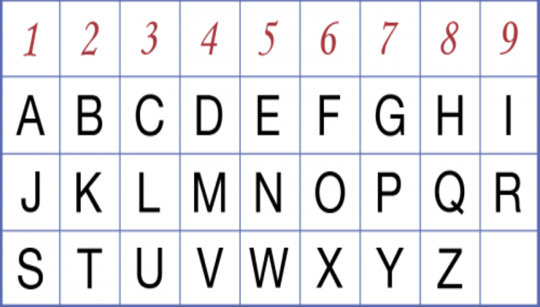
Actually, we need to work out the numbers we’re using first. While a person’s birthday is already very handily in a numeric form for you, their name is written up in pesky letters. But every letter has a corresponding numerological number, and by noting the number for each letter in a name, you’re able to calculate what you need.
Here’s a chart of the numbers, nice and easy and not necessary to memorize at all.
The numerological ‘alphabet’ if you will, only goes from the numbers 1-9. The letter ‘A’ marks 1, then J does again, then S. The more you work with numbers, the more you’ll come to just know what letters are associated with what, but even if you don’t, this chart is easy to replicate and even easier to find online.
The next part comes in writing out the numbers for a person’s name. You’ll want to keep this organized rather than messy, as you’ll be using different parts of the numbers to calculate different things. I like to write out the names, then write the numbers for all the vowels above the name, then all the numbers for the consonants below the name. When you’ve done so, it should look something like this:
Some things to note:
Y is treated as a vowel when there are no other vowels in a syllable (Ex: Lynn, Carolyn)
W is treated as a vowel when preceded by a vowel and when it produces a single sound (Ex: Bradshaw, Matthew)
The birthday, again, is already in numeric format, so now all of your numbers just need to be added properly. Which brings us back to the scary part.
The Actual Math
Really, it’s nothing more than basic sums.
If you can add, you can figure out your numbers. Hell, if you can’t add,
you can have a calculator figure it out for you.
It is a little more involved than adding all the numbers you’ve so dutifully marked down and calling it a day, but let’s work through it first.
First, add all the numbers from the vowel section together. Then, add all the numbers from the consonant section together. If we go off the name I provided above, it should look something like this:
Congrats, the hardest bit of math is over!
“But Shay,” you say. “You said the numerological alphabet only consists of the numbers 1-9!”
And so I did. But I also said only the worst of the math was over. Next, we need to break down the numbers we got until they fall into that range. What you do for this is you take each numeral in the number and you add them together.
Let’s break it down. Looking at the vowel section, we’ve been left with the number 22. To get the numerological number, you take each numeral and add them together – here, that looks like 2 + 2 and leaves us with the number 4, perfectly within our range.
Our consonant number at the moment is 54, or 5 + 4, which adds up to 9. Again, in range. Should you get a number that’s still too big, keep breaking it down until it’s only one digit. For example, the number 98 becomes 17 (9 + 8), but then 17 becomes 8 (1 + 7) and is now within the acceptable range.
You’ve just calculated the Inner Dreams number and the Soul Urge number. And by adding those two together (and reducing as necessary) you will have the Destiny Path number. In this case, it’s 4 (The Soul Urge and Inner Dreams numbers 9 and 4 add up to 13, and 13 as 1 + 3 equals 4).
That’s three numbers down, one to go.
We’ve largely neglected the Life Path number, but all it really requires is the reduction method we just covered.
Take my birthday. April 27th, 1993, or in number terms, 04/27/1993. All you have to do is add all these numbers together, then once they’re nice and neat in one giant number, you simplify it as you learned. 04 + 27 + 1993 = 2024, which gives us a number to reduce. Even though it’s more than two digits, you handle it the same way. 2 + 0 + 2 + 4 adds up to 8, making a quick work of the reduction and giving us our Life Path number.
For you visual learners out there, it looks something like this:
Breaking it Down
So now, we have all four of our numbers! And with minimal tears shed. For the sake of having everything in one place, all of my numbers put together look something like this:
A number showing up more than once implies a strength of presence in that number – two or three times indicates that the traits associated with that number are strong, as do numbers that ‘resonate’, such as how 4 fits evenly into 8 or 3 fits evenly into 9. If there are too many repetitions of a number, expect to see more and more of the negative associations of those traits brought to light. Keep your eye out for these, as they will amplify one another.
Okay, but what does it all mean?
The Divination
There are four major numbers you go for when putting someone’s numbers together. The Life Path number, the Destiny Path number, the Soul Urge number, and the Inner Dreams number.
Life Path:
The
life path number is the sum of the numbers in one’s birthday (date,
month, and year). It relates to the path in life one will take and the
traits one has at birth.
Destiny Path:
The
destiny path number is the sum of all letters in one’s full name. It
relates to the tasks one was meant to achieve in their lifetime.
Soul Urge:
The
soul urge number is the sum of all vowels in a person’s name. It
represents a person’s inner cravings, their likes and dislikes, and what
they value most.
Inner Dreams:
The
inner dreams number is the sum of all consonants in a person’s name. It
represents secret dreams, inner desires, and fantasies.
And lastly, the meaning of the numbers themselves. This post is already long enough to the point where I’m not going to write up a paragraph about each and every number (they are all available and more if you look them up online), but I’ll give you a run-down for each.
Scattered energies, self-centeredness, unfinished projects, lack of direction
4:
Positive Traits: Strong sense of order, highly practical, steady growth, fine management skills Negative Traits: Lack of imagination, stubborn, fixed opinions, argumentative, slow to act
So there you have it! Put the numbers you calculated to their associated meanings and work it out in your head, just like with tarot or other divinatory practices.
Just a few parting comments before I end this post.
In Summation
This is the setup for a slightly above basic numerological reading. The most basic that I ever use involves taking just the Life Path and Destiny path numbers. To take an even more complex spread, you could break down the person’s full name by each individual name, analyzing the vowels, consonants, and overall number for the first, middle, and last name individually, so that you can study what builds a person up into their full name and their path numbers. This gets very extensive very fast, and even with just the four above, you may end up doing three numbers per name plus the Life Path number. For your standard 3-name schema, this would involve ten numbers. Still manageable, but quite a lot.
On the topic of nicknames: generally, the rule in numerology is that you should use the name a person has held the longest. For example, Shay isn’t my birth name, but I’ve been called Shay for just over half of my lifetime. This is a good guideline, but please consider it only as a guideline. If someone has a name they do not wish to be called, respect them, and analyze the name they give you instead. An interesting thing to do – if the subject is comfortable – is to compare the birth name with the chosen name numerologically, and they can comment on advances that you have made through your life.
This is all I can think of at the moment! Go forth and numerolocize!
Lastly, I put together a blank template so you can practice on your own 😀
Quite apart from common table salt, or any other purely chemical salt
for that matter, the medieval alchemists refer to the ‘Salt of the
Philosophers’ or ‘Salt of the Sages’ (Sal Sapientie). One thing
that distinguishes what is often designated as “our Salt”—i.e.
“philosophical salt”—from common chemical salts is the fact that it is
seen to possess the ability to preserve not plants but metals. Basil Valentine, in Key IV of his Zwölf Schlüssel, states:
Just
as salt is the great preserver of all things and protects them from
putrefaction, so too is the salt of our magistry a protector of metals
from annihilation and corruption. However, if their balsam—their
embodied saline spirit (eingeleibter Salz-Geist)—were to die,
withering away from nature like a body which perishes and is no longer
fruitful, then the spirit of metals will depart, leaving through natural
death an empty, dead husk from which no life can ever rise again.
Once
again, through its dual nature—preserving and corrupting—a fundamental
ambivalence adheres to the reality embodied in salt. And yet, the key to
salt resides in its ultimately integrating function. It is the clavis which
binds and unbinds, preserves and corrupts. It itself does not undergo
the process which it enacts, embodies or disembodies. Importantly,
however, as one learns from Schwaller, salt acts as the permanent
mineral “memory” of this eternal process of generation and corruption.
Perhaps
the most interesting and influential synthesis of esoteric theological
and cosmological ideas on salt are those that crystallise in the
tradition of Jacob Boehme, where salt emerges as a spiritual-material
integrum central to a trinitarian theosophia. Here one learns that earthly or material salt recapitulates a heavenly potency called by Boehme salliter; this heavenly salt is an explosive force of light and fire likened to gunpowder (sal-nitre,
cf. Paracelsus’ ‘terrestrial lightning’). For Boehme, this
heavenly and earthly salt are indicated by the two “halves” of the
conventional salt symbol, which resemble two hemispheres, one turned
upon the other (one “giving” and the other “receiving”). These theories
reach a magnificent depth of expression in Georg von Welling’s Opus Mago-Cabbalisticum et Theosophicum
(1721). Welling (1655–1727), an alchemist for whom the books of
theology and nature were thoroughly complementary, worked as a director
of mining in the town of Baden-Durlach (a position that allowed him to
explore his extensive knowledge and passion for both the practicalities
and the mysteries of geology). His monumental Opus Mago-Cabbalisticum explores
how the rich relationship of salt as fire/air/sulphur on one hand, and
water/earth/mercury on the other, is played out in all its intricacies
to convey the mysterious dynamic of the fire-water juncture embodied in
heavenly and earthly salt (Welling uses the Hebrew term for heaven, schemajim, literally,
‘fire-water’ alongside the superimposed alchemical triangles of fire
and water to form the Star of David). In his initial chapters, Welling
describes the common symbol of salt as a ‘cubical’ figure and thus the
figure of an ‘earthly body’; ‘its form is diaphanous or transparent,
like glass’; it is ‘malleable and fluid and all bodies penetrate it with
ease’. ‘Its taste is sour or acidic and a little astringent’; it is of a
‘desiccating nature and character’; moreover, it is ‘cooling’ and yet
‘in its interior there is a natural or genuine fire’.
As
Magee has demonstrated, hermetic influences in general, and Paracelsian
and Boehmian ideas in particular, fed into and informed the work of G.
W. F. Hegel. ‘According to an ancient and general opinion’, writes
Hegel, ‘each body consists of four elements. In more recent times,
Paracelsus has regarded them as being composed of mercury or fluidity,
sulphur or oil, and salt, which Jacob Böhme called the great triad’. To
this, Hegel adds: ‘It should not be overlooked […] that in their essence
they contain and express the determinations of the Concept’. According
to Magee, this admission is highly significant, for Hegel is saying that
‘if the alchemical language of Paracelsus, Böhme, and others is
considered in a nonliteral way, its inner content is, in essence,
identical to his system’ (i.e. the ‘determinations of the Concept’).
Interestingly, despite Boehme’s known influence on mainstream
academic philosophers such as Schelling and Hegel, it is Nietzsche’s Zarathustra that
emerges from the modern German academic tradition with the most abiding
insights into the phenomenon of salt. Curiously, although it possesses
no apparent connections to esoteric or alchemical discourse, Zarathustra as
a whole is nevertheless pervaded with a pronounced Hermetic ambiance;
somehow, Nietzsche’s remarks on salt penetrate right to the heart of its
mysterium. At the end of book three, Zarathustra not only speaks of
salt as binding opposites, but also connects this to a desire for
eternity which cannot be satisfied through simple procreation:
If ever I drunk a full draught from that vessel of foaming spice, in which all things are well-blent: If ever my hand fused the nearest to the farthest, fire to spirit, desire to suffering and the worst to the best: If I myself were a grain of that redeeming salt that makes all things in the vessel well-blent:— —for there is a salt that binds good with evil; for even the most evil is worthy to be a spice for the final over-foaming— O how should I not be rutting after eternity and after the conjugal ring of rings—the ring of recurrence! Never have I found the woman by whom I wanted children, for it would be this woman that I love: for I love you, O Eternity! For I love you, O eternity!
Salt
as the redeeming juncture of opposites is framed by Nietzsche in terms
that evoke the themes of autonomous morality expressed in his Jenseits von Gut und Bösen.
Running deeper, however, is the surprising link that Nietzsche makes
between salt and a desire for eternity that cannot be met through
procreation; here one recognises not only the Indo-European ‘path of the
fathers’ versus the ‘path of the gods’, but also the two paths in
alchemy known as la voie humide and la voie sèche—the wet and the dry ways. Nietzsche taps directly into the crux of the human œuvre.
Genetic continuity, i.e. continuity of and through the species, does
not satisfy the soul’s desire for eternity; only the desire that is
fixed in the salt, deep in the bones, has the capacity to survive
biological generation and corruption. Nietzsche’s love for eternity
expresses the same reality that Schwaller articulated in terms of the
saline nucleus in the femur: the path of eternity, palingenesis and resurrection, hinges not on the chromosomes but upon a fixed mineral salt.
Unity manifests itself as Trinity. It is the
“creatrix” of form, but still not form itself; form emerges through
movement, that is, Time and Space. —Schwaller de Lubicz
Schwaller’s understanding of the tria prima
as the creatrix of form is essentially consonant with the trinitarian
conceptions of Egyptian (and later Pythagorean) cosmogonic theology.
Here, the creator’s divine hypostases—Hu, Sia and Heka—manifest as the
extra- or hyper-cosmic forces that exist before creation; they are the forces necessary to the establishment of creation rather than creation per se.
This may be compared to the identical conception that emerges in
Iamblichean theurgy, which distinguishes between hypercosmic and
encosmic divinities, or the same essential principles as carried through
into the trinitarian theology of Eastern Orthodoxy, which distinguishes
between uncreated and created energies. Beyond these general point of
orientation, Schwaller’s hermetic metaphysics accorded the tria prima some very specific characteristics:
The
Trinity, that is to say the Three Principles, is the basis of all
reasoning, and this is why in the whole “series of genesis” it is
necessary to have all [three] to establish the foundational Triad that
will be[come] the particular Triad. It includes first of all an abstract
or nourishing datum, secondly a datum of measure, rhythmisation and
fixation, and finally, a datum which is concrete or fixed like seed.
This is what the hermetic philosophers have transcribed, concretely and
symbolically, by Mercury, Sulphur and Salt, playing on the metallic
appearance in which metallic Mercury plays the role of nutritive
substance, Sulphur the coagulant of this Mercury, and Salt the fixed
product of this function. In general, everything in nature, being a
formed Species, will be Salt. Everything that coagulates a nourishing
substance will be Sulphur or of the nature of Sulphur, from the
chromosome to the curdling of milk. Everything that is coagulable will
be Mercury, whatever its form.
The image of coagulation—with
Sulphur as the coagulating agent, Mercury as the coagulated substance,
and Salt as the resulting form—is used repeatedly by Schwaller. The
formal articulation of this idea, as published in his mature œuvre, connects the motif to the embryological process:
In
biology, the great mystery is the existence, in all living beings, of
albumin or albuminoid (proteinaceous) matter. One of the albuminoid
substances is coagulable by heat (the white of the egg is of this type),
another is not. The albuminoid substance carrying the spermatozoa is of
this latter type. The albuminoid sperm cannot be coagulated because it
carries the spermatozoa that coagulate the albuminoid substance of the
female ovum. As soon as one spermatozoon has penetrated the ovum, this
ovum coagulates on its surface, thus preventing any further penetration:
fertilisation has occurred. (In reality, this impenetrability is not
caused by a material obstacle, the solid shell, but by the fact that the
two equal energetic polarities repel one another). The spermatozoon
therefore plays the role of a “vital coagulating fire” just as common
fire coagulates the feminine albumin. This is the action of a
masculine fire in a cold, passive, feminine environment. Here also,
there are always material carriers for these energies, but they manifest
the existence of an energy with an active male aspect and a passive
female aspect that undergoes or submits to it. Ordinary fire brutally
coagulates the white of an egg, but the spermatozoon coagulates it
gently by specifying it into the embryo of its species. This image shows
that the potentiality of the seed passes to a defined effect through
the coagulation of a passive substance, similar to the action of an acid
liquid in an alkaline liquid, which forms a specified salt. Now the
sperm is no more acid than the male albumin, but it plays in the animal
kingdom [animalement] the same role as acid; ordinary fire is
neither male nor acid and yet it has a type of male and acid action.
This and other considerations incline the philosopher to speak of an
Activity that is positive, acid and coagulating, without material
carrier, and of a Passivity, a substance that is negative, alkaline, and
coagulable, also without material carrier. From their interaction
results the initial, not-yet-specified coagulation, the threefold Unity, which is also called the “Creative Logos” (Word, Verbe) because the Logos, as speech, only signifies the name, that is, the definition of the “specificity” of things.
To
salt as the mean term between the agent and patient of coagulation, he
occasionally adds other revealing expressions, such as the following:
In geometry, in a triangle, the given line is Mercury, the Angles are Sulphur, and the resultant triangle is Salt.
Whereas here, Schwaller identifies Salt with a ‘datum’ or ‘given’ which is ‘fixed like seed’ (une donnée concrète ou fixée comme semence), elsewhere he identifies the active, sulphuric function with that of the seed (semence).
What this means is that the neutral saline product, once formed, then
acts in the sulphuric capacity of a seed and ferment, but also
foundation:
It can only be a matter of an
active Fire, that is, of a seminal “intensity”, like the “fire” of
pepper, for example, or better: the “fire” of either an organic or a
catalysing ferment. The character of all the ferments, i.e. the seeds,
is to determine into Time and Space a form of nourishment—in principle
without form; clearly, therefore, it plays a coagulating role. The
coagulation of all “bloods” is precisely their fixation into the form of
the species of the coagulating seed, the coagulation being, as in other
cases, a transformation of an aquatic element into a terrestrial or
solid element, without desiccation and without addition or diminution of
the component parts.
In the identification of both sulphur and salt as semence,
one discerns a specific coherence of opposites that, in elemental
terms, is described by the expression ‘Fire of the Earth’. The salt is
described in the passage quoted above as a seed (semence). This seed “becomes” seed again through the process of tree and fruit (growth, ferment, coagulation). It is at once a beginning and a finality (prima and ultima materia).
The reality described is non-dual. Beginning and end partake of
something that is not describable by an exclusively linear causality;
and yet it is seen to “grow” or “develop” along a definite “line” or
“path” of cause and effect; at the same time it partakes of a cyclic or
self-returning character; and yet, for Schwaller, it is not the circle
but the spherical spiral that provides the true image of its
reality: a vision which encompasses a punctillar centre, a process of
cyclic departure and return from this centre (oscillation), as well as
linear “development”, all of which are merely partial descriptors of a
more encompassing, and yet more mysterious, reality-process. The
fundamental coherence of this vision to the Bewußtwerdungsphänomenologie of
Jean Gebser (1905–1973) consolidates the significance of Schwaller’s
perception for the ontology of the primordial unity which is at once
duality and trinity. For Gebser, consciousness manifests through
point-like (vital-magical), polar-cyclic (mythic-psychological) and
rectilinear (mental-rational) ontologies, each being a visible
crystallisation of the ever-present, invisible and originary ontology
which unfolds itself not according to exclusively unitary, cyclic or
linear modalities of time and space, but according to its own innate
integrum.
Thus there is no contradiction in finding the presence
of fiery sulphur in the desiccating dryness of the salt, for it is
precisely in the one substance that the sulphuric seed (active function)
and saline seed (fixed kernel) cohere. The fixed, concrete seed-form
(itself a coagulation of mercury by sulphur) contains the active
sulphuric functions (the coagulating rhythms) which it will impose upon
the nutritive mercurial substance (unformed matter). ‘One nature’, as a
Graeco-Egyptian alchemical formula puts it, ‘acts upon itself’.
Images are from the Tarot deck designed by de Lubicz himself.
Among
the various perspectives that have been surveyed on the nature and the
principles inherent to salt, it is perhaps the Pythagorean
statement—‘salt is born from the purest sources, the sun and the
sea’—that pertains most directly to the deeper meaning of Schwaller’s
hermetic phenomenology. Salt for Schwaller was placed in a septennial
relationship comprising the tria prima and the four elements.
Elementally, salt was situated by Schwaller at the end of a progression
beginning with fire and air and ending in water and earth. Fire and air
form a triad with sulphur; air and water form a triad with mercury;
water and earth form a triad with salt. But salt was also understood to
join the end of this progression to a new beginning, to a new
fire/sulphur, exactly as the octave recapitulates the primordial tonos in
musical harmony. For Schwaller, it was precisely this ‘juncture of
abstract and concrete’ (fire and earth) that was identified with the
formation of the philosopher’s stone (or at least the key to the formation of the philosopher’s stone):
Relationship between Tria Prima
and Tetrastoicheia. Trinity (Sulphur-Mercury-Salt) begets quaternary
(Fire-Air-Water-Earth). The juncture of Fire and Earth (abstract and
concrete) is the means by which the end of the series is linked to its
beginning. Diagram after Schwaller and VandenBroeck.
In
this configuration (which prefigures the discussion of de Lubicz’s
colour theory undertaken elsewhere), one begin to see the hermetic
“problem” of salt, i.e. its mysterium. Salt partakes of something that
stands between water and fire (Pythagoras’ ‘purest sources’) in a way
that is intimately related to earth, to which it imparts its dryness.
Here one finds an imbroglio that suggests at once an element and a
principle. Its connection to fire is felt in the hermetic associations
of the elements (the sulphuric triad, fire and air, is characterised by
heat; the mercurial triad, air and water, is characterised by humidity
or wetness, while the saline triad, water and earth, is characterised by
coldness; however, it salt’s dryness—its desiccating quality—can only come from fire. Visser’s remarks, once again, prove cogent and penetrating:
Salt,
once isolated, is white and glittering. It is the opposite of wet. You
win it by freeing it from water with the help of fire and the sun, and
it dries out flesh. Eating salt causes thirst. Dryness, in the
pre-Socratic cosmic system which still informs our imagery, is always
connected with fire, heat, and light.
Thus, inherent to salt
is an equal participation in fire, sulphur and heat (+) and water,
mercury, and wetness (–), such that it may be analogised with a chemical
neutralisation reaction in which the positive and negative values
become electrically equalised. This neutral condition is for Schwaller
the very ground of being in which we are existentially and
phenomenologically situated (‘everything in nature, being a formed
Species, will be Salt’). Thus, to see existence—reality as we know it—as
a neutralisation reaction between an active sulphuric function (divinity, logos, eidos) and passive mercurial substance (prima materia),
to perceive the coagulating sulphur and the nourishing mercury through
the “cinnabar” of all things, this is to “find” the philosopher’s stone.
It is fundamentally, for Schwaller, a metaphysics of perception.




 Occult Aspects