The 13 Moon calendar is not what it appears. It is a coded synchronization matrix that enters us into an
alternate universe to prepare our minds for entry into galactic
culture.
The 13 Moon/28-day count is not an earth-based system but a gift from
the Galactic Maya that serves as a type of dimensional doorway to
reorient the human mind to fourth-dimensional time.
It is only in the guise of a “calendar” as a mercy and a familiar
bridge for the people of Earth. It is actually a galactic template, a
Sirian template, that enters us into the vast realm of the synchronic
order. But it is not really something that can be talked about as it
has to be experienced.
The daily affirmations are mathematically coded fourth-dimensional
radiograms that open your mind to new potentialities. Like a Zen koan,
they are meant to bypass your conceptual mind and tune you into
higher-dimensional frequencies.
By learning our galactic signature,
we start thinking archetypally of our role within the collective,
rather than individually of the personal. Our galactic signature is our
password to the fourth dimension; it helps us to identify with the
larger story playing out in an objective way where our role is magical
and creative.
13 Moons as a Template of Peace
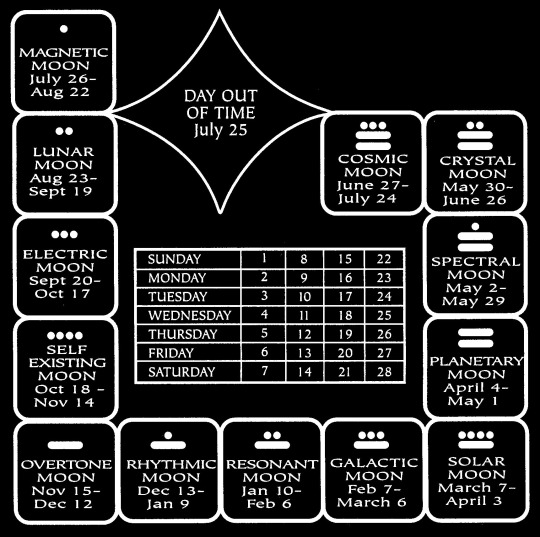
The 13 Moon calendar is a calendar of peace; peace that transcends
dogma. This is the whole point of it. It is based on the underlying mathematics of the Mayan calendar, based on the numbers: 4, 7, 13, 20, 52, 91, 260.
Mathematics are universal and far more creative than they have been
given credit for. Mathematics, inclusive of sacred geometries, define a
form that unlocks imaginal structures.
We live in an infinitely magical universe–not a close-ended linear
system where the only knowledge that exists was revealed thousands of
years ago. The universe is ever changing and creating itself anew. It is
happening now – as you read these words.
All the messengers, sages and galactic masters are here with us Now
to guide us through this shift of time. Past, future and present are
one. We live in a radial matrix of simultaneity that can be accessed
daily through the codes of the synchronic order via the 13 Moon
calendar.
13 Moon/28 days as Synchronization Template
The 13 Moon/28-day system embraces and synchronizes all true
calendrical and mathematical systems, from lunar calendars, to the Mayan
long count, to the Elder Futhark runes, to the I Ching hexagrams. In
other words this system reveals a master matrix, which contains all
other systems.
Keeping in mind also that the Maya used up to 17 calendars at once
because their perception of time was not linear, but based on
synchronization. The more cycles and systems you can track at once, the
more you can observe synchronic overlays.
13 Moons as a Sirian Timing Program
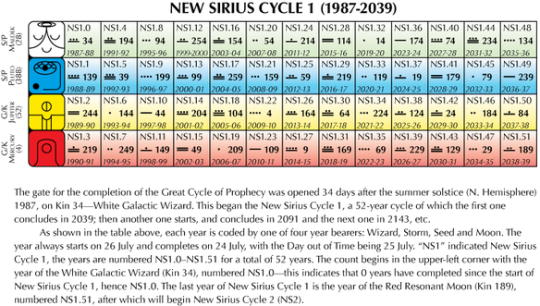
As a solar-galactic calendar with a July 26 synchronization date
based on the heliacal rising of the star Sirius, the 13 Moon Dreamspell
calendar is ultimately a Sirian timing program. (See graphic below: New Sirius Cycle).
In this way, the 13 Moon calendar and tools of the Law of Time are
intended to entrain our third-dimensional being into fourth- and
fifth-dimensional Sirian wisdom, or the realization of the supermental
superhuman.
By placing itself in the measure of the 13 Moon/28-day
synchronometer and its precise 52-year/orbital ring cycles, the human is
synchronized to the Sirius double universe star cycle, lifting it into a
truly galactic-cosmic consciousness and order of reality. —Valum Votan
This Sirian program is further unfolded in the various
fourth-dimensional tools such as Telektonon, 20 Tablets, 7:7::7:7 —
leading to the ultimate program of the Synchronotron 441 cube matrix system.
The 13 Moon calendar is also the key to enter the Cosmic History Chronicles. This
seven volume series lays out an entirely new galactic knowledge base so
that we can systematically begin to experience galactic/cosmic states
of consciousness in preparation for advanced telepathic technologies
including time travel and teleportation.
It is our duty to become multidimensional beings. The 13 Moon
calendar (synchronometer) is the key that opens the multidimensional
gate.
A child of metallurgy and the
traditional crafts, alchemy cannot be easily separated from the concrete
aspect of existence any more than it can be separated from the
transcendent. Indeed, both become interfusible, interdependent and
interchangeable. If alchemy appears elusive, it is precisely because it
cuts across categories ordinarily seen as mutually exclusive. For this
reason, alchemy may be better approached not so much as a fixed domain
of activity, but as a nondualprocess. Indeed, its sphere of operation is better comprehended as existing betweendomains, or better yet, as the medium in
which more ‘fixed’ domains proceed. Like the fusible nature of metals,
this medium may be regarded as the ‘substance’ from which fixed forms
‘solidify’, and into which they ‘dissolve’. As such, it is the conditio sine qua non for
transmutation and dissolution, for converting one form into another,
and for dissolving and abrogating the familiar boundaries or borders
between apparently fixed states.
One
explicit example of this is the fact that the key object of the western
alchemical quest itself—the philosopher’s stone or ‘universal medicine’
(the perfecting agent par excellence)— is also, literally, a universal poison. In the Greek alchemical manuscripts, the expression is given as katholikon pharmakon. The word katholikonmeans ‘universal, whole’, while pharmakon,
a very ambiguous word, means not only ‘medicine’, but also ‘poison’,
and ‘magical philtre’. According to the mercurial Jacques Derrida (who
perhaps understood ambivalence better than anyone):
this
‘medicine’, this philter, which acts as both remedy and poison, already
introduces itself into the body of the discourse with all its
ambivalence. This charm, this spellbinding virtue, this power of
fascination, can be—alternately or simultaneously—beneficent or
maleficent’.
‘If the pharmakon is
ambivalent’ continues Derrida, ‘it is because it constitutes the medium
in which opposites are opposed, the movement and the play that links
them among themselves, reverses them or makes one side cross over into
the other (soul/body, good/evil, inside/outside, memory/forgetfulness,
speech/writing, etc.)’ Thus, in conjunction with its ability for transformation, the (universal) pharmakon is also a medium for cosmic enantiodromia.
This
capacity for fluid interweaving between different states of existence
is perhaps most eloquently expressed within alchemical tradition proper
by the seventeenth century Sufi, Muhzin Fayz Kāshānī, who described a
process in which ‘spirits are corporealised and bodies spiritualised’, a
process that, according to Henry Corbin, takes place in an
ontologically real, yet liminal, zone—the mundus imaginalis—which Corbin defined precisely as a juncture between the eternal and the transient, the intelligible and the sensible: the intermonde or intermediary realm par excellence. Importantly,
Corbin’s phraseology is not only drawn from Persian and Arabic mystical
texts (which deeply tinctured the alchemy of the time), it is also
consonant with other, earlier Islamicate alchemical sources, such as
the Kitab Sirr al-Asrar(Latin: Secretum Secretorum), whose Tabula Smaragdina (Emerald
Tablet) famously states: ‘that which is above is like that which is
below, and that which is below is like that which is above, to perform
the miracles of the one thing’. This formula, which is further ascribed to [pseudo] Apollonius of Tyana’s Book of the Secret of Creation, orBook of Causes (Kitāb Sirr al-ḫalīqa, or Kitāb al-῾ilal), bears a still deeper identity to the hieratic art as practiced by the Neoplatonic theurgists. According to Proclus,
the
theurguists established their sacred knowledge after observing that all
things were in all things from the sympathy that exists between all
phenomena and between them and their invisible causes, and being amazed
by that they saw the lowest things in the highest and the highest in the
lowest.
In
the alchemical purview, the ‘higher’ and ‘lower’ aspects of existence
are ultimately reciprocal and interdependent expressions of a deeper,
more inclusive reality. Thus, to separate alchemy into a purely material
and a purely spiritual aspect in a mutually exclusive fashion, without
recognising their fundamental complementarity, is to miss the greater
flux between the volatile and the fixed with which alchemy is almost
invariably concerned. As a hieratic art, the alchemical vision of
reality encompasses all levels of existence within the holarchical monad, and as such engages the
world—including the world of duality, which is subsumed in the greater
whole—as a nondual reality: a simultaneously abstract and concrete
integrum.
In speaking of
alchemy as a nondual process it is important to understand just what is
meant when the term ‘nondual’ is used. The word itself is a formal
translation of the Sanskrit word advaita (a- + dvaita, ‘not dual’), and
is used to indicate an epistemology in which both ‘seer’ and ‘seen’ are
experienced not as separate entities but as a unity, a single act of
being in which both the subject and object of experience become agent
and patient of one divine act. While nondualism forms the basis of three
of the broadest currents in eastern metaphysics (Buddhism, Taoism and
Vedānta), it is also expressed explicitly or implicitly in the western
philosophical canon by figures such as Plotinus, Eckhart, Böhme, Blake,
Spinoza, Schelling, Hegel, Nietzsche, Bergson, Whitehead and Bohm, to
name but a few. Despite this, the idea of nondualism has not been
readily understood or accepted in the west, and this is because western
constructions of reality, especially after Decartes and Kant, are based
precisely upon a strict affirmation of mind-matter or subject-object
dualism. At the root of the matter lie two fundamentally different ways
of experiencing the world. One is the ‘everyday’ experience available to
everyone; the other proceeds from a metaphysical experience
theoretically available to, but not necessarily attained by, everyone.
Although dualism and nondualism describe two different experiences of
the world, it is not simply a recapitulation of the materialist-idealist
divide (which is simply another dualism). As David Loy remarks:
none
of these three [Buddhism, Taoism, Vedānta] denies the dualistic
‘relative’ world that we are familiar with and presuppose as ‘common
sense’: the world as a collection of discrete objects, interacting
causally in space and time. Their claim is rather than there is another,
nondual way of experiencing the world, and that this other mode of
experience is actually more veridical and superior to the dualistic mode
we usually take for granted. The difference between such nondualistic
approaches and the contemporary Western one (which, given its global
influence, can hardly be labelled Western any more) is that the latter
has constructed its metaphysics on the basis of dualistic experience
only, whereas the former acknowledges the deep significance of nondual
experience by constructing its metaphysical categories according to what
it reveals.
What
is proposed, therefore, is to begin to understand certain forms of
alchemy as an expression of a nondual experience of (and engagement
with) the world, not only with regard to the dualities of spirit and
matter, but also their corollaries: subjective experience and objective
experiment. As Prussian poet and Kulturphilosoph Jean Gebser
observes with regard to the structures of consciousness that underpin
entire modalities of civilisation, nondualistic or aperspectival
epistemologies do not exclude but integrate more perspectivally-bound epistemologies within a diaphanous whole. [ What
this means is that apparent dualities are not ultimate; rather, they
are relative expressions of a deeper reality that is ultimately free
from the limitations of dualism and opposition. It means that one can
see all things in the ‘ultimate’ reality, and reciprocally, the
‘ultimate’ reality in all things. It is to see, with Blake, ‘a World in a
Grain of Sand’ and ‘Eternity in an hour’. According
to this view, one eventually fails to distinguish between the ultimate
and the relative in a rigidly dualistic way, abandoning the attribution
of any inherent ontological primacy to one or the other. Because there
is no longer any essential contradiction or opposition
perceived to exist between them, so-called ‘material’ and ‘spiritual’
realities become co-present, interdependent expressions of a deeper,
‘existentiating’ field of being. What
is more, according to the ancient epistemology ‘like knows like’, the
nondual, aperspectival or integral nature of reality, in both its
relative and ultimate expressions, can only be known by the nondual,
aperspectival or integralconsciousness. It is in this sense that alchemy, in its more profound sense, necessitates a metaphysics of perception.
Quite apart from common table salt, or any other purely chemical salt
for that matter, the medieval alchemists refer to the ‘Salt of the
Philosophers’ or ‘Salt of the Sages’ (Sal Sapientie). One thing
that distinguishes what is often designated as “our Salt”—i.e.
“philosophical salt”—from common chemical salts is the fact that it is
seen to possess the ability to preserve not plants but metals. Basil Valentine, in Key IV of his Zwölf Schlüssel, states:
Just
as salt is the great preserver of all things and protects them from
putrefaction, so too is the salt of our magistry a protector of metals
from annihilation and corruption. However, if their balsam—their
embodied saline spirit (eingeleibter Salz-Geist)—were to die,
withering away from nature like a body which perishes and is no longer
fruitful, then the spirit of metals will depart, leaving through natural
death an empty, dead husk from which no life can ever rise again.
Once
again, through its dual nature—preserving and corrupting—a fundamental
ambivalence adheres to the reality embodied in salt. And yet, the key to
salt resides in its ultimately integrating function. It is the clavis which
binds and unbinds, preserves and corrupts. It itself does not undergo
the process which it enacts, embodies or disembodies. Importantly,
however, as one learns from Schwaller, salt acts as the permanent
mineral “memory” of this eternal process of generation and corruption.
Perhaps
the most interesting and influential synthesis of esoteric theological
and cosmological ideas on salt are those that crystallise in the
tradition of Jacob Boehme, where salt emerges as a spiritual-material
integrum central to a trinitarian theosophia. Here one learns that earthly or material salt recapitulates a heavenly potency called by Boehme salliter; this heavenly salt is an explosive force of light and fire likened to gunpowder (sal-nitre,
cf. Paracelsus’ ‘terrestrial lightning’). For Boehme, this
heavenly and earthly salt are indicated by the two “halves” of the
conventional salt symbol, which resemble two hemispheres, one turned
upon the other (one “giving” and the other “receiving”). These theories
reach a magnificent depth of expression in Georg von Welling’s Opus Mago-Cabbalisticum et Theosophicum
(1721). Welling (1655–1727), an alchemist for whom the books of
theology and nature were thoroughly complementary, worked as a director
of mining in the town of Baden-Durlach (a position that allowed him to
explore his extensive knowledge and passion for both the practicalities
and the mysteries of geology). His monumental Opus Mago-Cabbalisticum explores
how the rich relationship of salt as fire/air/sulphur on one hand, and
water/earth/mercury on the other, is played out in all its intricacies
to convey the mysterious dynamic of the fire-water juncture embodied in
heavenly and earthly salt (Welling uses the Hebrew term for heaven, schemajim, literally,
‘fire-water’ alongside the superimposed alchemical triangles of fire
and water to form the Star of David). In his initial chapters, Welling
describes the common symbol of salt as a ‘cubical’ figure and thus the
figure of an ‘earthly body’; ‘its form is diaphanous or transparent,
like glass’; it is ‘malleable and fluid and all bodies penetrate it with
ease’. ‘Its taste is sour or acidic and a little astringent’; it is of a
‘desiccating nature and character’; moreover, it is ‘cooling’ and yet
‘in its interior there is a natural or genuine fire’.
As
Magee has demonstrated, hermetic influences in general, and Paracelsian
and Boehmian ideas in particular, fed into and informed the work of G.
W. F. Hegel. ‘According to an ancient and general opinion’, writes
Hegel, ‘each body consists of four elements. In more recent times,
Paracelsus has regarded them as being composed of mercury or fluidity,
sulphur or oil, and salt, which Jacob Böhme called the great triad’. To
this, Hegel adds: ‘It should not be overlooked […] that in their essence
they contain and express the determinations of the Concept’. According
to Magee, this admission is highly significant, for Hegel is saying that
‘if the alchemical language of Paracelsus, Böhme, and others is
considered in a nonliteral way, its inner content is, in essence,
identical to his system’ (i.e. the ‘determinations of the Concept’).
Interestingly, despite Boehme’s known influence on mainstream
academic philosophers such as Schelling and Hegel, it is Nietzsche’s Zarathustra that
emerges from the modern German academic tradition with the most abiding
insights into the phenomenon of salt. Curiously, although it possesses
no apparent connections to esoteric or alchemical discourse, Zarathustra as
a whole is nevertheless pervaded with a pronounced Hermetic ambiance;
somehow, Nietzsche’s remarks on salt penetrate right to the heart of its
mysterium. At the end of book three, Zarathustra not only speaks of
salt as binding opposites, but also connects this to a desire for
eternity which cannot be satisfied through simple procreation:
If ever I drunk a full draught from that vessel of foaming spice, in which all things are well-blent: If ever my hand fused the nearest to the farthest, fire to spirit, desire to suffering and the worst to the best: If I myself were a grain of that redeeming salt that makes all things in the vessel well-blent:— —for there is a salt that binds good with evil; for even the most evil is worthy to be a spice for the final over-foaming— O how should I not be rutting after eternity and after the conjugal ring of rings—the ring of recurrence! Never have I found the woman by whom I wanted children, for it would be this woman that I love: for I love you, O Eternity! For I love you, O eternity!
Salt
as the redeeming juncture of opposites is framed by Nietzsche in terms
that evoke the themes of autonomous morality expressed in his Jenseits von Gut und Bösen.
Running deeper, however, is the surprising link that Nietzsche makes
between salt and a desire for eternity that cannot be met through
procreation; here one recognises not only the Indo-European ‘path of the
fathers’ versus the ‘path of the gods’, but also the two paths in
alchemy known as la voie humide and la voie sèche—the wet and the dry ways. Nietzsche taps directly into the crux of the human œuvre.
Genetic continuity, i.e. continuity of and through the species, does
not satisfy the soul’s desire for eternity; only the desire that is
fixed in the salt, deep in the bones, has the capacity to survive
biological generation and corruption. Nietzsche’s love for eternity
expresses the same reality that Schwaller articulated in terms of the
saline nucleus in the femur: the path of eternity, palingenesis and resurrection, hinges not on the chromosomes but upon a fixed mineral salt.
Unity manifests itself as Trinity. It is the
“creatrix” of form, but still not form itself; form emerges through
movement, that is, Time and Space. —Schwaller de Lubicz
Schwaller’s understanding of the tria prima
as the creatrix of form is essentially consonant with the trinitarian
conceptions of Egyptian (and later Pythagorean) cosmogonic theology.
Here, the creator’s divine hypostases—Hu, Sia and Heka—manifest as the
extra- or hyper-cosmic forces that exist before creation; they are the forces necessary to the establishment of creation rather than creation per se.
This may be compared to the identical conception that emerges in
Iamblichean theurgy, which distinguishes between hypercosmic and
encosmic divinities, or the same essential principles as carried through
into the trinitarian theology of Eastern Orthodoxy, which distinguishes
between uncreated and created energies. Beyond these general point of
orientation, Schwaller’s hermetic metaphysics accorded the tria prima some very specific characteristics:
The
Trinity, that is to say the Three Principles, is the basis of all
reasoning, and this is why in the whole “series of genesis” it is
necessary to have all [three] to establish the foundational Triad that
will be[come] the particular Triad. It includes first of all an abstract
or nourishing datum, secondly a datum of measure, rhythmisation and
fixation, and finally, a datum which is concrete or fixed like seed.
This is what the hermetic philosophers have transcribed, concretely and
symbolically, by Mercury, Sulphur and Salt, playing on the metallic
appearance in which metallic Mercury plays the role of nutritive
substance, Sulphur the coagulant of this Mercury, and Salt the fixed
product of this function. In general, everything in nature, being a
formed Species, will be Salt. Everything that coagulates a nourishing
substance will be Sulphur or of the nature of Sulphur, from the
chromosome to the curdling of milk. Everything that is coagulable will
be Mercury, whatever its form.
The image of coagulation—with
Sulphur as the coagulating agent, Mercury as the coagulated substance,
and Salt as the resulting form—is used repeatedly by Schwaller. The
formal articulation of this idea, as published in his mature œuvre, connects the motif to the embryological process:
In
biology, the great mystery is the existence, in all living beings, of
albumin or albuminoid (proteinaceous) matter. One of the albuminoid
substances is coagulable by heat (the white of the egg is of this type),
another is not. The albuminoid substance carrying the spermatozoa is of
this latter type. The albuminoid sperm cannot be coagulated because it
carries the spermatozoa that coagulate the albuminoid substance of the
female ovum. As soon as one spermatozoon has penetrated the ovum, this
ovum coagulates on its surface, thus preventing any further penetration:
fertilisation has occurred. (In reality, this impenetrability is not
caused by a material obstacle, the solid shell, but by the fact that the
two equal energetic polarities repel one another). The spermatozoon
therefore plays the role of a “vital coagulating fire” just as common
fire coagulates the feminine albumin. This is the action of a
masculine fire in a cold, passive, feminine environment. Here also,
there are always material carriers for these energies, but they manifest
the existence of an energy with an active male aspect and a passive
female aspect that undergoes or submits to it. Ordinary fire brutally
coagulates the white of an egg, but the spermatozoon coagulates it
gently by specifying it into the embryo of its species. This image shows
that the potentiality of the seed passes to a defined effect through
the coagulation of a passive substance, similar to the action of an acid
liquid in an alkaline liquid, which forms a specified salt. Now the
sperm is no more acid than the male albumin, but it plays in the animal
kingdom [animalement] the same role as acid; ordinary fire is
neither male nor acid and yet it has a type of male and acid action.
This and other considerations incline the philosopher to speak of an
Activity that is positive, acid and coagulating, without material
carrier, and of a Passivity, a substance that is negative, alkaline, and
coagulable, also without material carrier. From their interaction
results the initial, not-yet-specified coagulation, the threefold Unity, which is also called the “Creative Logos” (Word, Verbe) because the Logos, as speech, only signifies the name, that is, the definition of the “specificity” of things.
To
salt as the mean term between the agent and patient of coagulation, he
occasionally adds other revealing expressions, such as the following:
In geometry, in a triangle, the given line is Mercury, the Angles are Sulphur, and the resultant triangle is Salt.
Whereas here, Schwaller identifies Salt with a ‘datum’ or ‘given’ which is ‘fixed like seed’ (une donnée concrète ou fixée comme semence), elsewhere he identifies the active, sulphuric function with that of the seed (semence).
What this means is that the neutral saline product, once formed, then
acts in the sulphuric capacity of a seed and ferment, but also
foundation:
It can only be a matter of an
active Fire, that is, of a seminal “intensity”, like the “fire” of
pepper, for example, or better: the “fire” of either an organic or a
catalysing ferment. The character of all the ferments, i.e. the seeds,
is to determine into Time and Space a form of nourishment—in principle
without form; clearly, therefore, it plays a coagulating role. The
coagulation of all “bloods” is precisely their fixation into the form of
the species of the coagulating seed, the coagulation being, as in other
cases, a transformation of an aquatic element into a terrestrial or
solid element, without desiccation and without addition or diminution of
the component parts.
In the identification of both sulphur and salt as semence,
one discerns a specific coherence of opposites that, in elemental
terms, is described by the expression ‘Fire of the Earth’. The salt is
described in the passage quoted above as a seed (semence). This seed “becomes” seed again through the process of tree and fruit (growth, ferment, coagulation). It is at once a beginning and a finality (prima and ultima materia).
The reality described is non-dual. Beginning and end partake of
something that is not describable by an exclusively linear causality;
and yet it is seen to “grow” or “develop” along a definite “line” or
“path” of cause and effect; at the same time it partakes of a cyclic or
self-returning character; and yet, for Schwaller, it is not the circle
but the spherical spiral that provides the true image of its
reality: a vision which encompasses a punctillar centre, a process of
cyclic departure and return from this centre (oscillation), as well as
linear “development”, all of which are merely partial descriptors of a
more encompassing, and yet more mysterious, reality-process. The
fundamental coherence of this vision to the Bewußtwerdungsphänomenologie of
Jean Gebser (1905–1973) consolidates the significance of Schwaller’s
perception for the ontology of the primordial unity which is at once
duality and trinity. For Gebser, consciousness manifests through
point-like (vital-magical), polar-cyclic (mythic-psychological) and
rectilinear (mental-rational) ontologies, each being a visible
crystallisation of the ever-present, invisible and originary ontology
which unfolds itself not according to exclusively unitary, cyclic or
linear modalities of time and space, but according to its own innate
integrum.
Thus there is no contradiction in finding the presence
of fiery sulphur in the desiccating dryness of the salt, for it is
precisely in the one substance that the sulphuric seed (active function)
and saline seed (fixed kernel) cohere. The fixed, concrete seed-form
(itself a coagulation of mercury by sulphur) contains the active
sulphuric functions (the coagulating rhythms) which it will impose upon
the nutritive mercurial substance (unformed matter). ‘One nature’, as a
Graeco-Egyptian alchemical formula puts it, ‘acts upon itself’.
Images are from the Tarot deck designed by de Lubicz himself.
Among
the various perspectives that have been surveyed on the nature and the
principles inherent to salt, it is perhaps the Pythagorean
statement—‘salt is born from the purest sources, the sun and the
sea’—that pertains most directly to the deeper meaning of Schwaller’s
hermetic phenomenology. Salt for Schwaller was placed in a septennial
relationship comprising the tria prima and the four elements.
Elementally, salt was situated by Schwaller at the end of a progression
beginning with fire and air and ending in water and earth. Fire and air
form a triad with sulphur; air and water form a triad with mercury;
water and earth form a triad with salt. But salt was also understood to
join the end of this progression to a new beginning, to a new
fire/sulphur, exactly as the octave recapitulates the primordial tonos in
musical harmony. For Schwaller, it was precisely this ‘juncture of
abstract and concrete’ (fire and earth) that was identified with the
formation of the philosopher’s stone (or at least the key to the formation of the philosopher’s stone):
Relationship between Tria Prima
and Tetrastoicheia. Trinity (Sulphur-Mercury-Salt) begets quaternary
(Fire-Air-Water-Earth). The juncture of Fire and Earth (abstract and
concrete) is the means by which the end of the series is linked to its
beginning. Diagram after Schwaller and VandenBroeck.
In
this configuration (which prefigures the discussion of de Lubicz’s
colour theory undertaken elsewhere), one begin to see the hermetic
“problem” of salt, i.e. its mysterium. Salt partakes of something that
stands between water and fire (Pythagoras’ ‘purest sources’) in a way
that is intimately related to earth, to which it imparts its dryness.
Here one finds an imbroglio that suggests at once an element and a
principle. Its connection to fire is felt in the hermetic associations
of the elements (the sulphuric triad, fire and air, is characterised by
heat; the mercurial triad, air and water, is characterised by humidity
or wetness, while the saline triad, water and earth, is characterised by
coldness; however, it salt’s dryness—its desiccating quality—can only come from fire. Visser’s remarks, once again, prove cogent and penetrating:
Salt,
once isolated, is white and glittering. It is the opposite of wet. You
win it by freeing it from water with the help of fire and the sun, and
it dries out flesh. Eating salt causes thirst. Dryness, in the
pre-Socratic cosmic system which still informs our imagery, is always
connected with fire, heat, and light.
Thus, inherent to salt
is an equal participation in fire, sulphur and heat (+) and water,
mercury, and wetness (–), such that it may be analogised with a chemical
neutralisation reaction in which the positive and negative values
become electrically equalised. This neutral condition is for Schwaller
the very ground of being in which we are existentially and
phenomenologically situated (‘everything in nature, being a formed
Species, will be Salt’). Thus, to see existence—reality as we know it—as
a neutralisation reaction between an active sulphuric function (divinity, logos, eidos) and passive mercurial substance (prima materia),
to perceive the coagulating sulphur and the nourishing mercury through
the “cinnabar” of all things, this is to “find” the philosopher’s stone.
It is fundamentally, for Schwaller, a metaphysics of perception.
In this Integral Mandala we see the four ontoclines or gradations of Reality, as the four arms of the Mandala. Each of these correspond in a generic way to one of the primary parameters of Consciousness and Reality. These four themselves come from a Center, representing the Divine or Supreme or Absolute Reality, and this Center is itself made up of four as well as three levels.The four ontoclines are as follows:
Left – Self and Non-Self from True Self / “I” to Non-Self / “This” / Phenomena (and vice versa) – representing the Monadology (or pluratity and unity) of Selves. This pertains to the Nature of the Knowing Self (especially as elaborated in Eastern Philosophy). With Liberation (moksha, Enlightenment) in one realises one already is the Absolute (Atman-Brahman).
Bottom – The “Vertical” Physical-Spiritual Axis – from Transcendent Spiritual Mind down to Physical Matter (and vice-versa) – representing the Hierarchy (Great Chain of Being) of Octaves of Existence. This “Vertical” Axis or Planes of Existence (in which one ascends to the Absolute) corresponds to the various subtle and gross Universes and ocatves as described through Esotericism and Occultism with their understanding of the Nature of gross and subtle Realities, and to the ascent of Consciousness through levels of Existence.
Right – The “Horizontal” Inner-Outer Axis represents the contrast between the Innermost (Inner Light, Divine Soul) and Outermost (most external) Being – representing the Psychological Polarity of Being. The “Horizontal” Inner-Outer Axis corresponds to Psychology and Mysticism which addresses the depths of the being, and also on a more superficial level to the Arts with its dicotomy of Mythos and Logos, Imagination and Reason, and to depth and transpersonal psychology.
Top – The Universal-Individual-Atomistic Axis – From Universal Whole to “Atomistic” “Point” (and vice versa) constitutes the Holarchic arrangement of Systems. This “Concentric” Universal-Individual Axis corresponds, on the physical level, to Science especially the systems sciences and natural and applied sciences, also the social sciences in part. On the supraphysical it becomes the domain of Esotericism, but the basic principles of interaction, ecology, system dynamics, chaos theory, and so on. The overall Reality is the (esoteric) science of Cosmecology, which includes the experiential approach of Astrognosis.
All the ontoclines together represent the Spiritual Path; not literalist or exoteric religion, but Yoga, Sadhana, and Esoteric (Mystical) Religion; the Essense of Self-Transformation.
I have already mentioned
that Anaximenes considers Air to be the First
Principle (Arkhê) of the cosmos; it
is infinite, eternal, ever-moving and divine; he
calls Air the Father of the Gods (which recalls
Zeus’s common title: Father of Gods and Humans).
Anaximenes also says, “Just as our Breath-Soul
(Psukhê), being Air
(Aêr), governs us, so Spirit-Breath
(Pneuma) and Air (Aêr)
encompass the whole cosmos.” This suggests that
the governance of the cosmos is accomplished by the
Spirit-Breath of the World Soul. Indeed, Philemon
says that Air, who is called Zeus, knows everything
done by Gods or mortals, because He is everywhere
at once. So also Empedocles points to the God’s
subtle nature: "He is a Spirit-Mind
(Phrên), holy and ineffable, and
only Spirit-Mind, which darts through the whole
cosmos with its swift thoughts.“ (Note that the
term translated Spirit-Mind, Phrên,
is the singular of Phrenes, Breast.) Here
again we see Air as a medium of communication and
governance, but on the cosmic scale.
However, just as we all breathe the same Air,
and the Air in my breast is continuous with that in
yours, so also the World Soul is continuous with
individual souls (an idea we also find in the
Upanishads, where Brahman, the World Soul
identified with Prâna (Breath), is
identical to Âtman, the individual
Life-breath). As the nervous system integrates the
activities of individual organs to work for the
sake of the organism, so the Air binds our
individual souls into one World Soul. Microcosm
and macrocosm unite.
Philo of Biblos (64-140 CE) translated a
“Phoenician History,” which was supposed to have
been written by Sanchuniathon before the Trojan War
(which is not unlikely) and to be based on Egyptian
scriptures attributed to Thoth. According to this
myth, in the beginning there was a Primal Wind, a
breath of mist and darkness (i.e.
Aêr); also there was
Môt, the muddy chaos of Erebus
(khaos tholeron Erebôdes), that is,
the formless Primal Mud. The Primal Wind
fertilized itself and became Desire
(Pothos, perhaps corresponding to Semitic
Rûah, which means Breath but also
connotes Desire). Further, Môt became the
Cosmic Egg, and the cosmos was born when Desire
opened the Cosmic Egg (as also in the Orphic
cosmogonies), which led to a separation of the
Elements.
According to Eudemus (4th cent. BCE), the
Phoenicians who lived in Sidon also believed that
the universe was born of Air. In the beginning was
Time (Khronos), Desire (Pothos)
and Fog (Omikhlê). Desire and Fog
united, giving birth to Aêr and
Aura (Moving Air).
Human
beings have probably probed the cupola of the heavens in search of
meaning since the birth of ego consciousness. This was a time when
celestial and terrestrial events succeeded one another for reasons known
only to the divine autogenerator of the cosmos, when everything deemed
unconscious and inert could speak its mind, when magic was the world
language, and when the fundamental cohesion of all life was an
acknowledged and unspoken fact. Back then everything on the earth below
was thought to mimic and imitate conditions simulated in the Great
Above; the stars, planets, comets and other celestial bodies were the
shining genies whose words and whispers, actions and reactions,
agreements and disputations might incite minor and sometimes large-scale
consequences for the lives of all corporeal inhabitants. Eclipses,
conjunctions, oppositions, depressions, exaltations and other celestial
events worked like knee-jerk reactions, exacting benefic or malefic
influence, facilitating particular conditions, or awakening
transpersonal formative forces which would work through tribal
personalities. This Platonic-flavoured cosmos in which everything was
Aeolian, alive and functioned through a system of meaningful
correspondences entrenched itself deep in the collective psyche of human
beings and has never quite relinquished its hold.
Hence,
it would not be erroneous to suggest that the religious function of the
human psyche first found voice in archaic astrology, a philosophy which
assumes that the systematic, recurring but sometimes volatile
behaviours of the celestial inhabitants mediate over all corporeal
phenomena and their relationship to human life. Of course the mere fact
that exact situations involving the celestial bodies in the heavens are
recapitulated periodically and can be calculated with mathematical
precision can only mean that the qualities, influences and relevant
conditions that these events are inexplicably connected with are
predictable. If, then, the path of the human condition is foreseeable
through this sidereal divination then the oikoumene must, in
fact, have been hewn by a conscious and creative mind that transcribed
general details relating the fate of all its divine, semi-divine and
mortal inhabitants, as well as its own into the plastic and intangible
“ether” somewhere. Here we get a taste of the spiritual and holistic
origins of archaic astrology, which, when broken down anatomically,
consisted of three primary aims: to descry one’s future for a chance at
changing the trajectory of fate (astrology); for meteorological purposes
that included the prediction of weather (meteorology); and the
transcription of stellar cycles and arrangements whose movements would
have been tracked to determine an appropriate time for the inception of
agricultural endeavours (astronomy).
The
Chaldeans or Assyrians introduced tangible markers for the qualitative
and quantitative assessment of the heavens in the second millennium bce.
The star-gods, genies or divinities governed a pre-established and
insurmountable destiny that vacillated between auspicious and
inauspicious conditions brought on by specific stellar arrangements, and
all of life on earth basically swayed or reacted to the configuration
of these heavenly waters. Each was ascribed rulership over a specific
day or month, forcing a dissection of time. The Chaldeans proceeded to
define the band of sidereal space that encompasses the wheel of heaven
and interacts with the ecliptic orbit; the equinoctial markers, embraced
by the zodiacal signs of Aries and Libra, could be found at the
intersection of equator and ecliptic whilst their polar opposites, the
tropical or solstitial markers, were to be found in in Capricorn and
Cancer. The just mentioned zodiacal signs, twelve in all, were
represented zoomorphically, anthropomorphically or as composite
creatures using motifs derived from Babylonian mythology, and contained
an exact conformation of stars known as a constellation. With respect to
each individual “sign”, the stars contained in one constellation
pervaded the sidereal space taken up by the imagined zodiacal image in
the night skies.
Proceeding
along an analogous line of reasoning, the ancient Egyptians developed a
calendrical system by observing the heliacal rising and setting of
individual stars. In this arrangement the year was divided into
thirty-six ten-day periods known as decans, each heralded by the
heliacal rising of a particular star. The star Sothis or Sirius, a
celestial embodiment of the Egyptian goddess Hathor-Isis, stood sentry
over the thirty-six divisions as the inaugurator of the entire year. In
the third century bce,
when knowledge of oriental astrology and its esoteric philosophy of
astral determinism reached Egypt through a Hellenistic dispensation
enabled by Alexander the Great (356-323 bce),
the zodiacal and decanal systems merged and three decans were
incorporated into each zodiacal sign. A few acclaimed esotericists like René Adolphe Schwaller de Lubicz
(1887 – 1961) have argued against a Chaldean importation of astral
determinism into Egypt, claiming that the Egyptians were holistic
thinkers and believed that each part of the human body was under the
mediation of a different star-god or genie that could be invoked to heal
illnesses pertaining to its respective part. Despite its innovative
potential and viability, the theory is disparately related to the
current discussion and will not concern us for the time being.
A
little before Alexander’s conquest the holistic tradition of esoteric
astrology began to differentiate into subcategories. Meteorology became a
distinct branch but it wasn’t until the time of Johannes Kepler
(1571-1630) that the mechanistic natural protoscience known as astronomy
and the animistic qualitative cosmogony of astrology parted company.
The latter matured fully during the second century ce, a period when Claudius Ptolemy (90-168 ce) penned an astrological treatise entitled the Four Books, or Tetrabiblos
in Greek. It was a comprehensive volume of horoscopic astrology, a
subcategory of the divinatory art that seeks to comprehend meaning and
answer questions using a celestial chart or horoscope which captures an
exact moment in time. The work transcribed the qualities of the
astrological signs, the twelve zodiacal constellations on the wheel of
heaven that subsisted through the ages and remain both meaningful and
functional to this very day.
In
entertaining an esoteric interpretation on the zodiac one sees that the
universe is united as One but at the same time coloured by archetypal
forces or elemental blueprints that originate from a mother membrane and
act upon the existing spectrum of variegated consciousness. Of vital
importance is the acknowledgement of the twelve established signs as
functioning symbols; while our ancestors almost certainly imagined
shapes and signs in cupola of the star-studded night, their choice of
animals and figures , real or imagined, are not as random as some might
believe. As unlikely as it seems, the ascribed zoomorphic,
anthropomorphic or composite creatures exhibit qualities that correspond
dynamically to the inherent nature of the group of stars in their
respective corner of the heavens. To give an example the stars of Cancer
are symbolically depicted by the crab; the latter habitual tendency to
seek and never veer far from the comfort of its home, a trait almost
universal amongst all modes of being born under its section of the sky.
While individual stars may belong to a collective archetype in the
manner that a group of human cells belong to one organ and work in
conjunction with one another to achieve a common aim, their unique
positions, magnetism and gravitational force within the astral
configuration permits a degree of freedom from collective law. This is
why the zodiacal band of sidereal space was sometimes depicted in an
active state of unfurling like a parchment of Nile papyrus.
The name given to this precession of imagined figures that comprise real cosmic phenomenon–zoe-diac,
or circle of life–is wholly appropriate given that the general
archetypal patterns or transpersonal influences of being that exist
manifest through all complex life irrespective of time and space and are
deemed to repeat for all eternity like a broken record. The fiery,
restless, urgent and explosive Martian formative force that wishes to
subjugate, to divide and dissect, to compartmentalize, to create, to
own, to dominate and to ascend the evolutionary ladder, for instance, is
indigenous to the fixed stars of Aries. This energy seeps down into
consciousness, sometimes in copious amounts and sometimes in minute
quantities, depending on the trajectory of the sun’s annual circuit and
its conjunction with the stars of the respective constellation. In fact
the nature of the latter’s influence is determined by the conjunction of
the sun with the stars of the head, of the horns, of the hindquarters,
of the forepaws, and so forth. The bold head of the ram is aggression;
the horns raw abundance and virility; his hindquarters signpost stamina
but sometimes a gross overestimation of strength; his forepaws
vulnerability and restlessness. Notwithstanding its waxing and waning
powers, the Arian sign is ubiquitous and indestructible, an inhabitant
of the timeless zone that subjects and bends everything to its will.
This indissoluble will is why all animation is fated to endure an
endless cycle of everlasting repetition…




 Occult Aspects