The 13 Moon calendar is not what it appears. It is a coded synchronization matrix that enters us into an
alternate universe to prepare our minds for entry into galactic
culture.
The 13 Moon/28-day count is not an earth-based system but a gift from
the Galactic Maya that serves as a type of dimensional doorway to
reorient the human mind to fourth-dimensional time.
It is only in the guise of a “calendar” as a mercy and a familiar
bridge for the people of Earth. It is actually a galactic template, a
Sirian template, that enters us into the vast realm of the synchronic
order. But it is not really something that can be talked about as it
has to be experienced.
The daily affirmations are mathematically coded fourth-dimensional
radiograms that open your mind to new potentialities. Like a Zen koan,
they are meant to bypass your conceptual mind and tune you into
higher-dimensional frequencies.
By learning our galactic signature,
we start thinking archetypally of our role within the collective,
rather than individually of the personal. Our galactic signature is our
password to the fourth dimension; it helps us to identify with the
larger story playing out in an objective way where our role is magical
and creative.
13 Moons as a Template of Peace
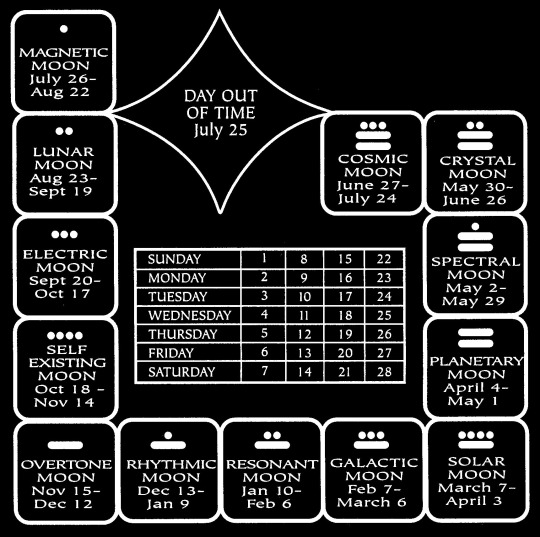
The 13 Moon calendar is a calendar of peace; peace that transcends
dogma. This is the whole point of it. It is based on the underlying mathematics of the Mayan calendar, based on the numbers: 4, 7, 13, 20, 52, 91, 260.
Mathematics are universal and far more creative than they have been
given credit for. Mathematics, inclusive of sacred geometries, define a
form that unlocks imaginal structures.
We live in an infinitely magical universe–not a close-ended linear
system where the only knowledge that exists was revealed thousands of
years ago. The universe is ever changing and creating itself anew. It is
happening now – as you read these words.
All the messengers, sages and galactic masters are here with us Now
to guide us through this shift of time. Past, future and present are
one. We live in a radial matrix of simultaneity that can be accessed
daily through the codes of the synchronic order via the 13 Moon
calendar.
13 Moon/28 days as Synchronization Template
The 13 Moon/28-day system embraces and synchronizes all true
calendrical and mathematical systems, from lunar calendars, to the Mayan
long count, to the Elder Futhark runes, to the I Ching hexagrams. In
other words this system reveals a master matrix, which contains all
other systems.
Keeping in mind also that the Maya used up to 17 calendars at once
because their perception of time was not linear, but based on
synchronization. The more cycles and systems you can track at once, the
more you can observe synchronic overlays.
13 Moons as a Sirian Timing Program
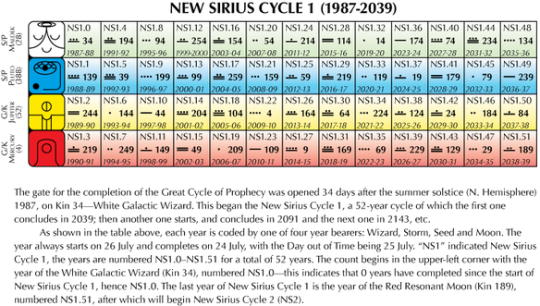
As a solar-galactic calendar with a July 26 synchronization date
based on the heliacal rising of the star Sirius, the 13 Moon Dreamspell
calendar is ultimately a Sirian timing program. (See graphic below: New Sirius Cycle).
In this way, the 13 Moon calendar and tools of the Law of Time are
intended to entrain our third-dimensional being into fourth- and
fifth-dimensional Sirian wisdom, or the realization of the supermental
superhuman.
By placing itself in the measure of the 13 Moon/28-day
synchronometer and its precise 52-year/orbital ring cycles, the human is
synchronized to the Sirius double universe star cycle, lifting it into a
truly galactic-cosmic consciousness and order of reality. —Valum Votan
This Sirian program is further unfolded in the various
fourth-dimensional tools such as Telektonon, 20 Tablets, 7:7::7:7 —
leading to the ultimate program of the Synchronotron 441 cube matrix system.
The 13 Moon calendar is also the key to enter the Cosmic History Chronicles. This
seven volume series lays out an entirely new galactic knowledge base so
that we can systematically begin to experience galactic/cosmic states
of consciousness in preparation for advanced telepathic technologies
including time travel and teleportation.
It is our duty to become multidimensional beings. The 13 Moon
calendar (synchronometer) is the key that opens the multidimensional
gate.
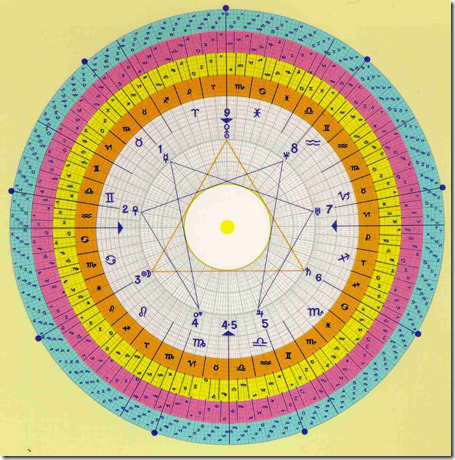
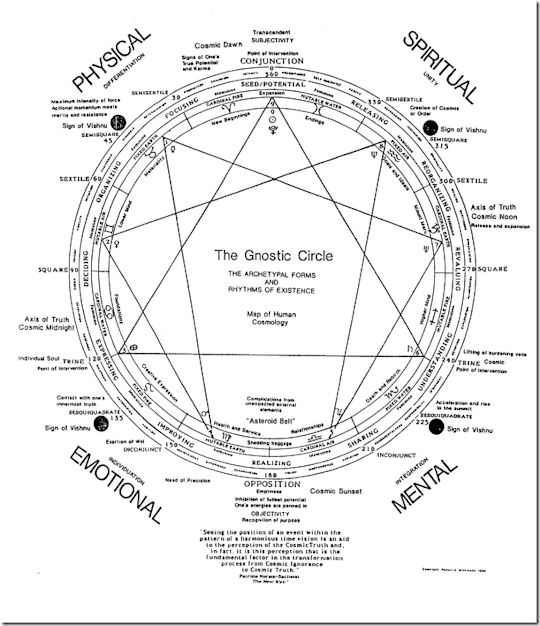
The Gnostic Circle is an alchemical Key of knowledge from the Vedic
texts of ancient India revealing the primary role of Time in our
developmental process. Most astrological systems are oriented toward
the individual’s egoic development, but the Gnostic Circle provides a
means by which we can perceive the imperatives of the Soul and its
hidden but primary influence in our lives. It is the unifying
element of a complete astrological work-up which helps us to understand
the cyclic nature of our developmental process; where we have been in
the past, where we happen to be at the present moment and what we are
moving toward in the future.
“The Gnostic Circle is the most effective method for understanding
the transformation of human consciousness. It represents a vision of
wholeness and has only one objective: it deals with the soul or seed of
the divine in each created thing and reveals the process by which that
seed is made to flower in its process of becoming.” – Patrizia
Norelli-Bachelet
Used in conjunction with the practice of yoga, the Gnostic Circle
reverses the long-standing perception of Time as the destroyer and
presents mankind with an entirely new awareness of Time as the
integrative mechanism by which a Divine purpose is expressed in the
world, thus it contains the highest wisdom of our age.
“The Gnostic Circle allows us to measure the progression of any event in time. And it provides the means of assessing an event’s relevance to time and place within a global and universal context. Above all, it permits us to appreciate the interconnectedness of events through a unified, spherical approach to Time. The
Gnostic Circle is a yardstick which can be applied to any event and by
which that event or object may be made to reveal its intrinsic nature
and objective value. In ancient literature and tradition, such a tool was sometimes referred to as the Golden Rod, or the Philosopher’s Stone. Its
value resided in the fact that because of its special relation to Time
and Space, it could provide an objective means to assess the
truth-conscious substance of any given situation or event or object. In
a word, it could objectively reveal the element’s inner pulse and place
within the greater harmony of life on Earth and within the solar
system.” The Vishaal Newsletter, – Oct 30, 1991
For each person there are two ways of being in the world, two
existential situations critical to our perception of life and reality.
The first and most common is an experience of the world from the historical perspective of linear time.
The second, and more rare, is the direct perception of non-linear time or cosmic cycles.
These modes of awareness represent two different worlds, one within the other. Non-linear
or sacred time appears under the paradoxical aspect of whole time, an
eternal present which is connected with man’s deepest spiritual
dimension. It is based upon a perception that time does not proceed
endlessly in a straight line. Rather it is always and everywhere a
closed curve, although from our ordinary perception, we do not see that
it’s movement is either curved or closed.
To move beyond the illusion of linearity and recover a realization of
whole time one must undergo a process of yoga which illumines the
cyclical nature of the life experience. This is most easily achieved
through the application of a cosmological model which highlights
certain essential relationships between man and the universe and which
unveils a common center. In ancient times these cosmological models
were based upon the known universe which was believed to consist of six
planets and a central Sun. It was not until the 20th century, following
the discovery of Uranus, Neptune and Pluto, that the complete
cosmological key could be revealed and man’s integral transformation
fully understood.
In ancient India, as in all other traditional societies, the
unveiling of this axis or ‘center’ was achieved through a disciplined
study of the archetypal language contained in the zodiacal hieroglyphs
and a knowledge of the principles of the Cosmic order. Once these
foundations are laid, one’s lived experience becomes revelatory. The
awareness gradually shifts from the ordinary linear perspective of past,
present and future to an experience of time as a cyclical developmental
process. As the individual lives and repeats these cycles of whole
time, he becomes imprinted with their order and aligned with their
harmonies. The axis of his being gradually shifts from the pivot of ego,
to a higher perceptual center. For it is by observing the cycles of his
own microcosmic process, that man comes to know the macrocosm and the
principles of its evolution. In the Veda, this realization is known as SWAR or Truth-Consciousness, and grants the seeker a direct and unequivocal perception of Unity.
‘The Gnostic Circle is merely the combination of the zodiac – the
occult circle which contains the knowledge of the evolution – and the
structural pattern of the solar system. The Circle of 12 is the zodiac,
and the Circle of 9 is our actual solar system, each orbit representing
one year of Earth life. The joint harmony of these two, superimposed or
synthesized in one circle, is what constitutes our key to the evolution
and flowering of the seed of the Spirit. In fact we can say that the
Gnostic Circle is mainly for this purpose. It shows mankind the ultimate
and ideal perfection that can be attained during this particular phase
of the evolution, during this great transition point from animal-mental
to the more divine mankind.’ – The Gnostic Circle p. 159, 1975, Patrizia Noreill-Bachelet
My favorite general tarot spread technique Ive been working with recently and starts to be my very fav overall. It works with mystical properties of number nine. You cannot find this technique anywhere on the internet.
Simplified:
1) Throw cards on the table, play chaotically with them, shuffling them as a kid at least for a minute. Tell Spirit how you gonna draw cards: 3 for past, 3 for present, 3 for future.
2) Get deck into form, then cut the deck into 3 piles (1-2-3), fold the deck back to form (1-2-3). Bear in mind from the beginning what you are conceptually doing.
3) Now draw every ninth card while puttin each of these cards in a column, one under the other. You will get 3 columns: past, present, future – together 9 cards. Leave unused cards aside.
4) bonus: if you will continue drawing next 9ths of cards – they will also fit to reading.
I figured this out after I realized that there are 7 notes in a major scale and 12 notes altogether. C is the first note on any piano, and has no flat (technically B is a flat but it’s also part of the major scale – this lines up with the fact that the first classical planet is the Moon, which correlates to only one zodiac sign. The fourth note in the C Major scale is F, and also has no flat, just as the fourth classical planet, the Sun, has only one zodiac. The rest of the notes have flats, which are given the nocturnal sign of the planet (black key=night), and the white keys have the day signs. Works out perfectly, oddly enough.
This aspect is form when two or more planets are within 3 degrees of one another (the tighter the degree is to 0, the more powerful and profound the integration of the two planetary energies into one another).
Each planet has their own individual energy, however in a conjunction, the planetary energy is expressed simultaneously in the style of the sign they are both placed. These planets will act together, not individualistically.
This aspect is considered a ‘hard’ aspect due to the fact they can express more positive or negative qualities depending on the style of drive of a planet.
Conjunctions to other planets can give that planet a style of expression as the conducting planet rules (Example: Sun conjunct Jupiter will give the native a Sagittarian style of expression to their self identity, regardless of sign. Conjuncting Jupiter will also greatly enhance the sign of the sun, making them far more prominent than without the conjunction).
EXAMPLE:
Easy – Moon conjunct Venus: Love and affection is also integrated into the natives style of nurturing and what they need to be emotionally satisfied. This is an extremely gentle, and affectionate conjunction.
Hard – Sun conjunct Saturn: This can be a very self limiting aspect, as Saturn puts blocks on the natives drive for self expression, making the native rather quiet and shy. This can also be an indication of someone who is prone to depression and self doubt.
Opposition (Hard)
This aspect if formed 177 – 183 degrees from one another (the closer to 180 degrees, the more prominent this aspect is felt).
This aspect show two conflicting energies within the self, that are contradicting and conflicting.
These planetary energies will make a ‘swinging’ motion, going back and forth as they try to gain dominance of expression.
This aspect feels internally tense, irritating and uncomfortable, as if no matter what you do, you can’t get exactly what you want.
Though this is another hard aspect, like the conjcuntion, it does carry benefits and can be balanced.
The first step to balancing this aspect lies in the realisation that you need BOTH energies to be expressed, not just one.
This aspect is easier to resolve if a trine to one or both planets is involved or is part of a T-Square.
The opposing planet, like the opposition, will integrate the style of the sign it rules (Example: Mars in pisces opposite Pluto in Virgo would indicate someone who acts passive in times of confrontation one time, than becomes explosive and aggressive – much like a mars in scorpio – another time).
This aspect can also be balanced as planets will more often than not share the same modality and be a in compatible element (apart from the cases where this aspect is formed by out of sign planets).
EXAMPLE:
Venus opposite Uranus: To balance this opposition, the native would need a sense of personal freedom in relationships in oder to form a functional relationship. This person may also fluctuate from being affection to passive, and in these time, some personal space will be needed, and they are ready, can return to the partner – unconventional relationships tend to manifest from people with this aspect.
Trine (Easy)
This aspect is formed when two planets are 117-123 degrees from one another (the closer to 120 degrees, the more prominent this aspect is expressed).
Training planets are often in the same element.
It is a easy, flowing aspect whereby planets interact with ease, often providing the native with a ‘talent’ or strength in and between characteristics and energies.
This aspect is so easy, the native will not notice this aspect in their own personality, and are often puzzled by others who can not express the planets training in the same way they do.
This aspect holds a lot of potential, though because the nature of the aspect is so natural and laid back, a transit or interaction with another who activates the trine in synastry may be needed for the potential to be manifested.
Acknowledging this aspect in your chart will help you better understand and utilise this talent/gift.
EXAMPLE:
Sun trine Mars: This will show a native who’s self-expression and self-drive flow together with ease. This person will have no problem expressing who they are and what they want, and have a great amount of personal drive to achieve goals. This can also give the native an aura of sexual magnetism and a heroic and stand-out presence.
Square (Hard)
This aspect is formed when two planets are 88-92 degrees apart (the closer to 90 degrees, the more prominent this aspect is expressed and felt).
Planets squaring one another will often be a planet with the same modality but with an incompatible element.
The tension caused by this aspect is described as a type of ‘friction’ – two planets having the same aim (modality) with a different style/method (element).
This aspect can force and issue/compose a challenge externally as the aspect is projected outside the self onto the outside world to be dealt and resolved with.
This aspect can pressure to to find a resolution based on the lessons of the planets (in signs) that are involved.
A lot of effort is required to resolve the issues proposed by this aspect.
EXAMPLE:
Mercury square Neptune: This native may have difficulty in differentiating facts from reality. There may be a lot of mental confusion with this aspect and a tendency to get lost in conversation, being spoken to and to transverse into a world of daydreaming and fantasy. Their concentration may be short, and may also be delusional in their thought. This aspect could also manifest a lair, or through a more positive manifestation, someone who can express their mental confusion through creative writing and materialising their fantasies into words/poetry.
Sextile (Easy)
This aspect is formed when two planets are 58 – 62 degrees from one another (the closer to 60 degrees, the more prominent this aspect is expressed and felt).
This aspect links planets of different modalities and elements, though the elements will be compatible (Earth/Water – Air/Fire)
These planets have compatible styles of expression and will ‘encourage’ one another in their form of expression
They can excite/stimulate one another, feeding each other productive energies
This aspect can manifest opportunities, but it is up to the native to decide whether or not they chose to use them. More to gain if taken, and if ignored or declined, nothing is lost.
This aspect is also another indicator for talents, possibly more active than the trine. You are more likely to notice and work on these talents.
EXAMPLE:
Mars sextile Pluto: This aspect would give the native formidable ability to incorporate raw plutonic power into their will power and drive. This can give great ability to put a lot off personal power into tasks and to achieve goals. This natives drive would be persistent and they would possess tremendous durability. This native may posses great physical power and have a large sex drive, not to mention quite sexually skilled and magnetic.
Inconjunct/Quincunx (Hard – often debated as a major or minor aspect.)
This aspect is formed when two planets are 148-152 degrees apart (the closer to 150 degrees, the more prominent this aspect is expressed and felt).
This is a point of major conflict between planets. Two planets that have no compatibility by sign or modality, yet are forced to interact with each other.
This aspect must be balanced and adjusted (either by escape rout via sextile or trine to one of the planets involved).
Those who poses this aspect in a tight orb (0′-2′) between planets often tend to compartmentalise the two areas of life indicated by the planets and points involved, acting out one planet at a time until the other planet becomes frustrated and takes over and is expressed.
Through the inflexibility of this aspect, it can manifest as an either ‘make or break’ situation.
A new, inventive and personal outcome can be created with this aspect.
EXAMPLE:
Venus inconjunct Saturn: This aspect can indicate a native who’s ability to express love and tender affection clashes with their sense of authority, structure and patriarchal nature. This person may give excessive amounts of affection and love and may begin to feel like they aren’t getting the same amount in return, thus resorting to becoming cold and rejecting any affection that the partner tries to give. This person may also try to be patriarchal and directing in a situation that really requires gentle affection and care.
The Zodiac is an imaginary belt of the Heavens, within which are the apparent paths of the Sun, Moon and Planets. The belt contains twelve Constellations of Stars (hence the twelve Signs of the Zodiac) and each of the twelve Signs are governed by one of these four Elements: Earth, Fire, Air or Water. Astrology plays a big part in the Zodiac, as it is the actual study of influence that the Sun, Moon, Stars and Planets have on an individual at the time of their Birth (which creates all the Sun/Moon/Rising Signs of the Zodiac).
I had an old posts on aspects that quite honestly I hate now that I look back on it, so I’m making a new one.
Firstly, aspects are made when two planets or points are a certain amount of degrees away from each other. As in, the aspect itself is not a physical thing, but a measurement of an angle between planets that shows a dynamic between them. Aspects don’t have to be exact and rarely they are, they can actually be a few degrees off which is called an orb. Chart calculators such as those on astro.com automatically have their aspect orb set up to 10˚ but you can change the settings to be exact or even up to 15˚. But most astrologers use no more than 10˚ and often times they will use a maximum orb lower than that. The smaller the orb, the stronger the aspect. But that’s not the only way you can tell how strong an aspect is. Aspects are also categorized into separating and applying aspects. Separating aspects in the natal chart are aspects that have been exact just before you were born, and applying aspects are ones that became exact after you were born. It is extremely rare that someone would be born with an aspect completely exact (as in 0˚00′). And of course with applying and separating aspects, the faster moving planet is the deciding factor as to if it’s applying or separating, also make sure to check if this planet is in retrograde to make sure of the status of this aspect. Applying aspects are generally considered to be stronger than separating aspects in the natal chart. Especially because they can be exact in your progressed chart.
Of course there are many kind of aspects, some stronger than others. The stronger aspects are major aspects, they include the conjunction, opposition, trine, and square. Arguably conjunctions are the strongest and oppositions are a close second, although trines and squares are still both quite strong in the chart.
So, starting with conjunctions these aspects are exact when two planets are 0˚ away from each other. This aspect helps join or fuse the qualities of the two planets or points together. They make a bond between the two planets. Conjunctions are generally thought of as a neutral aspect, and it can either have a more disharmonious or harmonious effect on someone depending on a) what planets are involved and b) how much the person has developed the aspect. Conjunctions are widely regarded as the strongest aspect and thus more astrologers are likely to use a larger orb with it. If your only conjunctions have a really wide orb then you may find that oppositions feel stronger to you.
On that note, oppositions, while being considered a strong aspect alongside conjunctions are quite different that the former aspect. Instead of bonding the two planetary energies, this aspect puts them against each other. There is a push and pull between them but they’re still strongly connected. Oppositions are just that, two planets opposite each other in the chart as in it is exact with two planets 180˚ away from one another. This aspect is generally considered disharmonious, and one of the most disharmonious aspects. But with enough development of an opposition it is possibly to use this push and pull to get the planetary energies to work together.
Next, there are trines. Trines are formed when two planets are 120˚ away from each other. Not as strong as the conjunction or opposition but still quite strong. These two planet’s energies work together to enrich each other. This aspect can been seen as some sort of “cosmic gift” placed in the chart. A lot of trines can indicate a lot of positive karma. This aspect is usually easy and helpful for someone without needing any development, but can also cause apathy and laziness in a person if it has too much presence because of it’s calm nature. But overall it is seen as a very harmonious aspect, and arguably the most harmonious aspect.
Finally, the last of the major aspects is the square. And as each angle in a square is 90˚, this aspect is exact when two planets are 90˚ away from each other. This has about the same strength as a trine. This aspect has a lot of tension and is often very disharmonious, and can cause conflict due to mutually exclusive desires and needs from the uncooperative planets. These as[pects can cause a lot of pressure but it can be worked with and at it’s best it can be very motivational for a person and can help with growth. A lot of squares can indicate having a lot of negative karma.
Besides the major aspects, there are also minor aspects. But before I get to those there are two aspects which astrologers disagree on if they are major or minor. Thus I think of them in their own in-between category. These two aspects are the sextile and the quincunx or inconjunct.
The sextile is when two planets are 60˚ away form each other. This is a very harmonious aspect and the two planets help to inspire each other. This aspect creates motivation and excitement. But it’s also a halved and thus weaker version of a trine, as in this gift is less present than that of the trine. And it does contain a slight bit of square-like tension which can especially be seen in the aspect pattern of a yod (will be discussed later). This aspect may aslo show some area of talent in a person’s life, but they may miss some opportunities with this due to lack of pressure to.
Then there is the quincunx, also known as the inconjunct. This aspect if exact when two points are 150˚ away from each other. This aspect is generally seen as neutral. This is because it is an aspect that holds a lot of potential but is hard to release. It is difficult to release since the two planets are often in signs of both differing and inharmonious elements and modalities which makes this potential hard to adjust to. This difficulty to adjust to can cause some tension, and there is also no promise that the potential of this aspect will be tapped into, but it can be very rewarding if it is.
Now, for the minor aspects. These aspects generally don’t stand alone to show something in the natal chart but rather stand to support something that is already shown otherwise in the natal chart and are thus very useful to interpreting a chart accurately. But these aspects generally include a much smaller orb and often must be exact or less than a 1˚ or 2˚ orb in my opinion. Minor aspects include quintile, bi-quintile, semi-sextile, semi-square, sesqui-square, semi-quintile, nonile, septile, and to even less importance than those semi-octile, squile, squine. tri-decile, and quindecile.
Quintiles are a harmonious aspect with an angle of 72˚. Quintiles can help indicate talent in the chart, as well as aspiration and ambition in certain areas. These often assist in showing talents already seen in the chart but these help pick out the talents that will be most worked at, and often these are more focused on artistic talents.
Bi-quintiles are also harmonious aspects such as a quintile and as the name states they are double the angle of a quintile so 144˚. These aspects mostly help to serve quintiles, but with even more of a focus on the arts. It can also help one become more aware of their quintiles.
Semi-sextiles are half of a sextile so 30˚ and is somewhat harmonious. It shows a potential that is hard to reach due to the complete difference in the signs of the two planets. This creates somewhat of a positive connection between two planets that otherwise would be difficult interacting with one another due to being in neighboring signs.
Semi-squares are just half of a square aka 45˚ and is seen as somewhat disharmonious. This aspect causes unapparent tension that can thus be hard to address and work on. This are tensions most people would rather ignore, maybe something you’d address momentarily but never reach a long-term solution for.
Sesqui-squares or otherwise known as sesquiquadrates are a square and a half so 135˚ and are somewhat disharmonious. Just like the square this causes conflicts and some tension, and possibly more apparent than the semi-square but even easier to suppress. This aspect if also very stubborn and indicates an issue that is very hard to work on.
Semi-quintiles or a decile is 1/10 of the circle of the natal chart as in a 36˚ angle. This is very similar to but much weaker than a quintile. But it also includes a bit of tension, although this is really hard to address both the talents and tension of this aspect and is most definitely just supporting something already shown in the chart.
Noniles or also known as noviles have a 40˚ angle. This aspect is somewhat harmonious and help make an idea, or make an already thought of idea in the natal chart a reality. It can also indicate a beginning of a new phase. One can barely notice this though and it requires a great deal of sensitivity and observation in order to.
Septiles have an angle of 51˚26′ and are a harmonious aspect. This can help show spirituality or religion in the chart. Many of these can help show what someone experiences and feels on a deeper level. It can also help show wisdom gained.
Semi-octiles are exact with an angle of 22.5˚ and is slightly harmonious. Not much else is known about this aspect and it has very little meaning in the horoscope.
Squiles have an angle of 75˚ and there isn’t much information on the specific of this aspect, but it is good to look at it in progressions to see if it seems to support anything else shown.
Squines have an angle of 105˚ and just like the Squile there is little to no information on it, but it is useful for progressions.
Tri-deciles are three times a decile as in 108˚ and is harmonious. It has a unique energies that complements any gifts shown in the chart. It symbolizes a divine motherly energy. And it can help show something that needs to be fulfilled.
Quindeciles have a 165˚ angle and are disharmonious. It can help support where in the chart one can become obsessive over something to the point of irrationality. It can show compulsivity and some sort of separation from reality.
Aspects can form aspect pattern. These have their own meaning and can be very important in the chart. Aspect patterns include a grand trine, grand cross, grand sextile, T-square, mystic rectangle, yod, and kite. Not everyone has an aspect pattern, and some are more common than other.
Grand trines are created when three planets are trine each other to form the shape of an equilateral triangle. This is a very harmonious aspect pattern and can increase the influence of the trines, as well as usually gives the person some sort of gift or talent. Nicknamed the “triangle of grace” quite appropriately. But, like the trine this aspect pattern can lead to some apathy or lack of motivation or care. This has a calming feeling to it but it’s talents may not be used if ignored due to lethargy.
Grand sextiles are formed when six planets are around the chart in sextile to one another which creates the shape of a hexagram. It is a very harmonious aspect pattern. This may also look like two grand trines upside down from each other. This is a rare aspect pattern and it strengthens the sextiles to make them more like a major aspect. Unlike a grand trine this pattern helps motivate and invited productivity.
T-squares are formed when two planets are opposite each other and square a third planet, this is a disharmonious aspect pattern. I’ve found this to be a very common aspect pattern, but many of them in one chart can indicate a lot of karma. The tension of the opposition in addition to the tension of the squares is all channeled through the squared planet. This is very intense and is nearly impossible to ignore. But T-squares, if worked with, can offer a lot of growth and help make you a stronger, better person.
A grand cross also called a grand square is created when four planets are square each other giving the shape of a square. Another way ot think of it is two T-squares forming a whole square. This can be disharmonious due to challenges and the stubborn nature it can cause. If these challenges are overcome, however, it can really help with stability. Often times these challenges may be triggered by transits.
Mystic rectangles are formed when two pairs planets form an opposition to each other and then each pair on each side also forms a sextile, creating the image of a rectangle. This is a harmonious aspect pattern and helps one figure out and deal with their oppositions. It helps the sextiles and trine work together to channel their harmonious energy through the oppositions.
Yods are formed when two planets are sextile each other and then both quincunx a third. This is a rare and disharmonious aspect pattern. It creates a desire to do something powerful or important (thus nicknames the “finger of god”) but it often doesn’t lead the person in the right direction to do so. This aspect pattern intensifies the quincunx and makes it act more like a major aspect. Yods can be thought of as channeling the worst of the sextile through the apex. This is a very stressful aspect to have and is very hard to ignore.
Finally, kites are formed when a grand trine has a fourth planet opposite one of the ends and sextile the other two. This is harmonious but like the grand trine can cause a lack of motivation. Although there is a great ease in the flow of energy between these planets. This aspect pattern helps encourage constructive ways of expressing the grand trine.
There are a few other things related to aspects that I might as well note…
Such as it being very favorable when a planet is conjunct the sun within 0′17˚ and it strengthens it, this is called cazimi. On the other hand a conjunction to the sun can be seen as combust if in the same sign and within 8° 30’ which can weaken it. Beyond combustion, yet within 17˚ of the sun is considered under the sun’s beams which still weakens a planet but not to the same extent as a combustion.
Aspects can occur outside of the signs they were suppose to, for example if a planet is near the end of one sign and another planet near the beginning of another they could form a trine but not in the same element. This is called dissociate aspect.
There are also parallels and contraparallels. This is working with the declinations of planets. Parallels are when two planets are of the same declination and the interpretation of this is considered similar to a conjunction, although probably not as strong. A contraparallel is when two planets have the same degrees of declination but are on opposite hemispheres. This is interpreted similarly to an opposition but is less potent in the chart.
More engravings from Claude Paradin’s Les Devises Heroiques—first published in 1556, reprinted in Occult Images (Agile Rabbit Editions) by Pepin Press in 2002 (various unknown artists, pre-16th century CE).
We devised the Alchemy Thoth Tarot Spread primarily for the
purpose of problem solving, though no doubt it has more subtle uses. The
three-card groups allow the Tarot dignities to be used. One advantage of this
layout is its simplicity; it is based on the idea that Rajas (Sulphur, action)
acts upon Tamas (Salt, inertia) to bring about Sattwas (Mercury, wisdom).
Alchemical Salt (5 2 8): The inertia that must be overcome; the
problem or any difficulties around the question.
Alchemical Sulphur (6 3 9): Activity; the action that is most likely to be taken by the Querent.
Alchemical Mercury (4 1 7): A synthesis of forces; the solution; that
which will come to pass.
If desired, a card may be chosen and placed in the centre of
the triad before shuffling and laying the other cards, to represent the
Querent.
Circular chart showing a modern set of Talismanic Geomantic Symbols.
The chart informs the Geomancer on the Elemental, Planetary and Zodiacal Correspondences (conforming to Agrippa’s ideas on Planetary Rulership). The upper half shows the Diurnal Figures and the lower half the Nocturnal. The Arabic words in the center of the Circle, “Ilm-al Raml”, translates to the “Science of the Sands”.
“Geomancy is an Art of Divination, wherby the judgement may be rendred by lot, or Destiny, to every question of every thing whatsoever, but the Art hereof consisteth especially in certain points where of certain figures are deducted according to the reason or rule of equality of inequality, likenesse or unlikenesse,; which Figures are also reduced to the Coelestiall Figures, assuming their natures and proprieties, according to the course and forms of the Signes and Planets.” – Henry Cornelius Agrippa




 Occult Aspects